


Iran grows most of the world’s saffron, yet cultivation leadership does not guarantee that Iranian farmers and exporters capture all the value created after harvest. The saffron export challenges often described as “raw export” are really questions about bulk sales, verified quality, packaging, market access and who owns the customer relationship.
What “raw saffron export” actually means
Saffron exported as a spice is not raw in the literal sense. The stigmas have already been separated from the flowers and dried. In industry discussions, “raw export” usually means selling dried saffron in bulk or in large packs before it receives consumer-facing packaging, a recognized brand or further product development.
That distinction matters. Bulk trade is not automatically wasteful or low quality. A food manufacturer may need a large pack, while a distributor may be legally responsible for final labelling in its own market. The economic concern begins when an exporter repeatedly sells an undifferentiated product, has little bargaining power and leaves testing, presentation, distribution and brand recognition to another business.
Iran saffron production and export quantity in 2025
Readers looking for an Iran saffron production and export quantity for 2025 need to separate production from exports and calendar years from the Iranian year. The Iranian Saffron Exporters Union’s customs-derived summary for year 1403 reports a net-weight total of 214,707,000 grams, or about 214.7 metric tonnes. Iranian year 1403 ran from March 2024 into March 2025, so it is not a calendar-2025 total.
The same caution applies to production. In September 2025, the Food and Agriculture Organization described Iran as producing more than 90% of the world’s saffron, but that announcement did not give a verified 2025 tonnage. An earlier version of this page used “nearly 95%”; the newer FAO wording is the safer description. A global share and an export volume answer different questions, and combining them into one number would be misleading.
For a dated series and an explanation of units, use our guide to Iranian saffron export statistics. It also explains why customs weight, trade value and crop production should not be treated as interchangeable. Iran saffron export news often mixes those measures, so the reporting period and unit deserve as much attention as the headline number.
The original 65% claim needs context
An earlier version of this article said that more than 65% of Khorasan saffron was exported in raw or poorly processed form. It supplied neither a date nor a dataset, so that percentage should not be read as a current statistic. The underlying concern remains legitimate: a large production share can coexist with weaker control over branding, distribution and retail margins.
The old article also referred to a government meeting where Iran’s Supreme Leader criticized raw and bulk exports. That reference explains the policy debate behind the article, but it does not by itself measure how much saffron was exported in each pack size or how much value stayed with farmers.
Why bulk saffron continues to be exported
Bulk export persists because it can solve practical problems. Overseas buyers may already own packaging lines, have established retail brands or need saffron as an ingredient. Final labels differ by country and sales channel. Smaller Iranian exporters may also prefer a quicker wholesale sale to the expense of building inventory, securing shelf space and supporting a consumer brand abroad.
Payments, freight, customs procedures, buyer concentration and exchange-rate uncertainty can further narrow the options. Telling every producer simply to “stop exporting in bulk” overlooks these commercial constraints. A stronger strategy gives businesses more than one route: traceable bulk lots for industrial buyers, compliant retail packs for suitable markets, and partnerships in which Iranian origin remains visible.
Where export value is genuinely added
Consistent post-harvest handling
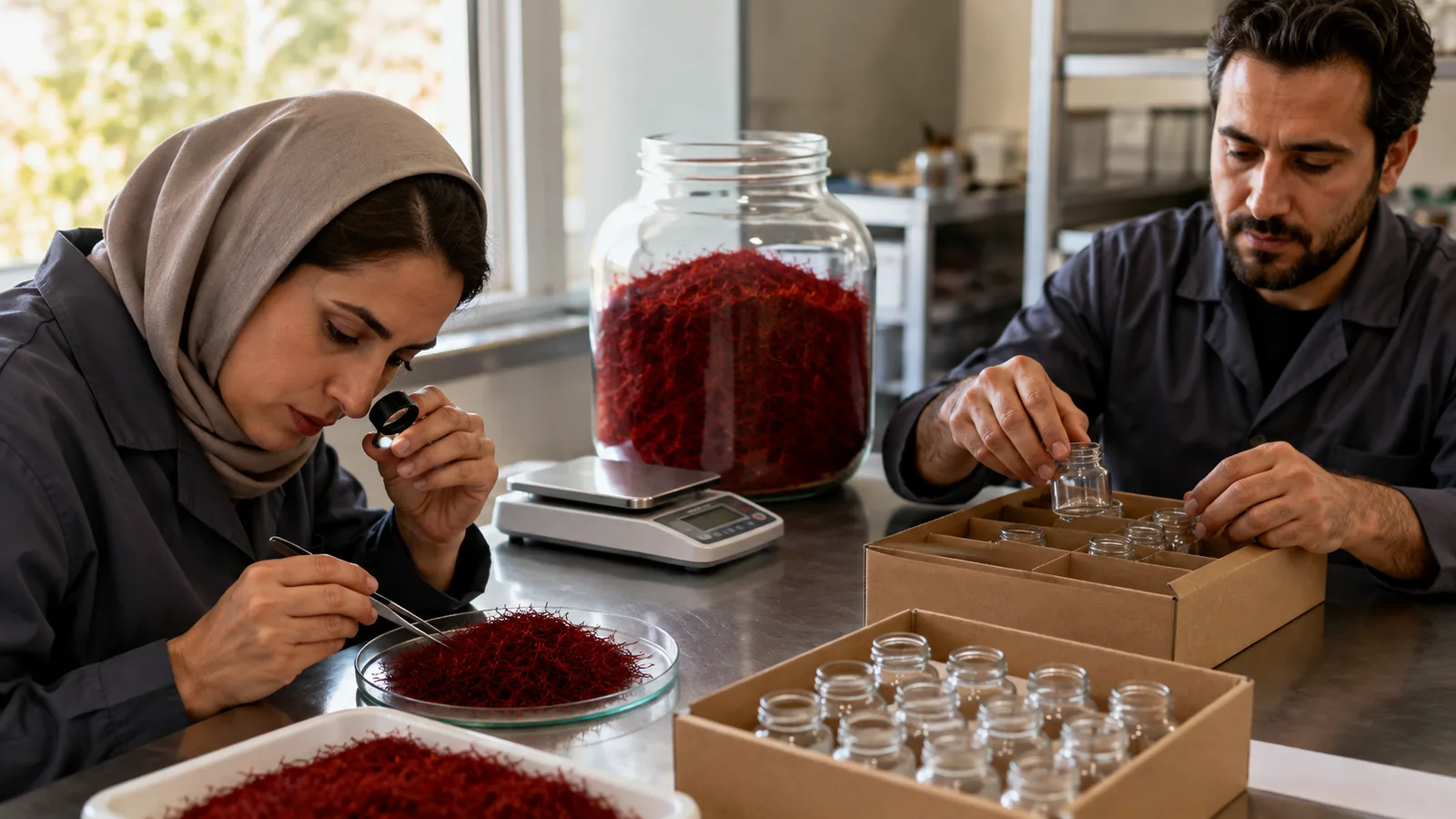
Value begins before a box is designed. Harvest timing, hygienic stigma separation, controlled drying, clean storage, sorting and lot segregation affect the condition that reaches a buyer. Training farmers and processors is therefore relevant, but it should be tied to measurable handling practices rather than the vague promise of “better saffron.”
Testing and an honest specification
A buyer needs to know what was tested, by whom, on which lot and under which method. The current ISO 3632-1:2025 specification covers dried saffron in filament, cut-filament and powder forms and includes storage and transport recommendations. Compliance is more useful than an unsupported superlative because it gives the parties a shared specification.
Testing does not turn every result into a consumer claim. Certificates must correspond to the shipped lot, and exporters still have to meet the importing market’s food-safety, contaminant, residue and labelling rules.
Packaging that protects rather than decorates
Retail packaging should limit moisture, light, contamination and physical damage while making the net quantity, identity, lot and required business information easy to read. A premium box that cannot protect the threads or satisfy local labels adds cost without adding durable value.
Origin and customer relationships
Brand value comes from repeatable experience: the same promised grade arriving on time, clear records when a question arises and an exporter who can explain origin and handling. Marketing can communicate those strengths, but it cannot substitute for them. That relationship is harder for an intermediary to replace than a decorative pack alone.
Does re-export erase Iranian origin?
Saffron can be imported in bulk, packed or blended under local rules and then sold by a company in another country. This helps explain why major trading and packaging centres can have a visible presence despite producing far less saffron than Iran. It does not prove that every foreign-branded jar contains Iranian saffron, nor does it justify calling a product’s declared origin false without traceability evidence.
Importer-reported 2024 data compiled through the World Bank’s WITS presentation of UN Comtrade identifies the European Union, Spain and China among important reported destinations for saffron from Iran. The EU aggregate includes member-country trade, so its line must not be added to Spain and Italy as if they were independent totals.
Processing does not mean making medical promises
The previous article described saffron’s medicinal, therapeutic and nutritional properties and proposed health, food and cosmetic markets as routes to greater value. Research into saffron’s constituents and possible uses is real, including work at Mashhad University of Medical Sciences. A research programme, however, is not proof that a saffron food product treats a disease.
New extracts, supplements or therapeutic products require their own evidence, manufacturing controls and regulatory route. Exporters should describe the product they can substantiate. For ordinary culinary saffron, purity, sensory quality, traceability and safe handling are sound claims; “unparalleled medicinal benefits” is not.
Raw export is not the same as a saffron shortage
A rise in bulk exports does not establish a shortage. Availability depends on the harvest, carry-over inventory, domestic demand, legal exports and informal trade. Price movement may reflect several of those factors at once. Current crop and customs records are needed before describing the market as short of saffron.
What a practical export improvement plan looks like
A useful plan starts with the intended buyer rather than one solution for the whole sector. An industrial food company, a specialist retailer and a restaurant distributor need different pack sizes, documents and service. Exporters can then decide which steps they should own and which require a reliable partner. Local testing, packing and sales work may support skilled employment, but job gains should be measured rather than assumed.
- Keep farm, harvest, drying, storage and lot records connected.
- Define a product specification and test against it consistently.
- Use packaging suited to the saffron form, journey and destination rules.
- Price testing, compliant packaging, freight, finance and after-sales work before choosing a channel.
- Protect Iranian origin with truthful labels and traceable documentation.
- Build repeat business in several markets instead of depending on one intermediary.
A better way to judge Iran’s saffron export position
The country’s production share is important, but it is only the starting point. Progress should be judged through dated export weight and value, the mix of bulk and retail-ready shipments, verified quality, destination diversity, repeat buyers and the income reaching growers and processors.
That is the central struggle with raw export. Calling saffron the “gold of the Iranian economy” does not create value on its own. Iran does not need to reject every bulk order; it needs the capability to choose when bulk trade makes sense and when testing, packaging, product development or a direct customer relationship can retain more value without sacrificing market access.

![Exporting Saffron to Turkey + Price Guide [Complete 0 to 100]](https://img.rowhanisaffron.com/20260827003933/saffron-export-turkey-quality-inspection.webp)



