


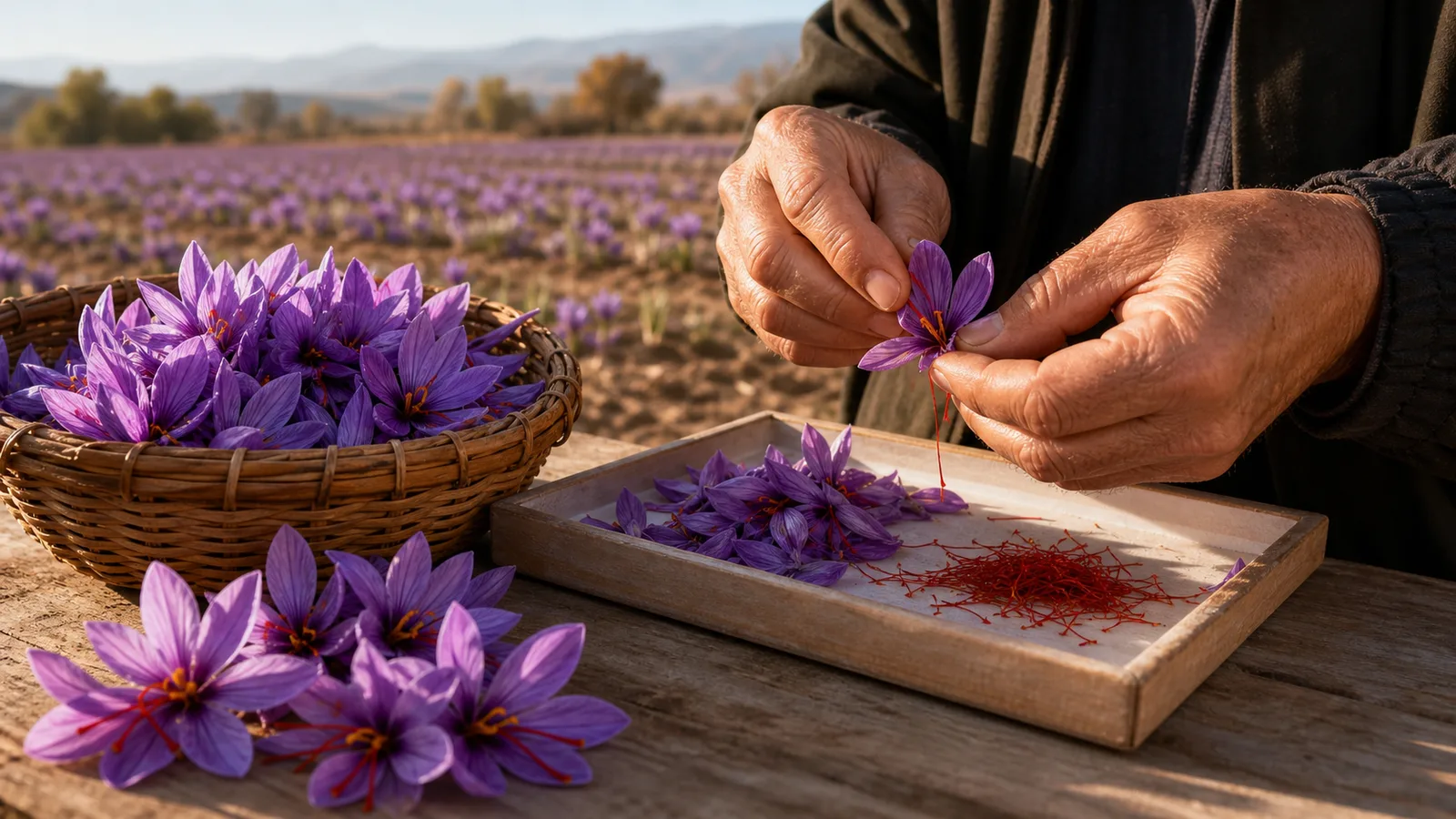
About saffron, the essential fact is simple: the spice is made from dried red stigmas of Crocus sativus, a purple-flowering crocus harvested in autumn. Each flower carries only three stigmas. They must be picked, separated and dried carefully, which is why a small amount represents a remarkable amount of field and hand work.
Saffron is used for its golden colour, distinctive aroma and gently bitter taste. It is also the subject of medical research, but a culinary spice and an experimental purified compound are not interchangeable. This guide separates what saffron is, how it is sold and used, and what science can—and cannot yet—say about it.
What part of the flower becomes saffron?
The saffron crocus grows from a corm rather than a seed-grown bulb. When a flower opens, its three vivid red stigmas form the valuable part. A small amount of yellow or pale style may remain attached depending on how the saffron is cut and graded.
The Codex standard CXS 351-2022 defines dried saffron as stigmas, sometimes with part of the style, from Crocus sativus. It recognises filaments, cut filaments and powder. That is more precise than calling the whole flower saffron.
Flowers are usually collected when they have recently opened. Workers then separate the stigmas and dry them under controlled conditions. Drying removes most of their water and helps develop the spice’s characteristic aroma, but excessive heat or damp storage can weaken quality.
Why is saffron called red gold?
Saffron is among the costliest spices by weight because every gram contains the dried product of many flowers. University of Vermont Extension estimates that approximately 150–170 flowers make one gram. The exact number varies with stigma size, growing conditions and final moisture.
The old version of this article paired 150 flowers per gram with 147,000 flowers per pound. Those two numbers cannot both be correct: a pound is about 454 grams. The useful estimate is therefore the per-gram range, not the inconsistent pound figure.
Price also reflects the short harvest window, rapid flower handling, drying loss, sorting, testing, storage and the grade or style being sold. A higher retail price does not by itself prove purity, just as a low price does not identify the exact problem. Origin, lot traceability and test results matter more than a dramatic “red gold” label.
What gives saffron its colour, taste and aroma?
Three groups of compounds explain much of saffron’s sensory character:
- Crocins are water-soluble pigments responsible for the strong yellow-to-golden colour released during blooming.
- Picrocrocin contributes the characteristic bitter taste.
- Safranal is a major part of the dried spice’s aroma.
These compounds are measured in saffron quality work, but a home cook does not need laboratory equipment to use the spice. Crush a small pinch of threads, let it bloom in warm water or another recipe liquid, and add both the liquid and threads to the dish. The colour should spread gradually rather than behave like loose artificial dye.
Iranian saffron styles and trade names
Iranian sellers use several familiar commercial names. They describe how much red stigma and pale style is present and how the threads are arranged, but they should not be confused with a universal guarantee of chemical grade.
- Dasteh or bunch saffron keeps red stigmas and more of the pale style together in a tied bundle.
- Pushal retains red stigmas with a smaller amount of yellow style.
- Sargol consists mainly of separated red stigma portions.
- Negin is selected for long, well-formed red threads with little or no visible style.
Names can be applied inconsistently between sellers. Codex classes and laboratory measurements provide a firmer basis for a contract, while the physical style helps a buyer understand what is in the pack.
How to recognise and store good saffron
Whole threads are easier to inspect than powder. Look for dry red filaments with natural variation and flared stigma ends, a characteristic aroma and a pack that identifies the responsible seller, net weight and lot. Avoid product that smells musty, appears damp or contains obvious foreign plant material. Our high-quality saffron buying guide gives a fuller practical checklist.
Codex states that saffron should have its characteristic colour, flavour and odour, be free from foreign odour and visible adulteration, and meet chemical and physical criteria for its class. No food additives are permitted in products covered by that standard.
At home, keep saffron airtight, dry and away from heat, light and strong-smelling foods. Grind only what a recipe needs. Powder has more exposed surface area, so it loses aroma and is harder to examine for adulteration.
Saffron, crocin and multiple-sclerosis research
An older source article said that saffron could “cure MS.” That is not what the cited research established, and it is not a safe health claim.
The likely source was a 2011 study in The Journal of Immunology. Researchers at the University of Alberta examined crocin, a saffron constituent, in cell systems and experimental autoimmune encephalomyelitis, a laboratory model used to study features of multiple sclerosis. Crocin reduced inflammatory and cellular stress signals; in treated mice it was associated with preserved myelination and axonal density. The study was preclinical. It did not show that eating saffron prevents, treats or cures MS in people.
Human research remains limited. A 2019 randomised trial assigned 40 people with MS to crocin capsules or placebo for 28 days and reported changes in several blood markers of oxidative stress and inflammation. A separate 2024 randomised trial gave 50 participants crocin or placebo for eight weeks; high-sensitivity C-reactive protein fell, but several other measured biomarkers and mental-health outcomes did not improve.
Small, short trials of measured crocin supplements do not establish a disease treatment, an effective culinary dose or long-term safety. People with MS should not replace prescribed care with saffron or crocin. Anyone considering a concentrated supplement should discuss it with the clinician who manages their medicines and condition.
Food use and traditional reputation
Saffron has a long culinary history in rice, bread, sweets, drinks and savoury dishes. A little can colour and perfume a whole recipe. It is often described traditionally as uplifting or joyful, but tradition is not the same as evidence that the spice treats depression or another illness.
For cooking, start with a small pinch. Blooming the threads distributes their colour and aroma more evenly than scattering dry strands at the end. Add more only after tasting; excess saffron can make a dish unpleasantly bitter and wastes an expensive ingredient.
About saffron in one sentence
Saffron is the carefully dried stigma of an autumn crocus: valuable because it is scarce and labour-intensive, useful because a tiny quantity brings colour, aroma and flavour, and scientifically interesting without being a proven cure-all.

![Exporting Saffron to Turkey + Price Guide [Complete 0 to 100]](https://img.rowhanisaffron.com/20260827003933/saffron-export-turkey-quality-inspection.webp)



