


Saffron was removed from the basket of essential goods in the sense described by an earlier Iranian market interview: as its price rose and household purchasing power weakened, consumers treated it less like a routine pantry item and more like an occasional luxury. This was an observation about demand, not an announcement that saffron had been deleted from a formal government list.
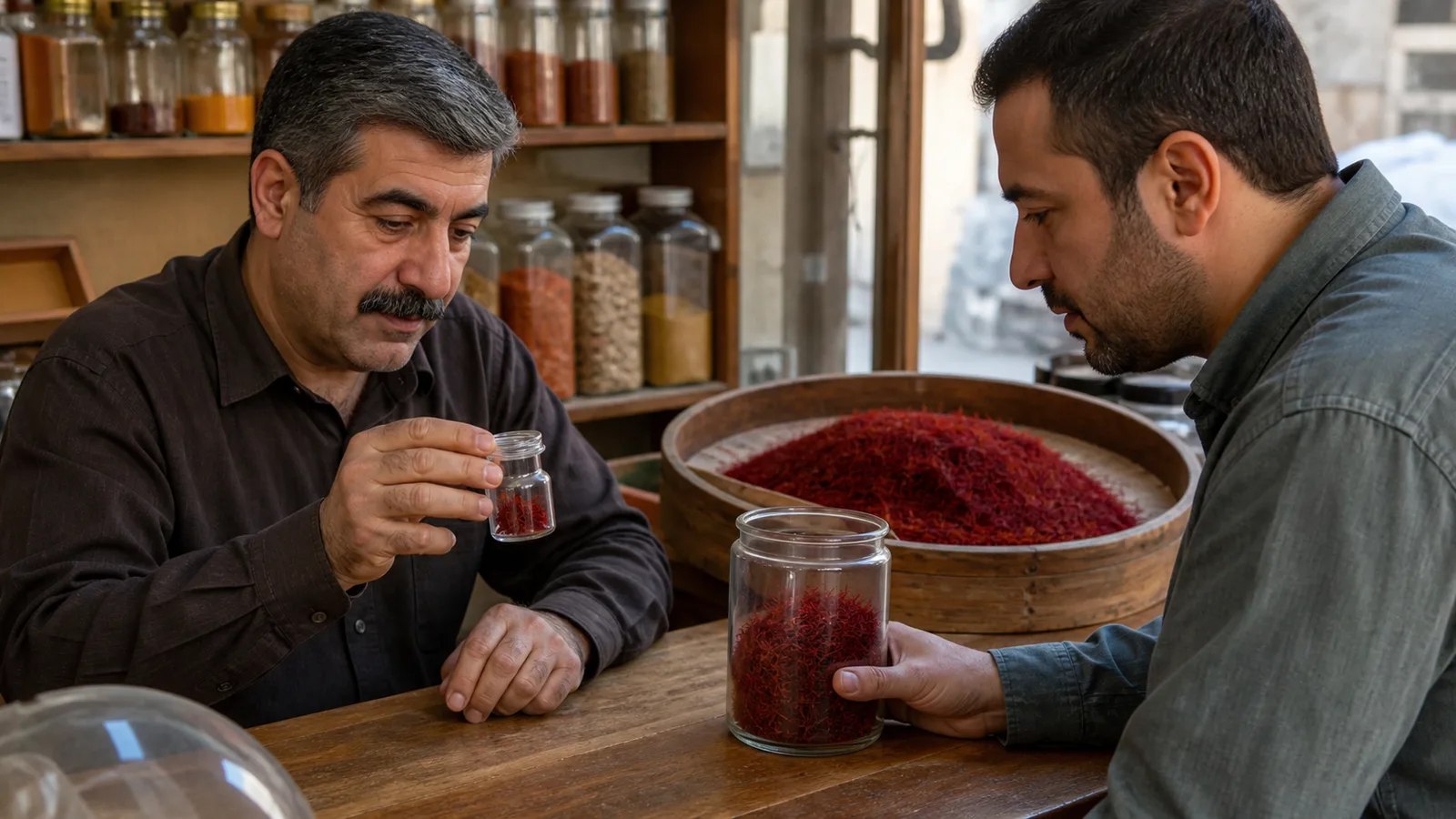
The interview and a related price report capture one volatile historical season. Their toman figures are not current prices. They are valuable because they show how harvest size, currency, inventory and speculative buying can affect farmers, households and exporters differently.
What “removed from the basket” meant
Ali Shariati Moghaddam, then director of the Saffron Export Development Fund, said domestic consumption had not increased and may have fallen as prices rose. In his words, households under financial pressure removed saffron from their basic consumption basket and treated it as a luxury.
Saffron was never a staple by weight. A family uses grams, not kilograms. Even so, price changes can alter how often it is bought, which grade is chosen and whether it is used in everyday rice and desserts or saved for guests and holidays.
Retail affordability also depends on pack size. A small sealed pack lowers the cash paid at one time but may cost more per gram than a larger one. Comparing only the package price can therefore hide the real unit price.
The archived 40% price swing
In the related report, Shariati Moghaddam described about a 40% domestic-price fluctuation over a year:
- about 4.5 million tomans per kilogram at the start of the earlier crop season;
- a rise to roughly 5.5 million tomans;
- more than 7 million tomans in the first months of the following year; and
- a later decline to about 6.5–6.8 million tomans per kilogram.
These are nominal historical figures quoted by one market participant. They do not identify a precise grade, date, transaction type or tax and delivery basis, so they should not be used to value saffron today.
What drove the increase
A smaller crop
The price report attributed part of the move to drought and hot weather. It estimated that output had fallen about 30%, equivalent to roughly 70 tonnes, in that crop year. This is a dated speaker estimate rather than a verified current production total.
Recent figures are different. An Iranian Agricultural Information Network report tied to the Ministry of Agriculture gives 336 tonnes from about 105,000 hectares, with an average of 3.3 kg/ha, for its stated period. Production numbers must always carry their year and source.
Currency and export purchasing power
The first interview said exchange-rate changes let exporters pay more in tomans while still selling to foreign customers. That can raise domestic competition for available lots. It does not guarantee that a grower’s real profit rises: labour, corms, water, processing and household costs may increase at the same time.
A currency move also makes comparisons deceptive. A higher toman price can coexist with a lower dollar price. Exporters and growers need both units, the transaction date and the grade before deciding whether the market improved.
Inventory and speculative demand
Shariati Moghaddam argued that mobile capital and intermediaries had entered saffron trading, creating non-consumption demand. The related report said brokers bought and stored product when supply looked tight, then might release it when they needed cash or expected prices to fall.
This is the speaker’s interpretation of that season, not proof that every intermediary manipulated the market. Traders can perform useful functions by aggregating small lots, financing stock and supplying buyers between harvests. The risk comes when opaque inventory and rumours make it hard to distinguish real consumption from short-term positioning.
Why a stored crop can change the market quickly
Dried saffron is compact and can be stored when handled correctly. That gives the market an inventory buffer, but the size and ownership of the buffer may be unclear. A production shortfall does not translate one-for-one into immediate scarcity if earlier stock exists. Conversely, a large harvest does not guarantee low retail prices if product is withheld or processing capacity is constrained.
Useful market reporting therefore separates:
- new-crop production;
- old-crop inventory;
- farm-gate purchases;
- domestic consumption;
- export shipments; and
- exchange or warehouse-certificate positions.
Combining them into one “saffron demand” number hides the mechanism behind a price change.
Iran’s share should not be frozen at 95%
The archived source said Iran supplied more than 95% of world saffron. Current FAO communication uses a lower range, estimating 85–90% of global production. Iran remains the clear leader, but using the updated range avoids turning an old dominance estimate into a permanent fact.
Leadership makes Iranian output important to world supply, yet other origins, inventories and buyer substitution still matter. It would be inaccurate to describe the market as entirely under one country’s control.
Farm livelihoods and the affordability trade-off
The source said the livelihoods of about 600,000 people in disadvantaged regions were economically tied to saffron. That is a historical stakeholder estimate; the post does not provide a method for counting full-time farmers, seasonal workers, processors or family members. It should be read as evidence of broad dependence, not a precise current employment census.
A very low farm-gate price can undermine those households and reduce care in the field. A rapid high-price spike can reduce domestic use, attract short-term speculation and make buyers delay orders. The desirable outcome is not a fixed cheap price. It is a market where grade, origin and supply are visible enough for growers and buyers to plan.
How consumers can buy without overpaying
For household use, compare price per gram, not only the pack total. Choose threads from a traceable seller, buy an amount you can use while it remains aromatic and store it sealed away from heat, moisture and light. Extremely low prices deserve the same scrutiny as sudden high ones.
For wholesale buying, define the harvest year, origin, thread type, grade, test method, batch size, packaging and delivery terms. Our current saffron price guide explains how to request a comparable quotation instead of relying on the 4.5–7-million-toman history.
The lasting lesson from that volatile year
The old reports described a sequence: weaker production, a rising exchange rate, speculative stockholding, a climb above 7 million tomans and a partial retreat as stored saffron was expected to return to the market. The exact numbers belong to that period, but the analytical framework still works.
Ask what crop, what inventory, what currency, what grade and what date sit behind a price. That is how a household affordability story and a farmer-income story can be understood without pretending they are the same problem.

![Exporting Saffron to Turkey + Price Guide [Complete 0 to 100]](https://img.rowhanisaffron.com/20260827003933/saffron-export-turkey-quality-inspection.webp)



