


Saffron test in Iran Zabol city began as a small model-cultivation project intended to show whether farmers in northern Sistan and Baluchestan could add saffron to a drought-affected crop pattern. The Saffron Zabol project’s 2019 report recorded the first experimental harvest, not proof that every field around Zabol was suitable or that saffron could replace other crops without a local water and soil assessment.
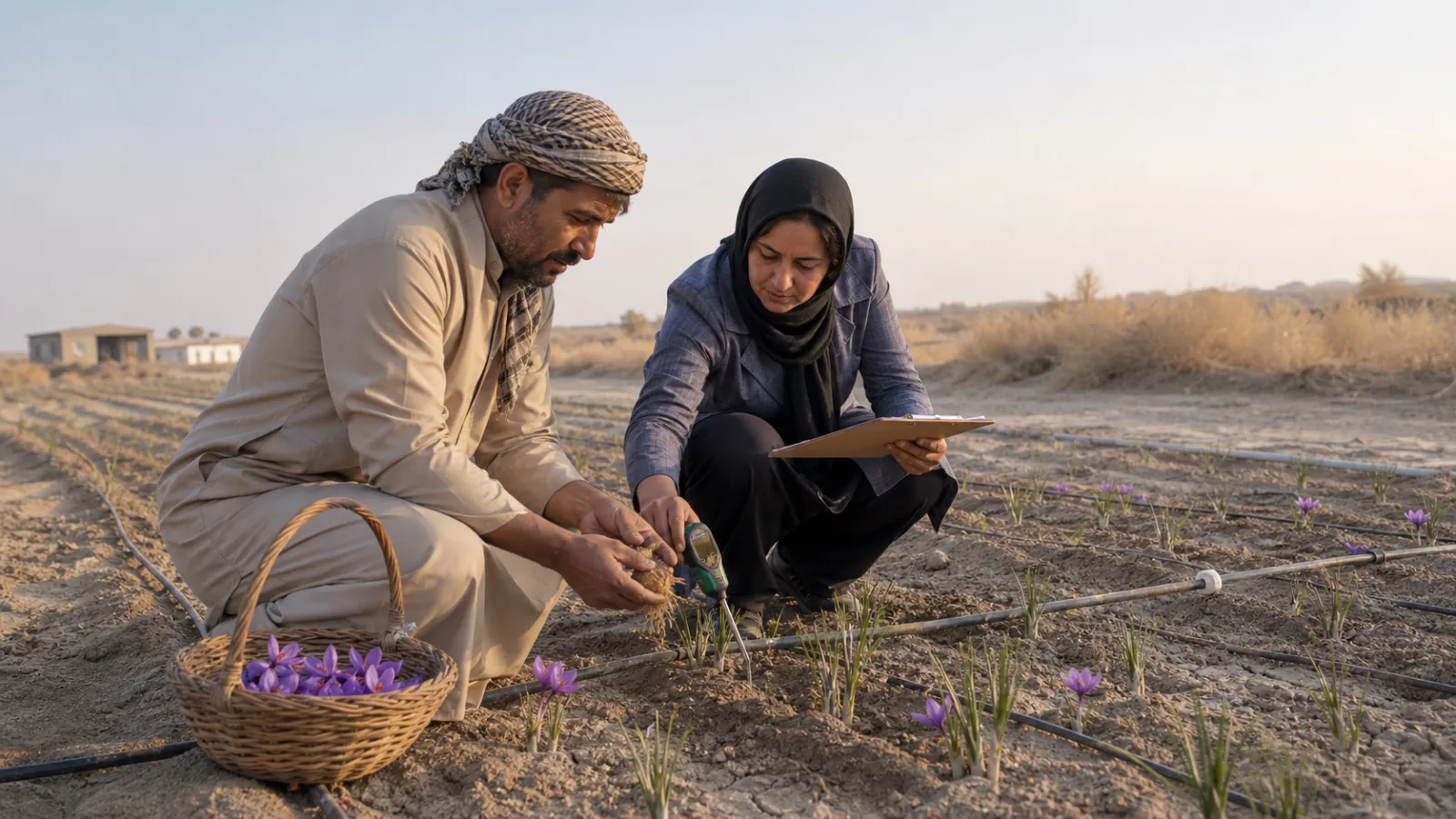
The Zabol pilot described in the original report
The source quoted an official named Bahrami, identified in translation as head of Zabol’s Agricultural Jihad extension or promotion unit. He said harvesting had begun on experimental saffron plots after model cultivation started two years earlier in Qasemabad village. The final locality was rendered as “Beknar” and cannot be resolved confidently from the article alone.
The programme was said to involve individual farmers allocating about 2,000 square metres each. Planting material was distributed free of charge. The source repeatedly called it saffron “onion,” but the correct botanical and farming term is saffron corm.
Bahrami linked the trial to recent drought and encouraged northern Sistan and Baluchestan farmers to reconsider their crop pattern. He also cited a national average dry-saffron yield of 6 kilograms per hectare and a seven-year life for a saffron field. Those figures are preserved as historical extension benchmarks, not guaranteed results for Zabol.
What the saffron test could establish
A first flowering shows that at least some corms completed establishment and produced blooms. It does not yet establish long-term yield, profitability or resilience. Saffron is perennial, and the number and size of daughter corms influence later seasons. Field performance can rise as the stand develops, then decline as crowding, disease or ageing become more important.
The Zabol trial is most useful when the same plots are followed over multiple harvests. Each season should record planted and productive area, corm source and size, flowers picked, dry stigma weight, irrigation, labour, losses and laboratory quality. A nearby comparison field or more than one treatment makes the result easier to interpret.
Does saffron suit northern Sistan and Baluchestan?
The original official said saffron was compatible with the region’s northern climate. Compatibility is not a province-wide yes-or-no question. Temperature during dormancy and flowering, soil drainage, salinity, water quality, wind exposure and the timing of irrigation can differ between villages and even adjacent fields.
Saffron generally needs dry conditions during dormancy and a well-drained root zone, but it still needs appropriately timed water for establishment, flowering and vegetative growth. Waterlogging can harm corms, while severe deficit can reduce flower and daughter-corm performance.
Published Iranian field research has found that irrigation level and planting density can change flower and corm yield. In one two-year semi-arid experiment, supplying only half the calculated water requirement reduced later flower and stigma yield compared with higher irrigation levels. That is a reason to measure local water response, not a schedule to copy into Zabol without testing.
Crop-pattern change should use a water budget
Calling a crop drought-tolerant can hide when the water is required and how much value it produces. A sensible comparison calculates seasonal irrigation volume, pumping energy, labour, marketable output and net return for saffron and the crops it might replace.
Timing matters too. Saffron’s calendar may shift demand away from the hottest months, which can be useful in some systems. Yet water availability at the first autumn irrigation and during active growth still has to be reliable. Salinity should be tested because a field with enough water may still be unsuitable if water and soil salts restrict plant performance.
The decision should be made per field. A successful 2,000-square-metre pilot can justify a larger test; it does not justify converting an entire farm at once.
Why corm quality matters
Free planting material lowers a farmer’s entry cost, but free is not the same as suitable. Corm lots should have a known source, sound condition and useful size distribution. Visible rot, injury and mixed or poorly stored material can weaken establishment and move problems into a new field.
Records should keep each supplied lot connected to its recipient plot. That makes it possible to tell whether weak performance came from planting material, field conditions or management. It also makes extension advice more specific than a general statement about Zabol saffron.
Understanding the 6 kg/ha figure
The article’s national average of 6 kilograms per hectare was plausible as a period benchmark, but an average conceals wide variation. New fields can yield less than established ones. Dry stigma cut, drying method and moisture affect the reported weight. Some figures refer to forecast area rather than area actually harvested.
A trial report should therefore publish its own measured result and denominator. “Six kilograms per hectare” is not a promise to participating farmers, and multiplying it by planted area is not a valid forecast without local flowering data.
Our saffron production statistics guide explains why crop year, field age, area definition and dry-product measurement must stay attached to any yield number.
What the seven-year statement means
A saffron corm does not simply remain unchanged for seven years. The planted mother corm is replaced by daughter corms as the plant cycles. The article’s “seven-year life” is better understood as a rough period during which a saffron stand may remain in place before congestion, disease risk or falling productivity makes lifting or renewal advisable.
The economically useful field life varies. Planting density, daughter-corm multiplication, soil, nutrition, weeds and disease all affect it. Annual records can show when yield per area and cost per gram start moving in the wrong direction.
Harvest and post-harvest quality in a pilot
A trial should evaluate more than flowers in the field. Picked blooms need clean containers, protection from crushing and prompt delivery for stigma separation. Drying must be controlled and recorded so that one village’s result can be compared with another’s.
ISO 21983:2019, confirmed as current in 2025, covers the stages from harvesting and flower transport through stigma separation, drying and storage before packing. Following a defined process prevents a promising crop trial from being undermined after picking.
When a Zabol farmer should expand
Expansion is safer after the pilot produces at least several seasons of records, the field’s water and salinity are understood, healthy replacement corms are available and there is a practical harvest-labour plan. The buyer, product form and quality requirements should be known before more land is planted.
The Zabol project had a sensible purpose: test saffron on small plots, reduce the first cost of corms and let farmers learn before committing more land. Its strongest legacy will not be the claim that saffron suits the whole region. It will be reliable local evidence showing where it works, what it requires and whether the return justifies the water, labour and risk.

![Exporting Saffron to Turkey + Price Guide [Complete 0 to 100]](https://img.rowhanisaffron.com/20260827003933/saffron-export-turkey-quality-inspection.webp)



