


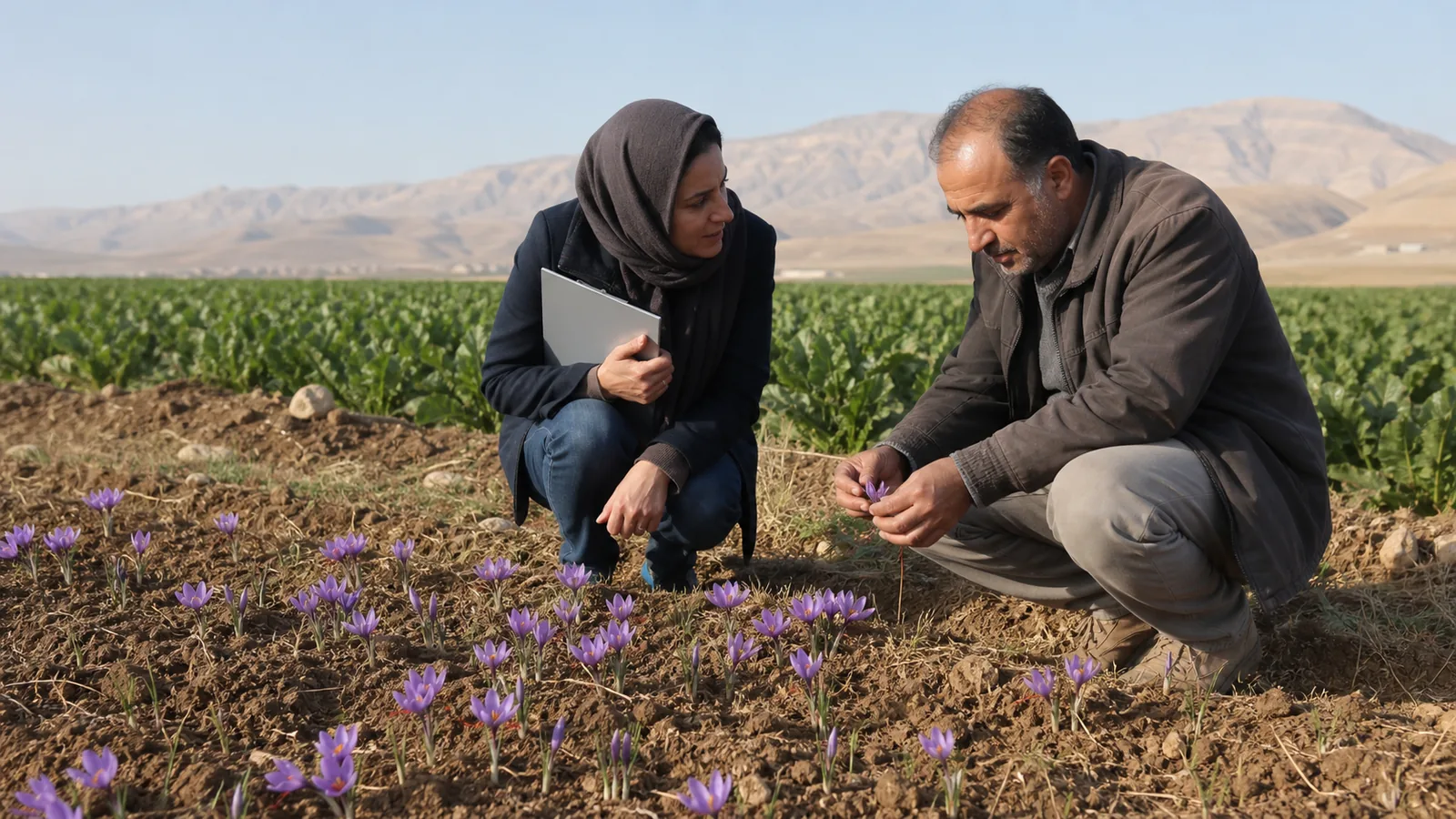
The short answer is no: saffron should not replace every sugar-beet field in Eslamabad-e Gharb. The proposal behind the headline was narrower. In 2014, a local official suggested using saffron on part of the county’s irrigated land because sugar beet was an important crop with a substantial demand for water. That idea is worth testing, but only field by field, with soil, climate, labour, rotation, processing and sales considered together.
Eslamabad-e Gharb is the city in Kermanshah Province that the old English translation calls “Islamabad West.” It also repeatedly turns the official’s title into “Governor of West Pakistan,” which is plainly a translation error. The report concerns western Iran, not Pakistan.
What the original crop-replacement proposal said
The surviving article attributes the comments to Karam Mohammadi, then the county governor, in an interview with the Kermanshah bureau of the Iranian Students’ News Agency. He described Eslamabad-e Gharb as having considerable agricultural and industrial potential, but argued that the farming sector needed to use its irrigated land more efficiently.
Two land figures were rendered as 84 million and 12 million hectares. Those numbers cannot describe a single county: even the smaller one would be impossibly large. They appear to be damaged translations of figures expressed in thousands, but the original Persian report is no longer available at the cited link, so the exact areas should not be reconstructed as fact.
The report also says the county accounted for 46 percent of sugar-beet production in a wider area, probably Kermanshah Province. Mohammadi’s point was not that beet production had failed. He said it was performing well, then contrasted that success with the crop’s water demand and proposed replacing part of the beet area with higher-value saffron.
Wheat, barley and other cereals were mentioned as established local crops. That matters because a change to saffron affects more than one harvest: it changes the farm’s rotation, cash-flow calendar, labour needs and the use of land for several years.
Why saffron entered the water discussion
Saffron’s active growth falls mainly in the cooler part of the year. Its corms are dormant through much of the hot summer, so the crop avoids the heavy summer irrigation associated with many alternatives. The Food and Agriculture Organization describes the qanat-based saffron system in Gonabad as a response to severe water scarcity and notes that saffron does not require large quantities of water.
That does not make saffron a no-water crop. It needs moisture at the right stages, especially around the start of growth and flowering, and the requirement changes with rainfall, soil, field age and irrigation method. A three-season Iranian field study published in Scientia Agricola found that irrigation method influenced stigma yield, quality and water-use efficiency. The useful lesson is to schedule and measure irrigation, not to repeat a generic claim that saffron simply “needs little water.”
Sugar beet has a different seasonal pattern and produces a large root crop. Its water and nitrogen decisions are closely tied to root yield, sugar content, rainfall and the price paid for recoverable sugar. Research on water-limited sugar-beet production in Iran treats the choice as an optimisation problem rather than assuming that one irrigation figure works everywhere.
For a farmer, the meaningful comparison is therefore cubic metres of water, labour hours and net return per hectare under local conditions. Comparing the retail price of a gram of saffron with the farm-gate price of a tonne of beet says almost nothing about either crop’s real margin.
A field is suitable only if the whole saffron cycle works
A water-saving ambition is not enough to establish a saffron field. The corms remain in the soil across several seasons, so drainage and soil structure matter. Waterlogging raises disease and corm-loss risk. Heavy, compacted ground may need more preparation than its apparent fertility suggests, while a field with poor access can become difficult during the short flower harvest.
Temperature timing also matters. Growers need conditions that support autumn flowering, winter leaf growth and healthy corm development before summer dormancy. A trial plot should record emergence, flower count, stigma yield, corm multiplication, disease, irrigation and labour rather than relying on a first-year visual impression.
Land preparation must suit the actual soil test and drainage pattern. Our guide to preparing ground for saffron explains why cultivation depth, organic matter, levelling and clean planting material need to be settled before the corms go in. The separate guide to saffron in water-scarce regions covers the crop’s seasonal water pattern without presenting it as drought-proof.
Labour can become the real constraint
Saffron saves neither time nor hands at harvest. Flowers emerge over a concentrated period and need to be collected promptly. The stigmas must then be separated carefully and dried under controlled conditions. A farm can have suitable land and enough water yet lose quality because too few trained people are available on peak mornings.
This is one of the sharpest differences from a contracted field crop. Sugar beet is bulky and its harvest and transport are demanding, but much of the work can be organised around machinery, delivery schedules and a known processor. Saffron is light and valuable, although its most delicate work is manual and arrives in a narrow window.
Before changing area, a grower needs a realistic flower-picking plan: who will be available, how quickly flowers reach the separation room, where clean trays and dryers will stand, and how each day’s lot will remain identifiable. Wages should be costed at the rate required to secure labour when neighbouring fields are flowering too.
The buyer matters as much as the field
The 2014 proposal described saffron as a higher-value alternative. Higher value is possible, but it is not automatic. Dried stigma yield is small, quality varies and the producer may wait for payment. A credible budget needs a conservative saleable yield, corm establishment and replacement costs, annual field work, harvest labour, drying, testing, packaging, storage and finance.
It should also name the buyer. A sugar factory provides an obvious destination for beet, even when contract terms or payment timing are imperfect. A new saffron grower needs a processor, cooperative or exporter that will state the lot specification, sampling method, price basis and payment date before planting expands.
Quality cannot be added at the end. Flowers left warm in deep containers deteriorate. Poor separation introduces yellow style and foreign matter. Inconsistent drying changes aroma, colour, moisture and storage stability. A high headline price usually refers to a properly prepared product, not every gram that leaves a field.
What a sensible replacement trial would compare
The safest approach is a measured pilot rather than a county-wide switch. Keep a comparable beet field or strip as the reference, document the same inputs for both crops and compare more than gross revenue.
- Water: meter each irrigation and record rainfall rather than estimating from the number of turns.
- Land: include preparation, the years occupied by saffron and the crops displaced from the rotation.
- Labour: separate routine field work from flower picking, stigma separation and drying at peak demand.
- Saleable output: use dried stigma weight and verified quality, not the weight of fresh flowers.
- Market: record the actual farm-gate offer, deductions, payment delay and rejected or downgraded material.
- Risk: include corm loss, disease, poor flowering, beet-contract terms, price variation and access to a buyer.
Results should be reviewed across several seasons. Saffron is perennial, and the first flowering year does not describe the mature field. Sugar-beet performance also moves with rainfall, irrigation, sugar content and factory arrangements. A single good or bad season is weak evidence for a permanent land-use decision.
Agricultural development also needs local industry
Mohammadi linked farm development with industrial development in the county. The old report mentions more than 28 industrial units and says some were inactive because of unspecified problems. Its damaged list appears to include a tile business, poultry-related operations, a yeast company and sugar processing, but several names are too distorted to identify reliably.
The connection he was making remains practical. Beet depends on lifting, transport and factory capacity. Saffron depends on fast flower handling, drying, grading, laboratory access, secure storage and routes to market. Moving hectares without building those services merely shifts the bottleneck from irrigation to processing and sales.
The same report gave a county employment target of 2,227 jobs and said 774 had been achieved, including work in agriculture. These are historical administrative figures, not current employment statistics. They do, however, explain why the crop proposal was framed as both a water and jobs policy.
So, should saffron take the place of sugar beet?
On some land, perhaps. A well-drained field with an appropriate climate, secure irrigation at the critical stages, clean corms, enough harvest labour and a defined buyer may justify a saffron trial. A field tied to a functioning beet contract, unsuitable for perennial corms, short of labour or far from clean processing may not.
The most defensible reading of the 2014 proposal is selective diversification. Saffron can reduce exposure to summer water demand and add a high-value crop to the farm, while sugar beet, cereals and other crops continue where they fit the land and local economy. The decision belongs in a measured farm plan, not in a slogan that one crop should replace another everywhere.
The local statements and figures above are preserved from the site’s January 2015 English report of a 2014 ISNA interview. Translation damage is identified rather than silently repaired. FAO and research sources were reviewed on 28 August 2026.

![Exporting Saffron to Turkey + Price Guide [Complete 0 to 100]](https://img.rowhanisaffron.com/20260827003933/saffron-export-turkey-quality-inspection.webp)



