


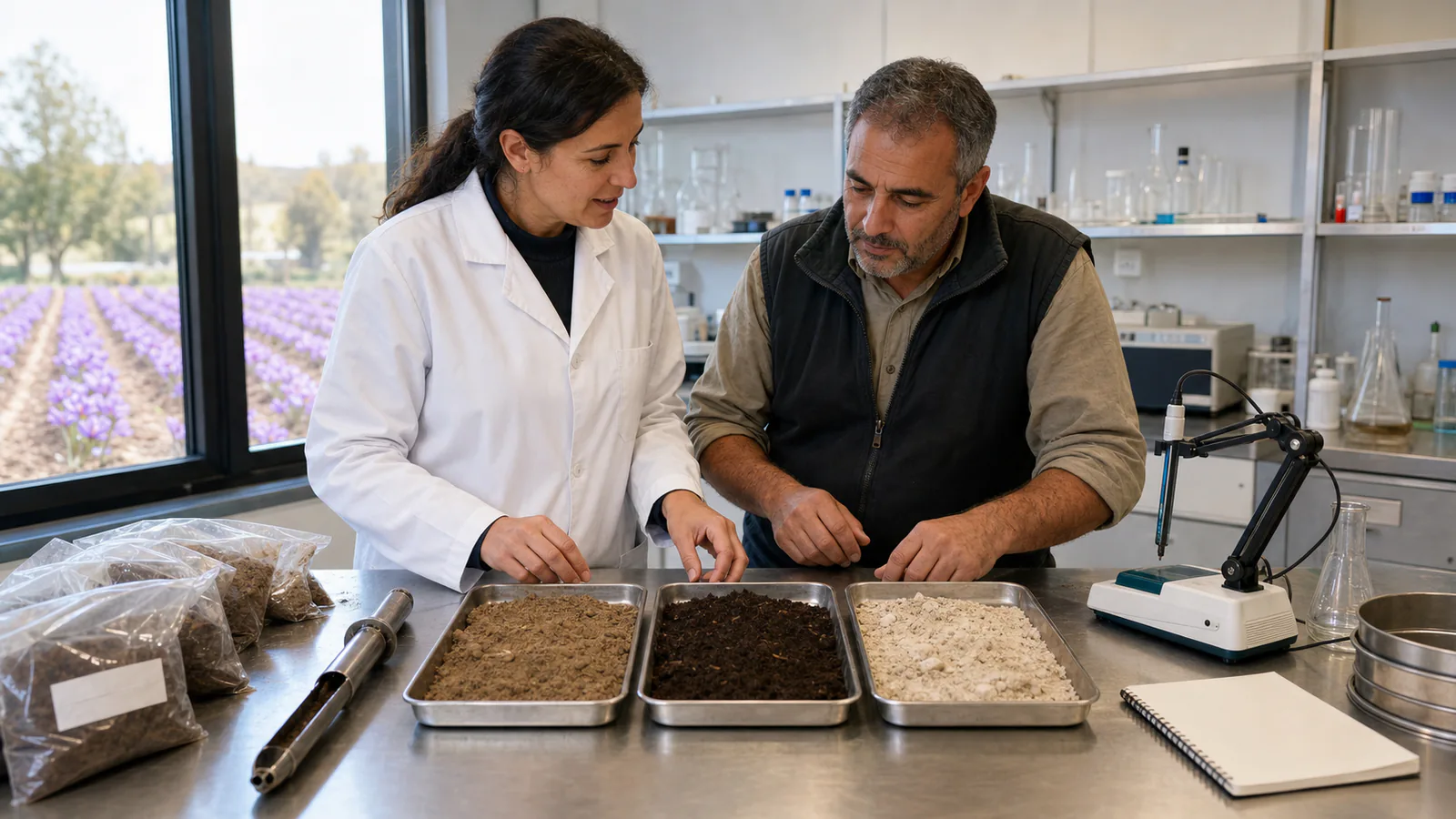
“Saffron soil lab is launched in Torbat” is the established English title of a report about the Saffron Research Institute in Torbat Heydarieh. The underlying Persian wording was future tense: the institute planned to create a soil laboratory dedicated to saffron. That distinction matters. The announcement described the work the lab was intended to support; it did not publish an opening date, test menu or accreditation certificate.
Ali Ahmadian, then identified as head of the institute, connected the proposed laboratory to a wider aim: bring field research closer to growers, processors, traders and exporters while reducing production costs and improving yield per hectare. The soil lab was one part of that programme, not a stand-alone answer to every farm problem.
How the Saffron Research Institute developed
According to the archived ISNA interview, construction of the institute began in the Iranian year 1386, corresponding to 2007–08, and the facility was completed in 1391, or 2012–13. It had begun as a Ferdowsi University of Mashhad centre before becoming separate and being transferred to the University of Torbat Heydarieh.
Ahmadian described it as the only specialised saffron research institute in Iran and the world. That was the director’s statement in the historical report, not an independently maintained global register. Its remit, however, was unusually broad. The institute worked across production, processing, packaging, trade, export and marketing rather than treating saffron as a field crop alone.
The report said its production work served both large and small landholders. Its science-and-industry goal was to connect research with the people who grew, handled and sold saffron. Ahmadian said producers, traders and exporters across the region all needed that link.
What the Torbat saffron soil lab was intended to do
The proposal was for a soil laboratory within the Saffron Research Institute, giving the institute direct access to another part of the crop’s research chain. Ahmadian said laboratory-equipment limitations were not expected to restrict its broader saffron work.
A useful agricultural soil lab turns a field sample into measurements. Depending on the question and methods available, those may include pH, electrical conductivity, texture, organic matter and plant-available nutrients. None of those figures is a complete recommendation on its own. A result becomes useful when it is tied to the correct field, sampling depth, crop history, irrigation water and stage of the saffron cycle.
That is why the laboratory’s relationship with growers matters as much as its instruments. The report’s emphasis on both large and small landholders suggests that the intended service was not simply academic analysis; field questions were supposed to feed research, and research was supposed to return to farms in a form people could use.
A soil test is only as good as the sample
A precise instrument cannot repair an unrepresentative sample. Soil collected from one wet corner, a fertiliser band or a patch beside a road may not describe the rest of a saffron field. Mixing different soil types or depths can hide the variation a grower needs to understand.
The ISO 18400-101 soil-sampling framework explains that a sampling plan should define what is taken, where it is taken and how it serves the investigation’s objective. It specifically includes agricultural soils and recognises that a site may need separate zones because of soil type or past use. ISO 18400-205 adds guidance for field procedures, transport and storage of samples from cultivated land.
For a saffron grower, a sound submission should therefore include more than a bag of earth. The field name, sampled area, depth, date, previous crop, visible problem and recent fertiliser or amendment history help the lab interpret what the sample represents.
Questions a saffron soil report can help answer
A soil analysis is most valuable when the grower begins with a real management question. Examples include:
- whether a prospective field has salinity or drainage concerns before corms are planted;
- whether visibly different parts of an established field should be sampled separately;
- whether a nutrient application is justified by measured soil conditions;
- how soil results should be considered alongside irrigation-water quality; and
- whether declining performance is consistent across the field or concentrated in specific zones.
The report cannot prove the cause of every weak patch. Corm health, planting density, field age, irrigation timing, pests, weeds, temperature and post-harvest practice also affect the amount and quality of dried saffron. A good recommendation considers those possibilities rather than prescribing fertiliser from one number.
The research programme reported at the time
The soil-lab announcement sat inside an active research programme. Ahmadian said six projects and 20 master’s and doctoral theses were then under way under the institute’s supervision. Their subjects covered production, processing, packaging, trade and medicinal properties. Four national saffron research projects were also reported as active.
Those counts belong to the interview date. They should not be read as the institute’s present project list. Their importance is structural: agronomy, post-harvest quality and market development were being studied under one roof, and the institute said it also supported research conducted elsewhere.
The sector problems the institute was studying
Ahmadian’s list of saffron-sector problems reached well beyond soil. It included too many decision-making bodies around the Saffron Strategic Council, slow improvement in production performance, the absence of a national brand, limited supply of processed products, profiteering by domestic and international intermediaries and a customs-tax legal barrier.
The surviving English version compressed these points into a single broken sentence. Restoring the list shows why the institute’s remit included trade and marketing. A higher field yield does not by itself create a strong product, a recognisable origin or a fair route to buyers.
Ahmadian also stressed that research takes time. The institute was evaluating projects and looking for rational solutions, but management and policy decisions were not laboratory results. That boundary remains important: a research institute can test a method or document a problem; adoption, regulation and funding require other institutions.
Research links from the field to the buyer
The planned soil lab belonged at the beginning of a much longer chain. Soil and irrigation affect the crop in the field. Harvest timing and drying affect the threads. Testing, packaging and documentation affect how a lot is described and sold. A failure at any stage can erase gains made earlier.
This is why the report called for stronger communication among scientists, producers and exporters. Farmers can identify recurring field problems. Laboratories can design reproducible measurements. Processors and buyers can explain which quality failures lead to rejection. When those groups exchange evidence, research questions become more useful.
Readers planning a field can continue with our saffron planting guide. For the product-testing side, see Iranian saffron standards. Soil analysis and finished-product testing answer different questions and should not be confused.
The 24-province figure and local coordination
The interview said saffron was being cultivated in 24 Iranian provinces at the time. It also mentioned the creation of a special county saffron committee as another step toward organising the crop in Torbat Heydarieh. Both are historical statements.
Expansion into more provinces makes location-specific research more necessary, not less. A recommendation developed for one combination of soil, climate and irrigation cannot be copied automatically to another. A specialised institute can help by keeping methods consistent while allowing recommendations to reflect local evidence.
What can and cannot be concluded today
The original report verifies that the institute announced a dedicated saffron soil laboratory and described why it wanted one. The title and early translation made the facility sound already operational. Without a dated institutional record of commissioning and scope, this article does not claim the announced soil unit opened on a particular day or still offers a particular service.
What survives clearly is the research logic. Saffron production improves when a field question is measured properly, the sample represents the land, and the result is interpreted alongside the crop’s management history. A laboratory can make that work possible. The value comes from the connection between the instrument, the scientist and the grower.
Sources and historical scope
- The archived ISNA interview reproduced in this post and its duplicate source, with statements attributed to Ali Ahmadian.
- ISO 18400-101:2017, Soil quality — Sampling — Part 101: Framework for the preparation and application of a sampling plan.
- ISO 18400-205:2018, Guidance on the procedure for investigation of natural, near-natural and cultivated sites.

![Exporting Saffron to Turkey + Price Guide [Complete 0 to 100]](https://img.rowhanisaffron.com/20260827003933/saffron-export-turkey-quality-inspection.webp)



