


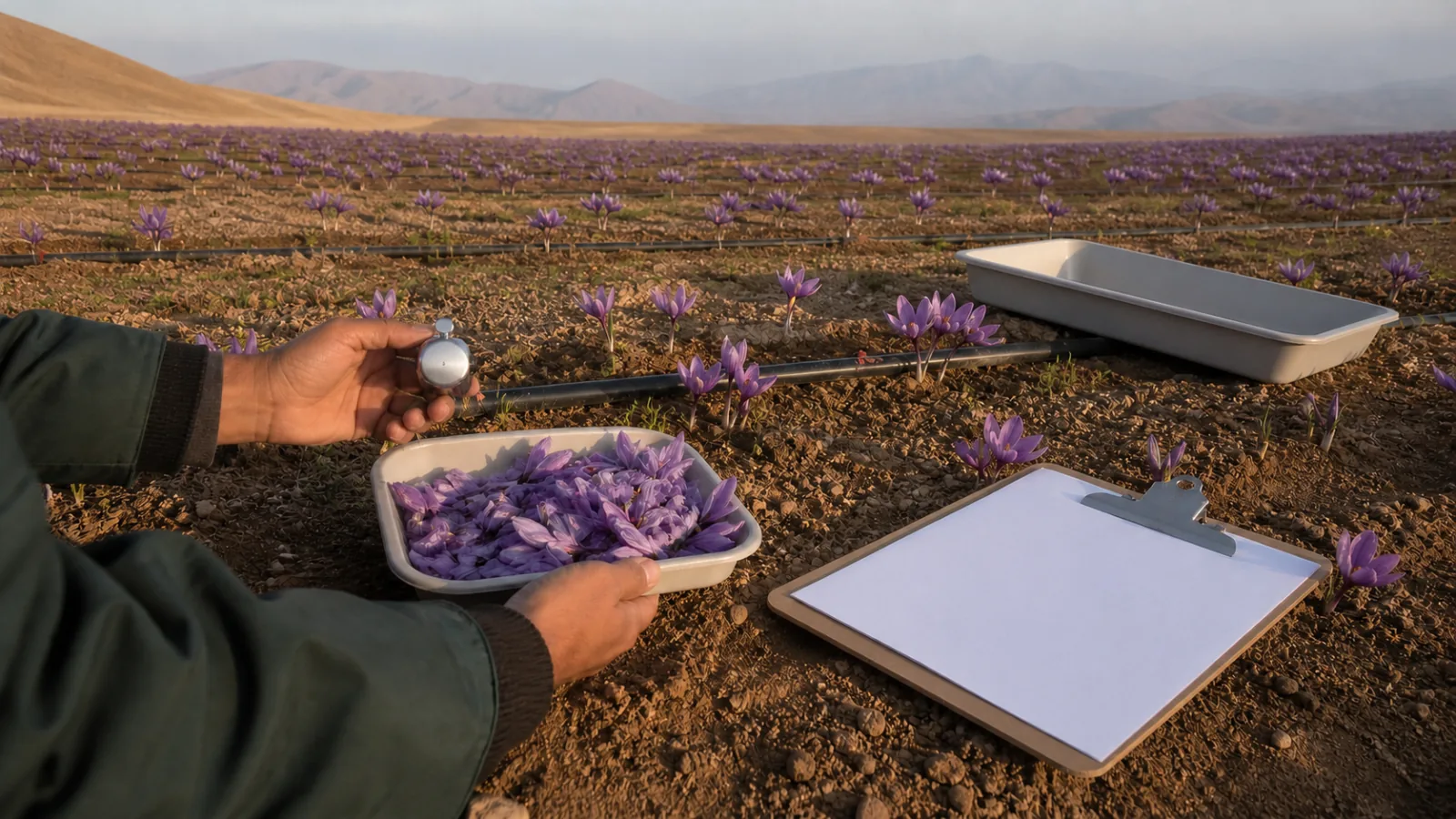
The statement that saffron production increased was a forecast, not a current production total. In the historical report, Gholamreza Miri expected Iran’s output to rise by 20 to 25 percent after favourable spring rainfall, stronger saffron prices and greater attention from growers. Those conditions were described for one season and should not be carried forward without new data.
The report is still useful because it shows how a production forecast is built—and where it can go wrong. More planted area, better crop care and useful rainfall may lift output, but the final number also depends on flowering, labour, drying losses and how consistently each province reports dry saffron.
What Gholamreza Miri said
Miri said saffron was being cultivated in 18 Iranian provinces. He referred to production estimates from previous years ranging from about 180 to 250 tonnes and noted that the available figures were not precise enough for a dependable count. Against that background, he forecast a 20–25 percent increase for the coming harvest.
The old translation repeated “April” while describing the favourable rainfall period. It is safer to preserve the meaning as spring rainfall than to invent exact Gregorian months from a damaged calendar translation.
Higher prices were another part of his explanation. A better expected return can encourage farmers to weed, irrigate and protect a saffron field more carefully, and it can bring dormant or marginal plots back into production. Price alone, however, does not create flowers.
Where the report said saffron was grown
The article named Isfahan, Chaharmahal and Bakhtiari, Ardabil, Alborz, South Khorasan, North Khorasan and Kerman. Its machine translation also listed Shiraz and Arak as though they were provinces; the intended provincial references are Fars and Markazi.
Miri attributed 80 percent of national production to Razavi Khorasan and 95 percent of world output to Iran. He also described the United Arab Emirates as the largest foreign buyer. These were dated statements by the interviewee, not permanent market shares.
Official production and trade tables can use different crop years, customs periods and definitions. A share based on dried output is not the same as a share based on export value, and shipments to a trading hub do not necessarily show the final country of consumption.
What can make saffron output rise?
National production is the result of harvested area multiplied by marketable yield. An increase can therefore come from new fields, better performance in existing fields, or both. Those causes have different long-term implications.
Young fields may produce modestly before corm numbers build. Older fields can decline when daughter corms become crowded or move too close to the surface. Corm health, planting depth, soil drainage, irrigation timing, nutrition, weed pressure and temperature around flower initiation all influence the result.
Rainfall can help replenish water resources, but rain at the wrong time may also interrupt picking or raise disease and drying risks. A national forecast should not translate “more rain” directly into “more saffron” without considering timing and local soil conditions.
Harvest capacity sets a practical ceiling
Saffron flowers emerge over a short season and are normally picked by hand. If flowering rises faster than the available labour, flowers may be collected late. Separation and drying can then become bottlenecks even when the field itself performs well.
For that reason, a sound forecast checks workers, collection containers, clean separation space, dryer capacity and sample storage. Marketable dry saffron—not flower weight or theoretical field capacity—is the useful final measure.
How to read production figures responsibly
Every number should carry a geography, crop year, unit and source. “Iran produced 250 tonnes” is incomplete unless the reader knows whether the figure is an estimate, whether it measures dry saffron, and which reporting period it covers.
Forecasts should be kept separate from final harvest estimates and revised official data. When two sources disagree, compare their definitions before averaging them. A wide historical range such as 180–250 tonnes is evidence of uncertainty, not permission to choose whichever number suits the argument.
Our maintained page on saffron production statistics explains the source and date boundaries behind larger market figures. FAO’s description of the qanat-based saffron system in Gonabad provides useful context for production under water scarcity.
The lasting lesson from this forecast
The 20–25 percent prediction should remain an attributed snapshot from the period in which it was made. Its lasting value is the reminder that price, rainfall and farmer effort interact, while statistics need consistent collection.
A credible current assessment would compare planted and harvested area, field age, provincial yields, flower-season weather, drying capacity and final dry output. Until those inputs are available for the same year, the headline “production increased” should not be mistaken for a verified present-day total.
Background sources: FAO’s official overview of the Qanat-based Saffron Farming System and the Iran-submitted production tables in the Codex saffron standard project document. All Miri figures remain attributed to the historical YJC report.

![Exporting Saffron to Turkey + Price Guide [Complete 0 to 100]](https://img.rowhanisaffron.com/20260827003933/saffron-export-turkey-quality-inspection.webp)



