


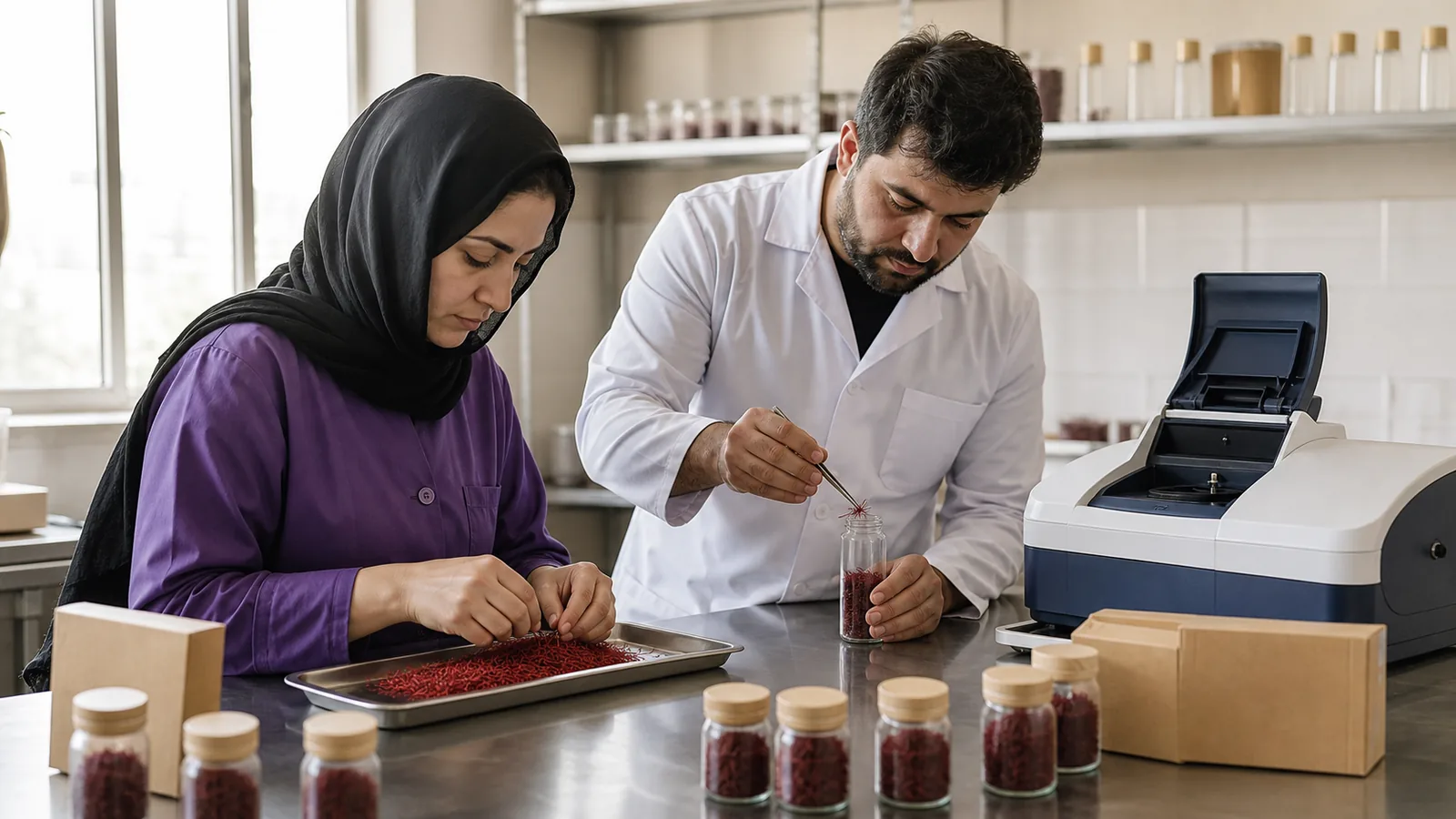
The old headline “Saffron production in Afghanistan is very low quality” is not supported by the article beneath it. The 2013 report was actually about Iran’s difficulty turning its dominant production share into a recognised international brand. Afghanistan appeared as a smaller producer that had done more visible branding, not as evidence of inferior saffron.
Research published since then also makes a country-wide low-quality claim untenable. Laboratory studies of samples from Herat found saffron that met high ISO quality measures. That does not mean every Afghan lot is excellent, just as Iran’s reputation cannot guarantee every Iranian lot. Saffron quality belongs to the tested batch.
What the 2013 report actually said
The comments were attributed to Mohammad Akbari, described as a deputy responsible for plant production in South Khorasan’s agricultural organisation, in an interview with the Iranian Agriculture News Agency. He called saffron an important export product and emphasised the foreign-exchange value it brought to Iran.
His concern was branding. Iran held a very large share of world production, yet only a small proportion of its saffron was sold under identifiable Iranian brands. The translated article contrasts this with Afghanistan, whose production was much smaller but whose saffron had gained a clearer identity in some markets.
The source used a figure of more than 70% for Iran’s world production share. It was a 2013 statement, not a current estimate. More recent research often places Iran’s share around 90%, but production percentages change with the season and dataset. The durable point is that high output and strong branding are different achievements.
What laboratory evidence says about Afghan saffron quality
A 2021 study indexed by FAO’s AGRIS database tested saffron from several parts of Herat Province. Researchers measured crocin, picrocrocin and safranal, the compounds associated respectively with colour, taste and aroma in the ISO test framework. All sampled locations met the study’s stated thresholds for ISO Category I.
A later comparison published in 2024 examined samples from seven Herat districts and nine saffron-producing villages around Torbat Heydarieh in Iran. It found variation by country and locality. The Afghan samples had higher average crocin and picrocrocin in that sample set, while the Iranian samples had the higher average safranal value. With one stated exception among the Iranian villages, the tested samples from both countries surpassed the referenced first-grade thresholds.
These are useful results, but their scope matters. They concern particular samples, regions and harvest years. They do not prove that all saffron from Herat is the same, that Afghan saffron is always better than Iranian saffron, or that a retail package matches a research sample.
Why origin alone cannot determine saffron quality
Saffron is the dried stigma of Crocus sativus. Its condition changes at several points before it reaches a buyer. Field management affects the flowers; separation, drying and storage affect the finished spice.
Important variables include:
- corm health and size;
- soil condition, organic matter and drainage;
- irrigation timing and unusual rainfall;
- how quickly flowers are picked and stigmas separated;
- drying temperature, time and uniformity;
- removal of yellow style material and foreign matter; and
- protection from moisture, light, contamination and odours in storage.
Two farms in the same district can therefore produce different results, and two lots from one farm can differ between seasons. A national label is meaningful for origin and tradition. It is not a laboratory result.
Farm advice in the South Khorasan report
Akbari said agricultural experts visited saffron farms and passed technical guidance to growers. The translated advice mentions spraying, adding organic matter to soil, choosing large corms and reducing damage from rain.
Those points need some present-day caution. “Spraying” is too vague to repeat as a recommendation: any plant-protection treatment should be based on an identified problem, local registration, label directions and residue requirements. More is not automatically better.
Organic matter can support soil structure and water management, but it should be suitable, mature and used according to field conditions. Larger, healthy corms can help establishment, while diseased planting material can spread problems regardless of size. Heavy or badly timed rainfall may damage flowers, delay picking or complicate drying, which explains the report’s concern about fluctuating rain.
Field practice is only one part of quality
The 2013 article suggests that Iran had already addressed the technical side of production. That conclusion is too broad. Even a well-managed field can lose value after harvest if flowers sit too long, stigmas are poorly separated, drying is uneven or the product absorbs moisture in storage.
An earlier World Bank value-chain study of Afghanistan identified weak post-harvest handling and limited access to functioning certification laboratories as constraints at that time. It also noted that better separation, drying, storage and testing could improve quality and market access. This historical evidence describes sector challenges, not permanent defects in Afghan saffron.
How saffron quality is measured
The current ISO 3632-1:2025 specification covers dried saffron in filament, cut-filament and powder forms. Its companion test framework is commonly used to assess characteristics linked to colour, taste and aroma, along with other specification requirements.
Those measurements are more useful than judging a lot by country alone. Buyers should also examine lot identity, moisture control, foreign matter, microbiological or residue requirements where applicable, packaging integrity and the credibility of the laboratory and sampling process.
A result applies to the sample tested. If a trader blends lots, substitutes product or stores it badly after testing, an old certificate may no longer describe what is in the package.
Branding is not the same as quality
Akbari argued that international branding was the key to further growth and suggested that a strong brand could solve the sector’s problems. Branding can help buyers recognise a supplier and can carry a record of consistent performance. It cannot solve every problem by itself.
A credible saffron brand needs substance behind the name:
- a stable definition of the product and grade;
- traceability from finished pack to lot and supplier;
- appropriate sampling and independent test evidence;
- packaging that protects the spice;
- honest origin and quality claims; and
- a process for handling complaints and non-conforming lots.
Without those controls, a brand is only a label. With them, it becomes a promise that can be checked.
Iran and Afghanistan should be compared lot by lot
Iran has a much larger saffron industry and long-established production regions. Afghanistan, particularly Herat, has developed saffron as a high-value crop and created businesses around cultivation, processing and packing. Both countries can produce strong saffron, and both can produce lots affected by weak handling.
The fair comparison is not “Iran good, Afghanistan bad” or the reverse. It is whether two identified lots were sampled properly, tested by a competent laboratory, handled well and described honestly.
For a wider view of country estimates and why production, export and quality figures should remain separate, read our saffron production statistics guide.
Source and review note
We corrected and reviewed this article on 28 August 2026. Its South Khorasan attribution, farm-extension points, more-than-70% production statement and branding argument remain identified as claims from the 2013 IANA report. Current quality context comes from the FAO AGRIS records for the 2021 Herat quality study and the 2024 Afghanistan–Iran comparison, the World Bank’s Afghan saffron value-chain study, and the official ISO 3632-1:2025 page.

![Exporting Saffron to Turkey + Price Guide [Complete 0 to 100]](https://img.rowhanisaffron.com/20260827003933/saffron-export-turkey-quality-inspection.webp)



