


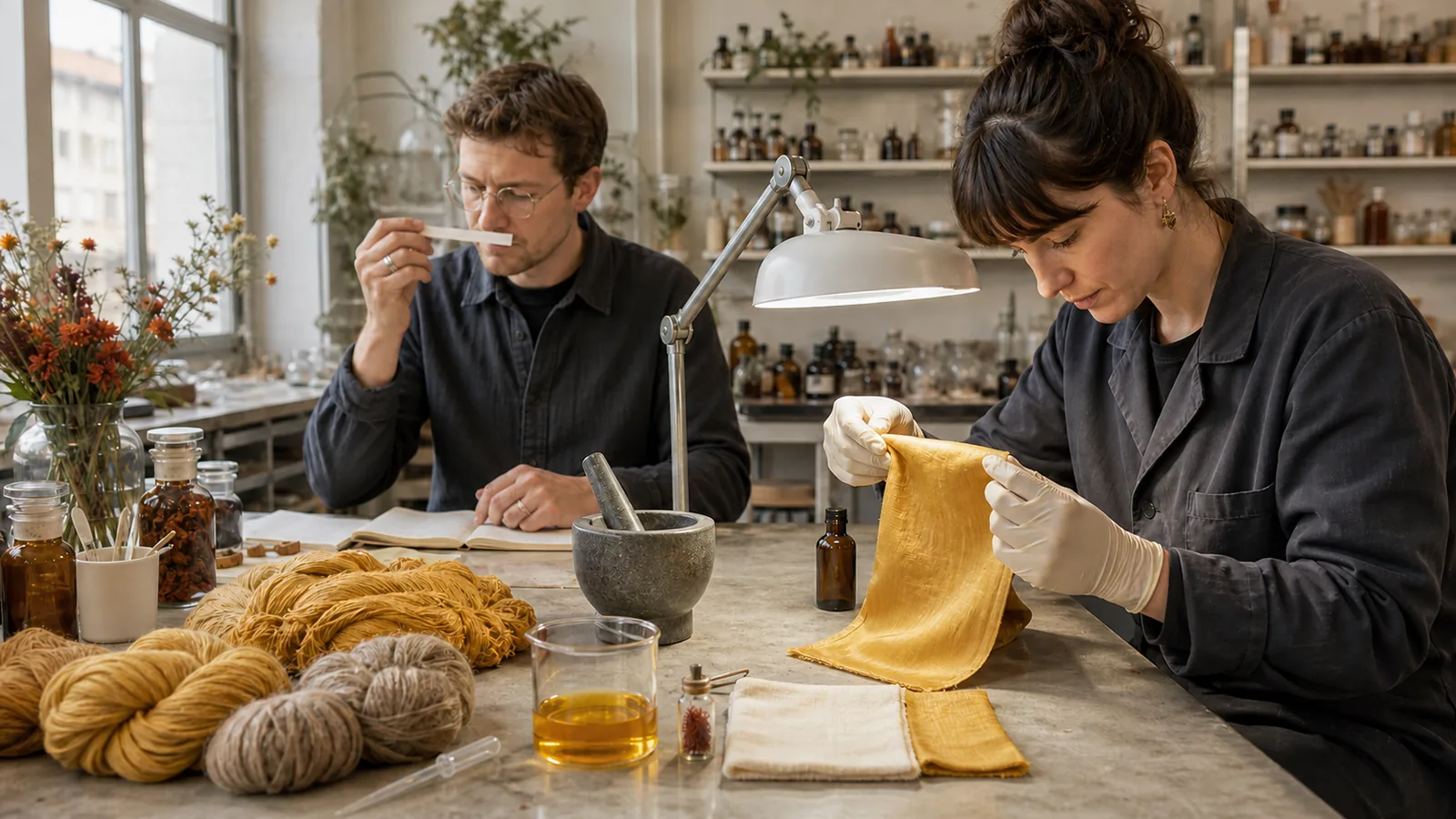
The industrial uses of saffron begin with what the spice naturally provides: colour, aroma and flavour. Food is the clearest commercial application. Saffron also has a documented history as a textile and artistic dye, while fragrance and cosmetic uses are more specialised because genuine saffron is scarce, expensive and chemically sensitive.
The old version of this article mixed historical practice with broad claims about modern paint, perfume and deodorant industries. A better account separates a real ingredient function from a traditional use, a laboratory experiment and a product-development idea.
Why saffron can be used as a colourant
Saffron consists of the dried stigmas of Crocus sativus. Crocins, a family of water-soluble carotenoid pigments, create its strong golden-yellow to orange colour in water-based preparations. That solubility distinguishes crocins from many carotenoids that need help to disperse in water.
The translated source said purple, red and yellow dyes could all be made from saffron. Genuine saffron stigma mainly gives a yellow-orange colour. A purple or deep red result may depend on another material, the surface, concentration, mordant, lighting or a confusion with the purple flower and red stigmas. We do not present all three as predictable saffron dye colours.
Saffron in food manufacturing
Food producers use saffron where colour, flavour and aroma are wanted together: rice products, bakery items, dairy desserts, confectionery, sauces and drinks are familiar examples. The ingredient is not simply a neutral yellow dye. Picrocrocin contributes bitterness and taste, while volatile compounds formed during drying shape the aroma.
For a repeatable product, a manufacturer has to control:
- the saffron form and grade;
- dose and extraction time;
- water temperature and product pH;
- exposure to light, oxygen and heat;
- lot-to-lot colour and aroma strength; and
- authenticity, contaminants and applicable food rules.
Because saffron is valuable, it is usually selected for products where its identity and sensory character matter. If a manufacturer needs colour without saffron flavour or at very high volume, another permitted colourant may be more practical.
Textile dyeing with saffron
Saffron has been used historically to colour textiles, including silk and wool. The old article also names cotton and carpet yarn. Published dye research has tested crude saffron extracts and isolated crocin on cotton and wool, measuring properties such as wash and light fastness after different treatments.
That evidence shows saffron can dye fibre; it does not make it a routine modern industrial textile dye. The cost of the spice, the amount required, the need for a controlled process and sensitivity to washing or light can limit its use. Today it is better understood as a heritage, craft, conservation or high-value experimental colourant than a bulk dye for ordinary fabric.
The source refers to Professor Mohammad Hassan and a book about valuable Iranian silk, apparently describing saffron-coloured carpet yarn used by women weavers. The title and attribution are damaged in translation, so we retain this only as a historical reference rather than a fully verified quotation.
Paint, manuscripts and decorative colour
Historical sources describe saffron colour in painting, manuscripts and decorative work. Its water-soluble pigment can produce a vivid golden-yellow wash, which explains why it could be used on paper or selected surfaces.
The 2013 text also says saffron colour appeared in old buildings and was sometimes used for writing prayers. These are plausible traditional practices, but the page does not identify a building, manuscript, date or conservation analysis. They should not be turned into a claim that saffron is a standard ingredient in contemporary architectural paint or printing ink.
Modern coatings require known performance under light, humidity, abrasion, binders and ageing. A historic botanical wash and an industrial paint formulation are not the same product.
Saffron aroma and safranal
Safranal is one of the principal volatile compounds associated with saffron aroma. Gas-chromatography research has identified it as an important marker in saffron’s volatile profile, although aroma is produced by a mixture of compounds rather than safranal alone.
Its concentration is also not fixed. Drying, storage time and temperature can change the relationship between safranal and its precursors. A 2023 analytical study notes that safranal is volatile and degrades readily, which is one reason accurate quantification requires care.
The old article says saffron is used in many precious essential oils and perfumes. Saffron or saffron-inspired accords do appear in niche fragrance, but the statement should not imply that most perfume contains genuine saffron essential oil. A fragrance formula may use an extract, isolated aroma material or a reconstructed accord, and commercial formulas are rarely disclosed in full.
Perfume and deodorant are different applications
A perfume is designed to create a controlled scent. A deodorant must address body odour while meeting safety, stability and labelling requirements for the intended skin contact. A pleasant saffron aroma does not by itself demonstrate deodorising or antimicrobial performance.
We found no evidence in the original page for calling saffron a general deodorant ingredient. Any such product would need an actual formulation, safe-use assessment and performance evidence. The term is therefore retained only as part of the old claim, not as a recommended industrial use.
Cosmetic and personal-care development
Research reviews discuss plant-derived colourants, including saffron, for cosmetic applications. Examples and experimental formulations do not automatically establish commercial scale, regulatory approval in every market or a benefit for skin.
For a cosmetic developer, the practical questions are colour stability, odour, compatibility with the formula, microbial and contaminant controls, allergen or irritation assessment, packaging, permissible claims and cost. The ingredient name on a label should identify what is actually used, not a vague “saffron essence” that could mean several different materials.
Why cost limits industrial use
Saffron is harvested and separated by hand in large numbers of flowers, so genuine spice is costly. That economics shapes every non-food application. A product using saffron only for yellow colour competes with less expensive natural and synthetic alternatives.
Industrial interest may instead focus on:
- a premium product in which saffron identity is part of the value;
- small, controlled doses of an extract;
- heritage textiles, art materials or conservation research;
- analytical standards and authenticity work; or
- research into crocins, picrocrocin, safranal and related compounds.
Not every laboratory result becomes a viable factory process. Yield, extraction solvents, stability, safety, waste, legal status and cost all have to be tested at the intended scale.
Quality requirements depend on the application
Food saffron, a textile extract and a fragrance material do not share one specification. The current ISO 3632-1:2025 standard covers dried saffron in filament, cut-filament and powder forms and provides an important reference for the spice. A derived extract or finished cosmetic may need additional specifications and market-specific regulatory review.
Buyers should define the intended use first, then agree on identity, grade, analytical method, contaminant limits, packaging, storage and shelf-life evidence. A certificate that is useful for food-grade saffron cannot automatically answer every question about a concentrated extract in another product category.
The claim that saffron made workers happy
The translated source ends with an anecdote that carpet workers were smiling and happy because saffron was present in the workplace. It provides no study or direct, verifiable quotation. We have not repeated that as an occupational or mood effect.
The more defensible reading is cultural: saffron-coloured yarn and its scent may have been memorable parts of a traditional craft setting. That is a human observation, not evidence that industrial exposure improves wellbeing.
Source and review note
We reviewed this article on 28 August 2026. Historical textile, building, prayer-writing, perfume and carpet-work references remain identified as claims from the translated 2013 source. Technical context comes from peer-reviewed work on saffron and crocin textile dyeing, a review of plant-derived colourants, PubMed-indexed studies of saffron volatile profiles and safranal measurement, and the official ISO 3632-1:2025 specification page.

![Exporting Saffron to Turkey + Price Guide [Complete 0 to 100]](https://img.rowhanisaffron.com/20260827003933/saffron-export-turkey-quality-inspection.webp)



