


Iranian saffron travels far beyond the farms where its flowers are picked. It may be sold in an Iranian retail pack, shipped in bulk for use by a food producer, or packed again in another country. Understanding that route matters because the place of packing is not necessarily the place where the saffron was grown.
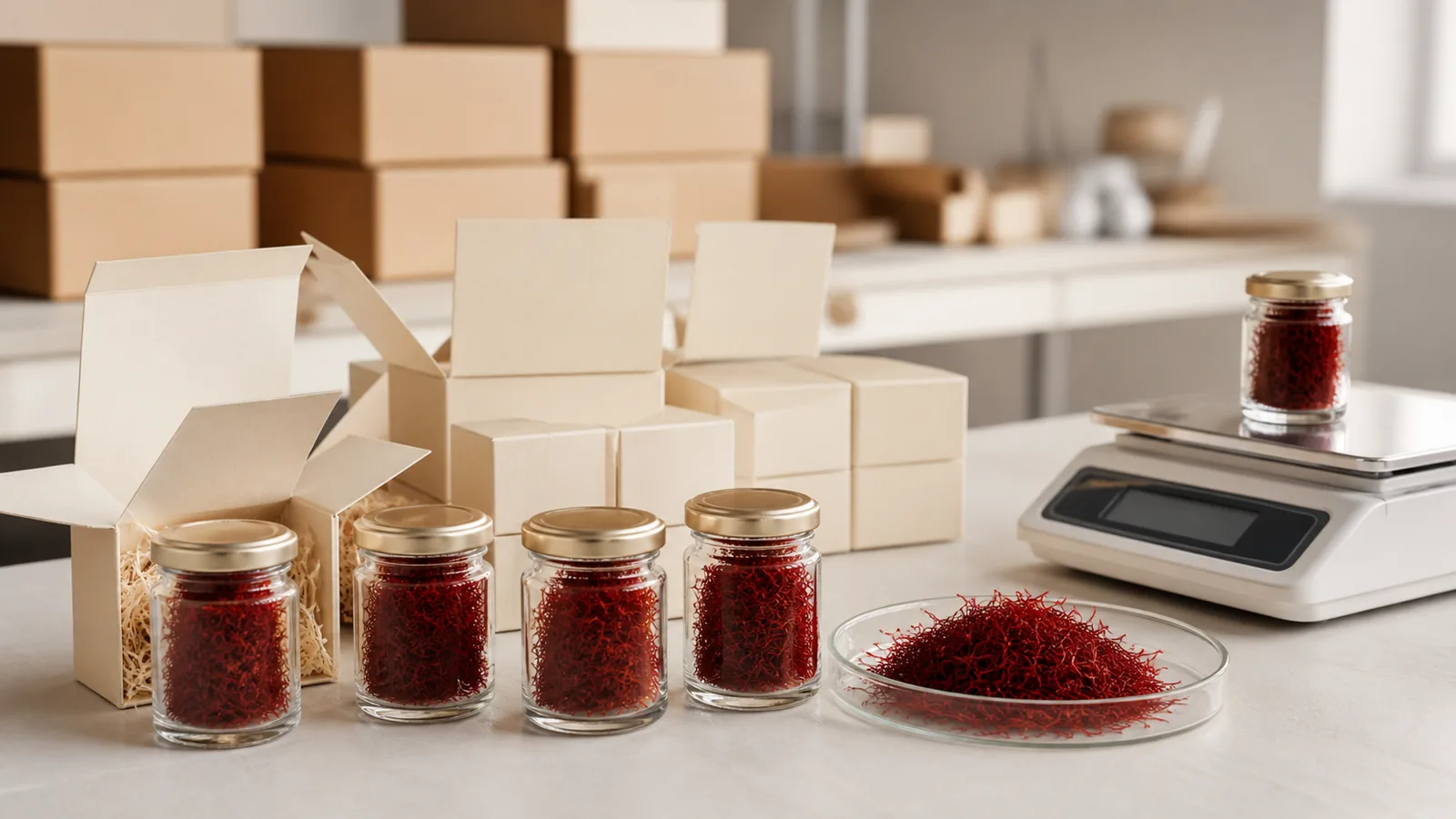
Saffron of Iran and saffron sold outside Iran
Iran is the source of more than 90% of the world’s saffron, according to the UN Food and Agriculture Organization. That scale gives Iranian growers an unusual position in the international market, but production leadership does not automatically mean that every overseas customer sees Iran clearly on the final pack.
Saffron can cross borders at several stages. Some lots leave Iran in finished consumer packaging. Others are exported in larger containers for a distributor, retailer or manufacturer to portion in the destination market. The second route is normal in international food trade, provided that labelling and origin statements are accurate.
What trade data can—and cannot—tell us
The original article named the UAE and Spain as buyers of Iranian saffron and claimed that product was being repackaged under another name. It also contained two incompatible numbers: a heading said “half” of Iranian saffron, while the text said about 3%. Neither percentage was supported by a source, so neither should be treated as established fact.
Trade records do confirm that Spain is an important market. World Bank WITS data drawn from UN Comtrade show that Spain reported importing 39,649 kg of saffron from Iran in 2024. China, Italy, Kuwait, Germany, Qatar and Belgium also reported imports from Iran. These figures establish trade flows; they do not reveal what happened to every shipment after import or prove that its origin was concealed.
The older report also named Turkey, the UAE and Persian Gulf countries as active markets. Because it supplied no dated trade table, that list is best read as a period-specific observation rather than a current ranking.
Readers can inspect the current country and quantity breakdown in the World Bank WITS saffron trade table for Iran. The product is recorded under HS code 091020.
Why packaging still matters
The president of the Iranian Saffron Exporters Association was quoted in the earlier report as calling for hygienic packaging that identifies the product, manufacturer, country of origin, and production and expiry dates. The precise legal fields depend on the destination market and the type of pack, but the underlying point remains sound: a buyer should be able to identify what the product is and trace where it came from.
A useful commercial saffron label commonly includes:
- the product name and whether it contains threads, cut threads or powder;
- net weight;
- country of origin or harvest, where required;
- producer, packer or responsible food-business details;
- lot or batch identification;
- packing or best-before information appropriate to the market;
- storage instructions; and
- a grade or test reference when one is genuinely documented.
For the European Union, origin information becomes mandatory when omitting it could mislead a consumer about the food’s true origin. The European Commission’s origin-labelling guidance also addresses cases where the stated origin of a food differs from that of its primary ingredient.
Packed in Spain is not the same as grown in Spain
A jar can truthfully say that it was packed in Spain while containing saffron harvested in Iran. Those statements describe two different stages. Trouble begins when the overall label or presentation leads a reasonable buyer to believe the growing origin was somewhere else.
For customers comparing saffron from Iran with saffron sold elsewhere, the most useful questions are straightforward: Where was it harvested? Who packed it? Is there a lot number? Is the grade supported by a recognised test? Can the seller trace the lot back through the supply chain?
Authenticity matters more than a national slogan
Origin is important, but it is not a substitute for evidence about the contents of a pack. In 2025, FAO Iran announced a project with Ferdowsi University of Mashhad to improve saffron-authenticity testing. The work is aimed at detecting adulteration and strengthening confidence across the value chain.
The FAO announcement on saffron authenticity testing links that work directly with better opportunities for growers and traders. This is a more useful basis for protecting the reputation of Iranian saffron than an unsupported claim that every foreign-packed product has been mislabelled.
How more export value can stay with Iranian producers
Bulk exports may offer efficient routes to large buyers, so they are not inherently a failure. The economic question is how much processing, quality assurance, branding and customer trust can also be built at origin.
Clean post-harvest handling, reliable testing, traceable batches and packaging designed for the destination market allow exporters to offer more than an anonymous commodity. They can also help a serious buyer distinguish verified Iranian saffron from a package that merely relies on decorative language.
Choosing Iranian saffron as a gift
Saffron suits a gift because a small, well-protected pack is useful and easy to carry. Choose sealed threads rather than an untraceable loose powder, check the origin and lot information, and make sure the container protects the spice from light and moisture. An attractive box is welcome, but it should never replace clear product information.
Iranian saffron and saffron sold around the world are connected by a long supply chain. The clearest way to respect the people at its beginning is to state the origin honestly, preserve the product carefully and give the customer enough information to make an informed choice.

![Exporting Saffron to Turkey + Price Guide [Complete 0 to 100]](https://img.rowhanisaffron.com/20260827003933/saffron-export-turkey-quality-inspection.webp)



