


In water-stressed parts of Kerman, the case for saffron as an alternative to pistachios begins with water and a very different growing cycle. The idea is promising, but it is not a simple one-for-one crop swap.
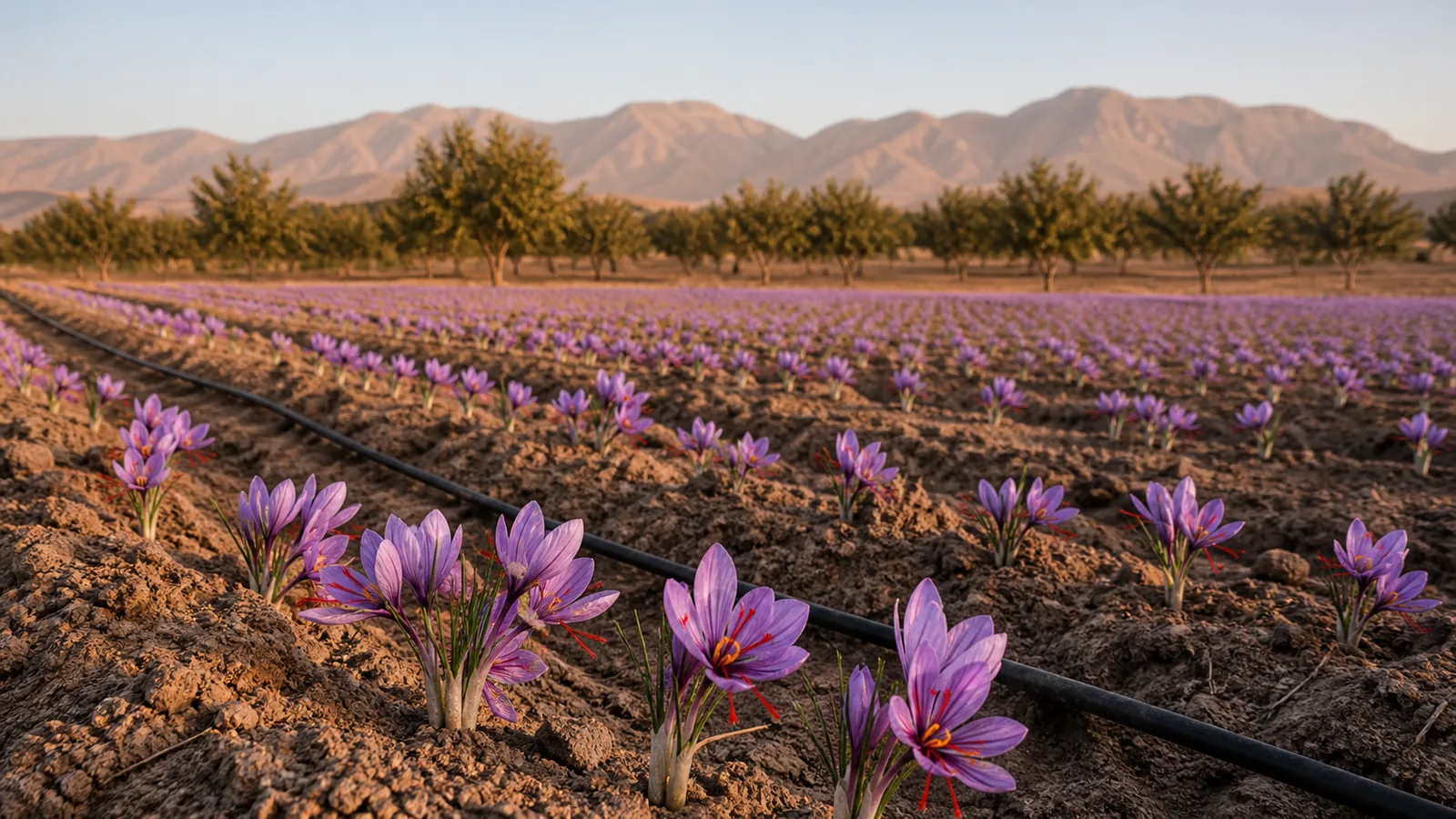
Saffron can suit dry regions, yet it still needs well-timed irrigation, healthy corms, suitable soil and a reliable harvest workforce. A scientific review of saffron water requirements describes the crop as drought-tolerant and water-productive while stressing that satisfactory yields in dry parts of Iran still depend on irrigation. For a Kerman grower, the sensible question is therefore not simply “saffron or pistachios?” It is whether a particular field, water source and business can support saffron better than the orchard or crop it would replace.
Why growers consider saffron as an alternative to pistachios
Pistachio is a long-lived tree crop. Converting an orchard is a major decision involving established trees, sunk costs and years of future production. Saffron is a perennial corm crop with a shorter production cycle, a concentrated autumn harvest and a high value relative to the small weight sold. Those differences can make saffron attractive where groundwater is limited or a damaged orchard is no longer economical.
That does not make pistachios obsolete. In Rafsanjan, pistachio remains central to local livelihoods, and current FAO work with Iranian pistachio growers focuses on improving water management, orchard resilience and product quality. A healthy orchard with workable water may still be the better asset. Saffron is an option to assess, not a universal prescription.
The original provincial account behind this article presented three reasons for expanding saffron in Kerman:
- its irrigation needs occur on a different schedule from those of a mature pistachio orchard;
- planting, flower picking, stigma separation and drying create seasonal work;
- dried saffron is compact, valuable and suitable for trade beyond the province.
Each benefit depends on execution. Poor corms, unsuitable drainage, badly timed watering, labour shortages or weak drying and marketing can turn a promising crop into an expensive disappointment.
What the historical Kerman report recorded
The figures below come from the earlier provincial report preserved in this post. They are historical claims, not current Kerman statistics. The surviving English text does not provide a publication link or a dependable reporting year, and one translated line describes a crop year beginning in October 2013. The numbers are retained for context and search continuity, but they should not be used as a present-day planting budget.
At the provincial level, the report recorded 500 hectares under saffron and a plan to add another 605 hectares. It attributed 2,460 kilograms of harvested saffron, valued at 123 billion rials, to the season being discussed. It also said the proposed expansion would require 3,630 tonnes of saffron corms and 121 thousand million rials in credit, with private-sector coordination considered necessary where local corm supplies were insufficient.
The account divided the reported 500 hectares among ten areas:
- Zarand: 160 hectares
- Kuhbanan: 120 hectares
- Baft: 70 hectares
- Shahr-e Babak: 50 hectares
- Sirjan: 35 hectares
- Kerman: 20 hectares
- Bardsir: 14 hectares
- Rabor: 14 hectares
- Rafsanjan: 12 hectares
- Ravar: 5 hectares
Bam was also named among the parts of Kerman Province considered suitable for saffron, although it did not appear in that 500-hectare breakdown. These place names matter because “Kerman” covers markedly different elevations and local climates; provincial suitability does not prove that every field is suitable.
Why some of the old figures do not line up
The same report quoted a provincial yield of 15.6 kilograms per hectare, while its 2,460-kilogram total across 500 hectares works out to a much lower average. It also described Zarand first as having 160 hectares and later as having 170 hectares. These may refer to different dates, established versus newly planted fields, or statements from different officials. Without the source tables, choosing one number and presenting it as certain would be misleading.
The employment estimates use different units too. One passage says 20 people per hectare in each cultivation period; another gives about 200 person-days per hectare during harvest; the Zarand section forecasts 12,000 people working daily at the seasonal peak. They show why labour was part of the policy case, but they are not interchangeable measures of permanent jobs.
Zarand’s role in the expansion story
Zarand was described as the leading saffron area in Kerman. The report named Dashtkhak, Sarbanan, Jarjafak and Hatkan as producing localities. A district official put the cultivated area at 170 hectares, forecast a harvest of about 800 kilograms and gave a field average of four to five kilograms per hectare. He also said the area had grown by ten hectares during the season discussed.
Those numbers fit a wider point: saffron performance varies sharply from one field and year to another. Corm size and health, planting density, irrigation timing, temperature around flowering, field age, soil conditions and harvest speed all affect the result. A province-wide average cannot replace a trial plot and a farm-specific budget.
The Zarand account also mentioned the cold-climate potential for barberry. That detail is useful because changing a cultivation pattern need not mean choosing one replacement crop for an entire district. A diversified plan may spread climatic, labour and market risk more effectively.
Water is only the first part of the decision
Check the field and water source
Saffron dislikes prolonged waterlogging, so drainage matters as much as the headline amount of water. A grower should test soil texture, salinity and irrigation-water quality, then match irrigation timing to local weather and the age of the saffron field. “Low water use” is not permission to plant without a water plan.
Count corm quality and establishment costs
The old expansion proposal’s 3,630-tonne corm estimate shows how quickly planting-material needs grow at provincial scale. Farmers need healthy, correctly identified corms, clean storage and a realistic planting density. Cheap or diseased material can compromise several seasons, so the budget should include inspection, transport, land preparation and replacement losses rather than the corm price alone.
Plan for a short, labour-intensive harvest
Flowers must be collected and handled promptly. Stigmas then need careful separation and controlled drying. The original report identified high harvesting costs and dependence on many workers as central constraints. Expansion makes sense only when trained labour and hygienic processing capacity can keep pace with the flowers.
Secure drying, packaging and a buyer
Provincial officials described training courses, finance for saffron farms and support for fully mechanized dryers. They also identified packaging, international marketing and smuggling as problems. These are not afterthoughts: colour, aroma, moisture, cleanliness and traceability can be damaged after an otherwise successful harvest. A planting plan should name the drying method, packaging standard and likely sales channel before the corms enter the ground.
Training and realistic farm trials matter
The historical programme said 136 saffron farmers had attended workshops covering cultivation, harvesting, pests and diseases. That kind of local training is more useful than copying a generic schedule from another province. Kerman’s districts differ, and advice should reflect the field’s altitude, frost pattern, soil and water.
For a farmer considering Iranian saffron as an alternative to pistachios, a cautious sequence is stronger than a province-wide promise:
- document the orchard or field’s actual water, yield and cost history;
- test soil and irrigation water and obtain local agronomic advice;
- price verified corms, labour, drying, packaging and finance;
- identify a buyer and the quality requirements before planting;
- begin with a manageable trial area and compare several seasons of results.
A practical conclusion for Kerman growers
Iranian saffron can be a suitable alternative to pistachios on some water-constrained land, especially when an orchard is no longer viable and the farm has the climate, labour and processing support saffron requires. It should not be treated as an automatic replacement for a productive pistachio orchard.
The older Kerman programme captured a genuine search for crops that could support income and employment under water pressure. Its strongest lesson is still useful: changing the cultivation pattern must connect agronomy to the whole business, from water and corms to harvesting, drying, packaging and sale. The final choice belongs at field level, supported by current local measurements rather than historical provincial targets.

![Exporting Saffron to Turkey + Price Guide [Complete 0 to 100]](https://img.rowhanisaffron.com/20260827003933/saffron-export-turkey-quality-inspection.webp)



