


Saffron is expensive because a small finished weight requires careful field work, a short harvest window, hand separation of the stigmas and controlled drying, followed by testing, storage and distribution. The price also changes sharply with grade, crop condition, origin evidence, package size and commercial terms. The figures in this article—6 million to 13 million tomans per kilogram—belong to an Iranian market report from 2019, not the current market.
The expensive saffron price reported in 2019
Ali Hosseini, identified as a member of the National Saffron Council, said the Iranian market had risen by about 1 million tomans per kilogram in one week. He put the minimum at 6 million tomans and the upper end at roughly 12–13 million tomans per kilogram.
Those figures were a market snapshot. The original report did not define the exact date of each quote, saffron grade, crop year, test result or delivery terms. They show the scale and speed of the movement under discussion, but they cannot be reused as a current offer.
Why so little saffron requires so much work
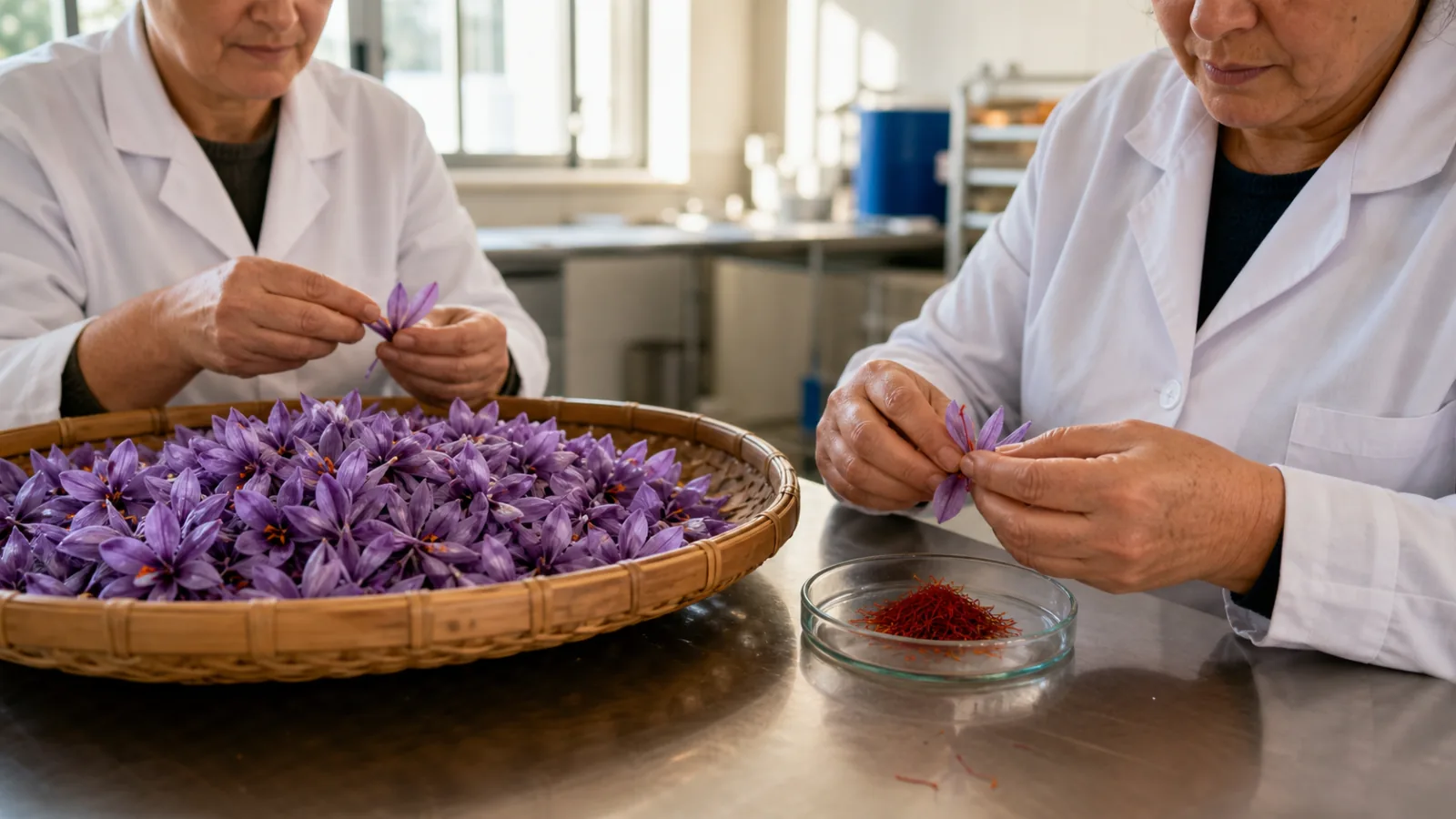
Saffron comes from the red stigmas of Crocus sativus flowers. The flowers are harvested during a concentrated seasonal period, and the delicate stigmas have to be separated promptly. Drying then reduces their weight and helps stabilize the spice. A mistake at either stage can affect colour, aroma, cleanliness and storage life.
The cost chain starts before harvest. Farmers establish and maintain corm beds, manage irrigation and weeds, organize labour when flowers appear and transport the crop for separation. Processors sort, dry, test and protect the threads. Buyers later pay for packaging, compliance, freight and retail distribution. Not every lot carries all of these costs at the same level, which is one reason there is no single expensive saffron price.
Grade and evidence change what “expensive” means
A kilogram of long red stigma sections is not the same product as a kilogram containing more yellow style, broken material, excess moisture or foreign matter. A visual grade can describe the cut, but it cannot prove all quality characteristics.
The current ISO 3632-1:2025 saffron specification applies to dried saffron in filament, cut-filament and powder forms. Buyers still need a lot-specific report and the method used. A higher-priced lot may be reasonable if it offers demonstrably better form, consistency, testing and traceability. A high price without evidence proves nothing.
The “butterfly” price was a mistranslated mesghal
The old English text says Hosseini considered 40,000–45,000 tomans a rational price for each “butterfly” of saffron and that the market exceeded 50,000 tomans. “Butterfly” is not a saffron trading unit. The underlying word was almost certainly mesghal, a traditional Iranian weight unit of roughly 4.6 g.
Read that statement as an attributed 2019 price per mesghal, not a reference to a package shape or grade. It sits broadly within the reported per-kilogram range after unit conversion, but the article does not provide enough precision to reconstruct an exact quote. Rounding, grade and market level can account for part of the difference.
Bulk saffron is not automatically low quality
Hosseini said the private sector did not oppose exchange trading but argued that saffron should not be offered only in raw or bulk form. His concern was value addition: processing, documented quality and suitable packaging can help Iranian businesses retain more of the final value.
Bulk is a format, not a quality verdict. A food manufacturer or professional packer may need a properly tested bulk lot, while a small decorative jar may carry weak or misleading information. The useful distinction is between an identified, protected lot and an undocumented one. Retail packaging adds value when it solves a real buyer need and keeps origin and quality accurate.
Did exchange supply cause the weekly rise?
Hosseini linked the fluctuation to discussion and signals surrounding saffron supply on the commodity exchange. He questioned government-linked supply into a market he described as previously stable and argued that much of the available saffron was already held by intermediaries rather than farmers.
The article provides no daily exchange series, inventory report or counterfactual showing what prices would have done without those trades. His explanation should therefore remain an industry participant’s view, not a proven single cause. Harvest timing, stock release, export orders, currency conditions and expectations can move together.
A transparent exchange can improve price discovery when the lot specification, warehouse stock, fees and completed volumes are visible. It can also amplify attention around a price move. Whether a particular trade helps farmers depends on who owns the saffron and what costs are deducted before payment reaches the grower.
Why export competition limits price increases
Hosseini estimated that 70–80% of Iranian saffron production went to target export markets. The original report did not supply the dataset or reporting year behind that share, so it should not be treated as a current statistic. It does capture the exposure of an export-oriented crop: foreign buyers can reduce orders, change grades or source from another country if the complete offer becomes uncompetitive.
Iran is the world’s largest producer, but it is not the only one. FAO currently estimates Iran at roughly 85–90% of world production, with saffron also grown in Afghanistan, India, Spain, Greece, Morocco and elsewhere. Competition includes price, but also authenticity, consistency, delivery, service and compliance.
For historical scale, the WITS presentation of UN Comtrade data records Iranian saffron exports in 2019 at about $297.2 million and 282,996 kg. Aggregate customs values combine many lots and destinations, so they do not establish a retail or farm-gate price.
Retail, wholesale and farm-gate prices are different
A farmer may sell freshly dried saffron in a local transaction. An exporter may quote a tested bulk lot with freight and documentation. A retailer divides that lot into smaller packs and pays for packaging, inventory, marketing, payment processing and customer service. Comparing the final price per kilogram across those levels without the included services produces a misleading gap.
Small packs often have a higher unit price because the jar, label and handling are spread across fewer grams. That can be sensible for a household that uses a small amount at a time. Commercial buyers should compare equivalent weights and terms, then check whether the quoted form and test basis match.
How to judge whether saffron is worth its price
Start with the intended use and the quantity needed. Then ask the seller for information that makes the offer verifiable:
- declared growing origin and supporting lot records;
- filament, cut-filament or powder form;
- commercial grade and a clear physical description;
- harvest or packing date and storage history;
- a recent lot-specific test report for a significant purchase;
- net saffron weight, excluding the container; and
- delivery, tax and payment terms included in the price.
Our guide to the price of authentic saffron explains how quality and authenticity affect a real quotation. The cheapest offer can be poor value if the lot is old, weak, adulterated or badly documented. The most expensive offer can also be poor value if the premium rests on presentation alone.
The useful lesson in the old headline
Saffron is expensive for structural reasons, but its price is not arbitrary. Labour, yield, grade, crop timing, stock, export demand and the route to the customer all leave a trace in the final number. The 2019 article recorded a one-week rise and a debate over exchange supply, packaging and intermediaries.
Keep those numbers in their year. For a decision today, compare dated offers for the same form, lot evidence, weight and delivery terms. That is the only fair way to decide whether an expensive saffron price is justified.

![Exporting Saffron to Turkey + Price Guide [Complete 0 to 100]](https://img.rowhanisaffron.com/20260827003933/saffron-export-turkey-quality-inspection.webp)



