


In a 2020 agricultural report, Kermanshah officials described saffron as a promising addition to the farmers’ crop basket. Their case rested on expanding cultivation, encouraging small businesses and building a value chain that could move the province beyond raw production.
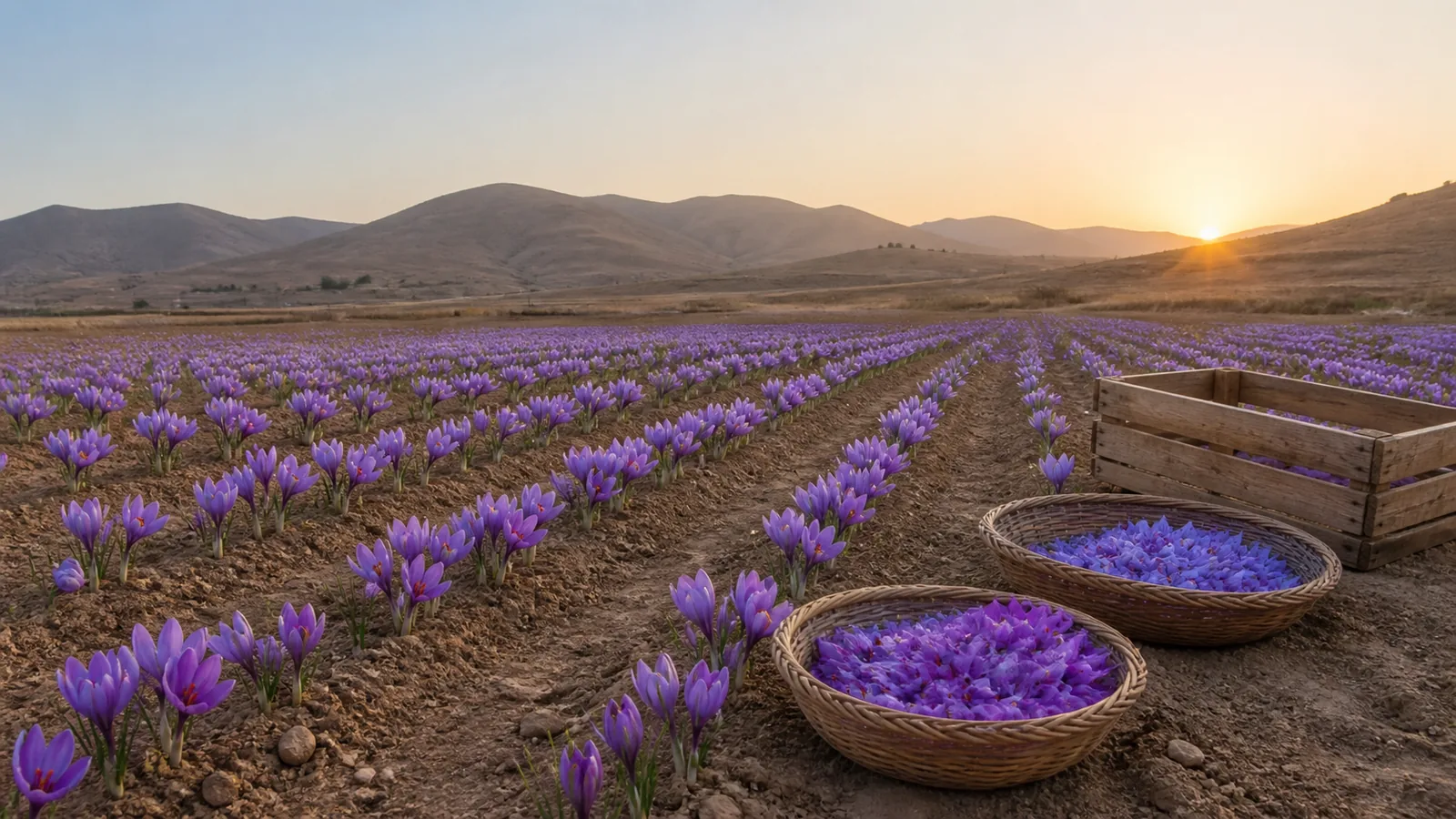
The figures and plans below belong to that report period; they should not be read as current acreage or a present-day production forecast.
304 hectares under saffron cultivation
Zarei, identified in the report as Kermanshah Province’s director of agriculture, said 304 hectares were dedicated to saffron cultivation. A further 120 hectares were planned for addition, which would have taken the total to 424 hectares if fully implemented.
He connected the crop with household employment and said the harvest could create temporary work for about 200 people. The statement did not provide a calculation method or specify whether that number referred to jobs, workers per day or a longer seasonal total, so it is best retained as the official’s estimate rather than treated as a verified employment count.
Yield reported in Sonqor and Koliai
The report singled out growers in Sonqor (also transliterated as Songor) and Koliai (Keliai), saying some had achieved yields of 7.5 kilograms of dried saffron per hectare. That was presented as evidence of local progress, not as a guaranteed yield for every farm.
Actual output depends on corm quality and density, field age, soil, irrigation, weather, harvest timing and processing. A single reported result can show what was achieved in one setting, but farmers need local agronomic advice before using it for financial planning.
Why officials focused on a saffron value chain
Hatami, described as the province’s deputy governor for economic affairs, argued that production alone would not create a durable saffron sector. In his account, the relevant participants needed to cooperate across the value chain and support small enterprises.
For Kermanshah, that chain would include:
- healthy planting material and field support;
- careful flower harvesting and stigma separation;
- controlled drying and hygienic handling;
- quality testing and traceability;
- packaging, branding and market access.
Each stage affects what buyers receive. Expanding hectares without equal attention to drying, storage and sales can increase volume without necessarily increasing the value retained by local growers.
Branding and export ambitions
The report presented Kermanshah as a possible saffron-exporting province and called for a distinct regional brand plus packaging suitable for international markets. Those were ambitions, not proof that a global brand or export programme had already been completed.
Branding would also need evidence behind it: consistent grading, reliable origin records, contaminant controls and packaging that protects saffron from moisture, light and substitution. A name and attractive box cannot compensate for uneven product quality.
Reading the 2020 report today
The lasting point is the officials’ systems view. Cultivation can create an opportunity, but lasting returns depend on the connections between farms, processors, testing, packaging and buyers. Our related report on saffron harvesting from Kermanshah Province farms provides more local harvest context.
Any current assessment should now verify the acreage, employment, yield and export position with newer provincial data. This page preserves what Zarei and Hatami reported in 2020 while keeping their projections clearly tied to that date.

![Exporting Saffron to Turkey + Price Guide [Complete 0 to 100]](https://img.rowhanisaffron.com/20260827003933/saffron-export-turkey-quality-inspection.webp)



