


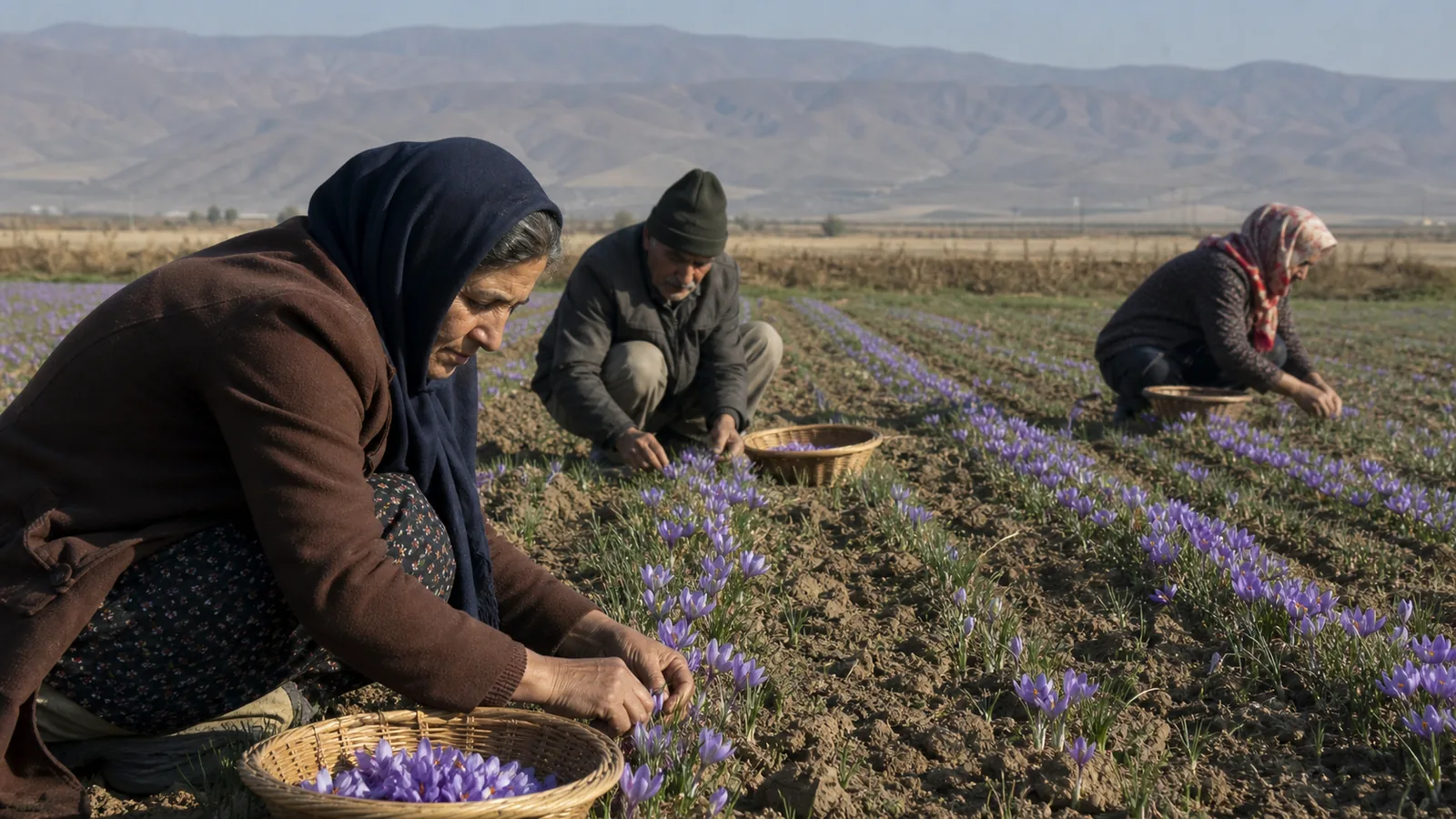
Saffron harvest in Miandoab city in Iran began as a small programme: 15 farmers cultivated four hectares, with an expected 18 kilograms of dried saffron. That forecast equals 4.5 kilograms per hectare. Historical reports from Taybad and neighboring Banab show the same crop at two very different stages—one a major production hub, the other still considering saffron as an alternative after declining rainfall.
The three accounts belong together as a study in scale. They also need careful reading. Harvest forecasts are not final weights, seasonal labor is not permanent employment, old purchase prices are not current prices, and local plant-health announcements should not be treated as a universal treatment plan.
The Miandoab saffron harvest
Ali Dianti, identified as director of Miandoab’s Agricultural Jihad office, said workshops and promotional activity had encouraged 15 farmers to plant saffron on four hectares. The district forecast was 18 kilograms, or an average of 4.5 kilograms per hectare.
The older article translated the area as four “acres,” but its yield calculation uses hectares and the local reporting context also describes hectares. Treating the area as four hectares is the only reading that reconciles 18 kilograms with the stated 4.5 kg/ha average.
Dianti described a local yield curve of 1.5 to two kilograms per hectare in the first year, four to six in the second, and eight to ten in the third. These are historical local expectations, not guaranteed biological milestones. Corm size, field age, density, soil, drainage, weather, nutrition and harvest handling can all change the result.
Taybad: one of Iran’s large saffron hubs
Taybad was operating on a scale far beyond the Miandoab project. Agricultural Jihad director Mohammad Miri reported that the planted area had risen 15% to 6,850 hectares. The district forecast was more than 25 tonnes of dried saffron, and he gave an average yield of 4.4 kilograms per hectare.
Those numbers are not perfectly aligned. Multiplying 6,850 hectares by 4.4 kg/ha gives about 30.14 tonnes, not merely 25 tonnes. “More than 25 tonnes” can include 30 tonnes, but the difference may also reflect immature land or a conservative forecast. The source does not separate productive from newly planted hectares, so no tighter total is invented.
What the employment number means
The translated source says each hectare creates work for more than 100 people “a day” and that roughly 700,000 people are employed daily. Read literally, that would exceed the district’s scale. The arithmetic—about 100 labor days for each of 6,850 hectares—points instead to approximately 685,000 to 700,000 person-days across planting, field care and harvest.
A person-day is one person working for one day. It can describe a large seasonal labor requirement without claiming 700,000 simultaneous workers or permanent jobs.
Taybad’s historical supportive-purchase scheme
Miri said a provincial supportive-purchase programme would begin on November 12 to stabilize the market and give growers an alternative to intermediaries. The article listed four historical price points: 82 million, 90 million, 95 million and 105 million rials per kilogram.
The translated text labels the first two as ordinary and higher-quality “straw” saffron but omits clear category names for the final two. These should not be reconstructed from guesswork. The values are preserved as the report’s four grades, not quoted as current prices and not mapped to modern commercial grades.
Taybad also had two active saffron processing and packaging units, with three further applicants seeking licenses. Processing capacity can shorten the route from flower to dried product, but a license application is not an operating facility and packaging does not itself prove grade.
Fertilizer, corm movement and plant-health warnings
The Taybad report recorded distribution of more than 250 tonnes of subsidized nitrogen, phosphate and potash fertilizers, alongside a recommendation to use organic inputs. A total-distribution figure is not a per-field prescription. Balanced nutrition depends on soil and crop assessment, and more fertilizer does not automatically mean more saffron.
Officials also warned about mites on saffron corms and a bacterial disease translated as Burkholderia. The source does not provide a mite species, bacterial species, diagnostic laboratory or incidence rate. Research identifies the bulb mite Rhizoglyphus robini as one saffron pest and documents several fungal and bacterial organisms associated with corm rot, but that does not prove the exact cause in every Taybad field.
The local programme placed biological products involving Trichoderma and mycorrhizal fungi on its management agenda. Research supports some Trichoderma strains as possible corm-rot biocontrol agents, yet efficacy is organism-, formulation- and site-specific. Growers should use diagnosed, locally registered measures under the regional plant-protection service rather than copy a product name from a historical news article.
The lowest-risk advice in the announcement remains useful: use healthy corms, control their movement, avoid excessive irrigation, choose suitable planting depth and density, balance nutrients and follow local surveillance notices. Its blanket wording about avoiding chemical pesticides is retained only as Taybad policy for that programme, not universal pest-control advice.
Neighboring Banab considered saffron
At a water and agriculture workshop, Banab official Ja’far Sadeghi reported annual rainfall of 206 millimetres, 23% below the comparable prior period. The translated source incorrectly says millilitres, a volume unit; rainfall is measured in millimetres.
The workshop also discussed frost-damaged gardens and weak crop-insurance uptake. Its detailed insured-grain figures contradict one another—describing both a fall from 1,300 to 530 hectares and an increase from 530 to 1,453—so those values cannot support a clean trend and are not repeated as fact.
Edible-onion cultivation reportedly declined by 300 hectares, from 1,700 to 1,400, a reduction of about 17.6%. Against that background, the office promoted saffron and pistachio as possible lower-water alternatives. Saffron had begun on roughly one hectare, with plans to expand if the trial justified it.
Banab’s constraints were broader than crop choice. Officials cited limited conversion from traditional irrigation, gaps between training and implementation, and poorly maintained or narrowing roads between fields. A new crop cannot solve those infrastructure and coordination problems on its own.
What the three reports show together
- Miandoab: a four-hectare project with 15 farmers and an 18 kg forecast.
- Taybad: 6,850 hectares, more than 25 tonnes forecast, major seasonal labor and an organized purchase/processing system.
- Banab: about one hectare at the proposal stage, responding to rainfall decline and pressure on existing crops.
Miandoab’s value is its small, readable baseline. Taybad shows the market, labor and plant-health systems required when cultivation reaches thousands of hectares. Banab shows why an alternative-crop proposal should begin with a measured pilot rather than a promise.
What a follow-up should verify
For each district, a complete report would separate productive and young land, record final dry weight, verify the number of distinct workers and person-days, name purchase-grade specifications, document operating processing capacity, report disease diagnoses, and measure net grower income after labor, corm, irrigation and input costs.
Until then, the Miandoab page preserves the useful historical record without flattening the three places into one claim. Saffron was a small harvest in Miandoab, an established value chain in Taybad and a proposed adaptation in Banab.

![Exporting Saffron to Turkey + Price Guide [Complete 0 to 100]](https://img.rowhanisaffron.com/20260827003933/saffron-export-turkey-quality-inspection.webp)



