


Saffron harvest in Gonabad city decreased by 30% in the crop year described by this historical report. Alireza Hosseinzadeh, then director of Gonabad Agricultural Jihad, said output fell from 12 tonnes in the previous season to 10 tonnes.
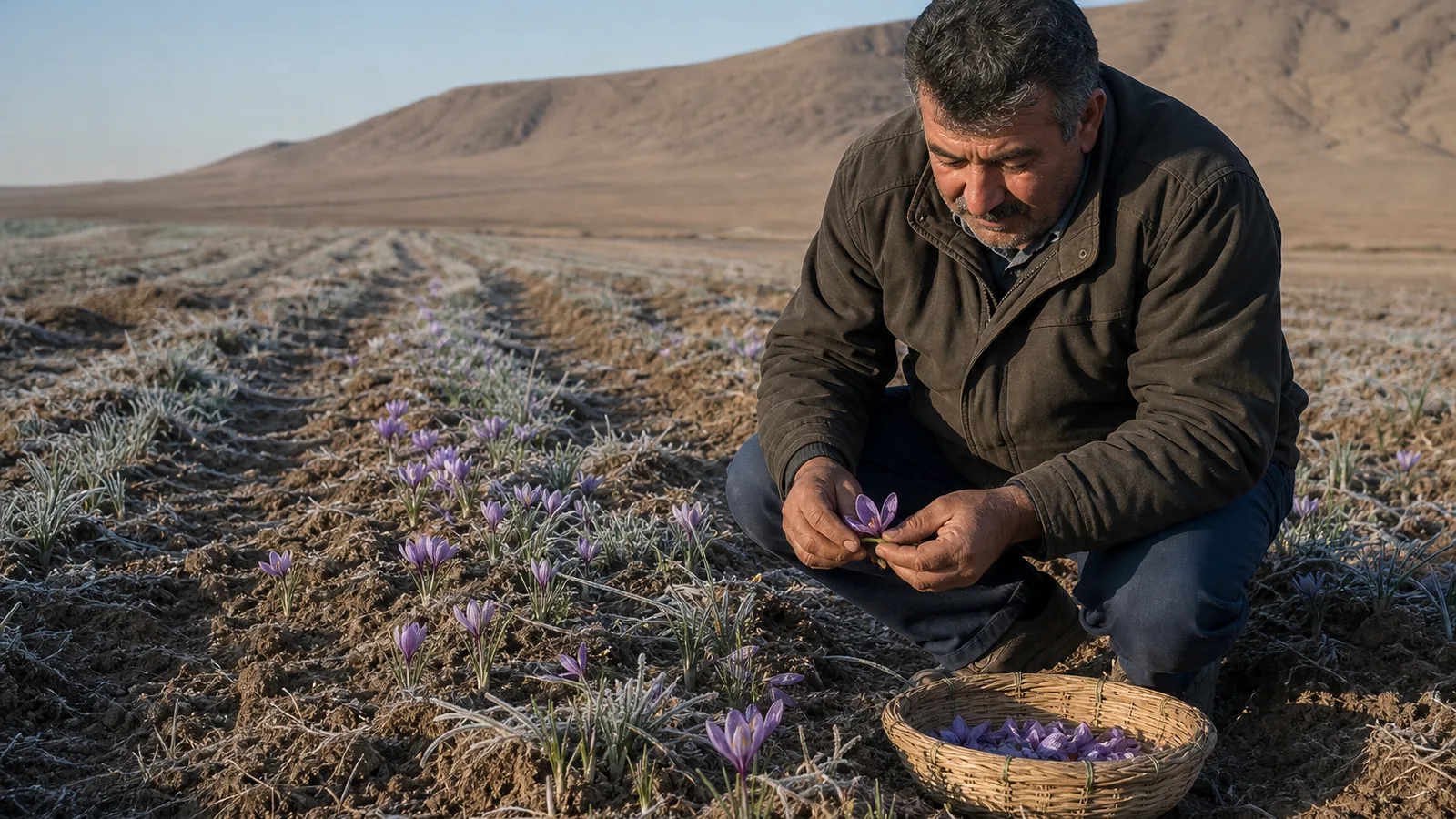
What Gonabad’s 30-percent decline meant
Hosseinzadeh attributed the weaker saffron harvest to several pressures arriving in the same season. He listed temperature fluctuations during planting and harvest, cold and frost damage in late November while flowers were being picked, and pests and diseases affecting the crop.
The account also quoted crop damage of 25 percent and a harvest reduction of 30 percent. Those percentages may describe different measurements, but the source did not define their denominators. They should remain separate rather than being treated as interchangeable.
The tonnage does not equal a 30-percent fall
A decline from 12 tonnes to 10 tonnes is a loss of two tonnes. Calculated against the earlier 12-tonne harvest, that is about 16.7 percent, not 30 percent. The arithmetic does not prove that the official’s 30-percent estimate was wrong; it shows that the published figures do not fully reconcile.
The percentage may have referred to expected output, particular fields, fresh flower volume or another baseline that was not included in the report. With no supporting denominator, the responsible reading is to preserve both statements and make the gap visible.
Ten tonnes from 3,500 hectares
The report placed Gonabad’s saffron area at 3,500 hectares and said those fields produced 10 tonnes of dried saffron in the affected season. Dividing the two figures gives roughly 2.86 kilograms per planted hectare. That is a simple calculation from the reported totals, not an independently published yield figure.
Planted area may include young, ageing or otherwise non-bearing plots, so it is not always the same as productive harvest area. Frost can also affect fields unevenly. Without a bearing-area figure, the calculation is useful for context but cannot describe every farm in the county.
Why frost and timing mattered
Saffron flowers have a short picking window. A cold event during flowering can reduce what reaches the basket, while temperature swings earlier in the cycle may affect emergence. Hosseinzadeh also mentioned crop pests and diseases, though the report did not name a species, document field tests or allocate a share of the loss to each cause.
That limitation matters. The article records the local authority’s explanation for one season; it is not a diagnosis for another field or a treatment guide. Growers facing similar symptoms need advice based on current local conditions and direct crop inspection.
Gonabad’s qanat-based saffron heritage
The original report connected Gonabad’s saffron quality with its traditional qanat irrigation system. The FAO listing for Gonabad’s qanat-based saffron farming system confirms that it has been a Globally Important Agricultural Heritage System since 2018.
FAO describes a farming landscape shaped by severe water scarcity, local knowledge and dependable qanat water. That designation recognises the agricultural system and its role in livelihoods, biodiversity and food security. It is not a certification that every batch from Gonabad has the same grade, nor does it remove the climate and market risks described in this harvest report.
Historic support prices for Poushal and Negin
The report said the Ministry of Agriculture and the Rural Cooperative Organization were operating a support-purchase programme at the Gonabad buying centre. Two historic rates were quoted: 110 million rials per kilogram for high-quality Poushal saffron and 130 million rials per kilogram for high-quality Negin.
These were programme prices for that season, not current retail, wholesale or export values. The old translation described the grades as “straw” and “gem”; Poushal and Negin are the relevant saffron trade names. Keeping the grades and the date context prevents an obsolete support price from being mistaken for today’s market.
Costs rose while the reported price did not
Hosseinzadeh said growers faced higher labour, fertiliser and machinery costs while the season’s saffron price had not changed from the previous year. A smaller crop under those conditions could squeeze farm income from both sides: less product to sell and more expense attached to each stage of cultivation and harvest.
The account did not publish invoices, a cost-per-hectare calculation or a farm-income survey. It is therefore best read as the director’s description of pressure on growers, not as a quantified profitability study.
Saffron within Gonabad’s wider agriculture
In earlier years, the report said, Gonabad produced about 19,300 tonnes of horticultural products annually, including 12 tonnes of saffron. For the affected crop year, it put dried saffron at 10 tonnes.
The same account described 34,000 agricultural producers, 20,000 hectares of irrigated land, 1,700 hectares of rain-fed land and 500,000 head of livestock. It gave total annual agricultural, horticultural and livestock production as 87,000 tonnes. These numbers cover different categories: the 19,300-tonne figure concerns horticulture, while 87,000 tonnes combines a broader range of farm output.
Reading the Gonabad harvest record carefully
The report’s main message is that Gonabad endured a difficult saffron season. Officials described output falling from 12 tonnes to 10, pointed to frost, temperature variation, pests and diseases, and said growers were dealing with rising costs and flat prices.
Its headline 30-percent decline, separate 25-percent damage estimate and tonnage arithmetic do not share a documented baseline. Preserving all three without forcing them into agreement gives a more accurate account of what was reported—and of what remains unknown.

![Exporting Saffron to Turkey + Price Guide [Complete 0 to 100]](https://img.rowhanisaffron.com/20260827003933/saffron-export-turkey-quality-inspection.webp)



