


North Khorasan was reported to have produced 20 tonnes of dried saffron from roughly 4,200 hectares in the season covered by this article. The same account valued the crop at 2.2 trillion rials and described output as 10 percent higher than the previous year.
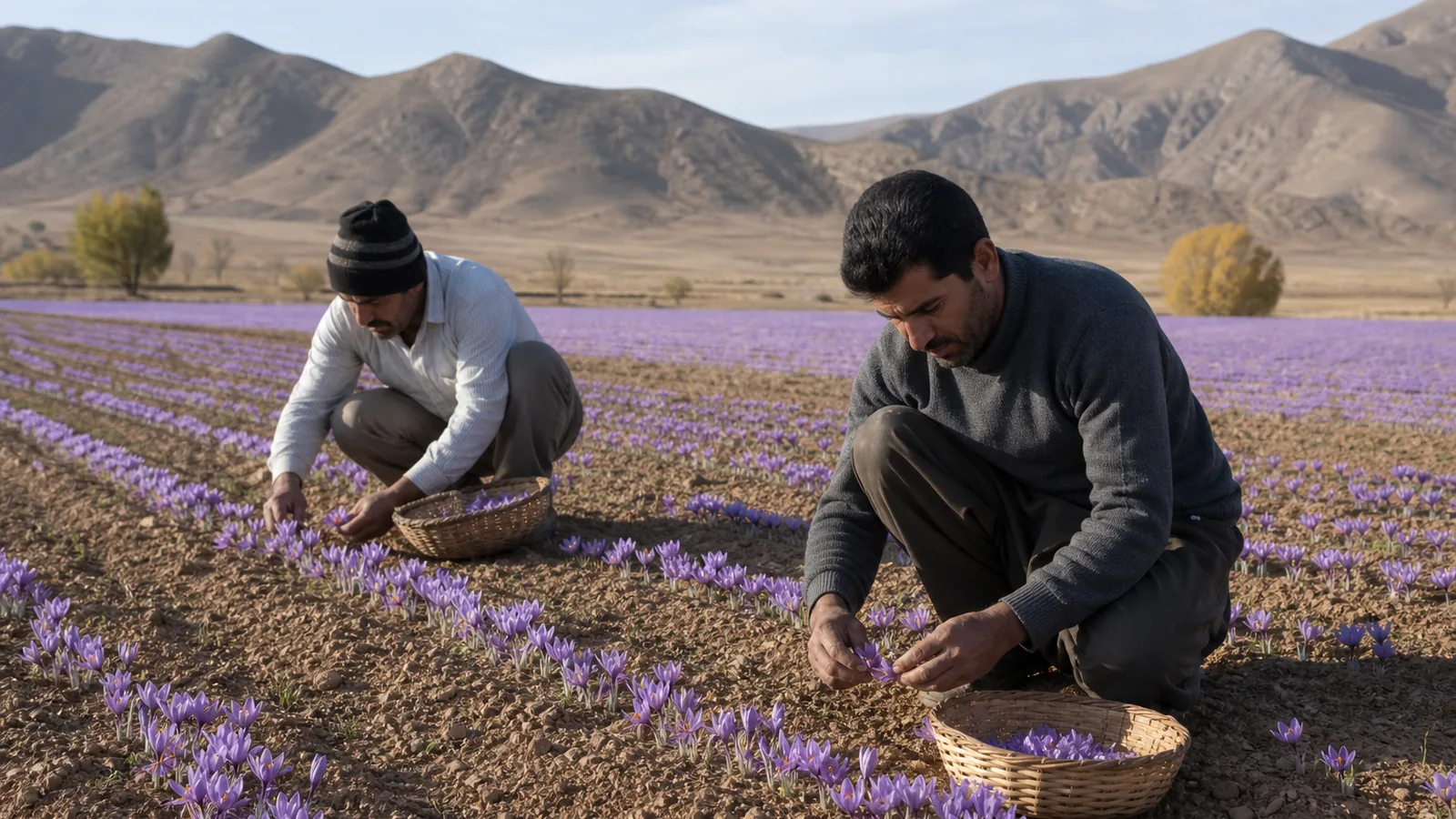
What the 20-tonne harvest figure records
Mohammad Ali Sharikian, then director of horticultural affairs at the North Khorasan Agricultural Jihad Organization, was cited as the source of the provincial figures. They belong to a particular harvest period and should not be read as a current production forecast or a standing annual average.
The account paired three headline numbers: 20 tonnes of saffron, about 4,200 hectares under cultivation and an estimated value of 2.2 trillion rials. It also said production had increased by 10 percent year on year. Those figures capture the scale of the season, but they do not all use a clearly stated denominator.
North Khorasan’s place in Iranian saffron production
Sharikian said North Khorasan ranked third among Iran’s provinces for saffron area and production, behind Razavi Khorasan and South Khorasan. He also described it as the leading province for productivity at the time.
A contemporaneous IANA report on the North Khorasan harvest supports the ranking and 10-percent-growth statements. That report referred to 4,300 hectares and a forecast of 21 tonnes rather than the completed 20-tonne figure in this article. The difference matters: forecasts, planted area and final dried output can change as a season progresses.
Farooj was the provincial centre
Farooj was identified as North Khorasan’s main saffron-producing county. Other official reporting from the same period put Farooj at 2,453 hectares and about 14 tonnes a year, making it the largest contributor within the province. Shirvan and Esfarayen followed it in area and production.
This concentration helps explain why provincial averages can hide substantial local variation. Field age, corm condition, soil, irrigation timing, weather and harvest labour can all affect the amount of dried saffron obtained from one hectare. A provincial figure is useful for scale; it is not a promise of what an individual farm will yield.
The yield figures use different bases
The original account quoted an average yield of 6.2 kilograms per hectare for North Khorasan and compared it with a national average of 4 kilograms. Simple division, however, gives a different result: 20,000 kilograms divided by 4,200 hectares is about 4.76 kilograms per hectare.
A separate IANA account of the province’s saffron sector quoted 20 tonnes from 4,200 hectares, a provincial yield of 6.4 kilograms per hectare and a national figure of 3.8. It did not explain the arithmetic mismatch either.
The most likely issue is that total planted area and productive bearing area were not the same, but the source does not provide the missing figure. The responsible reading is therefore to keep the reported yield separate from the calculation instead of forcing them to agree.
Why saffron suited the province’s farm calendar
Sharikian described saffron as an economically valuable crop suited to arid and semi-arid areas. He also noted that its important irrigation periods do not exactly coincide with peak demand from many summer crops. That timing can ease seasonal competition for water, although it does not make saffron a water-free crop.
Successful fields still depend on local soil and drainage, sound corms, timely irrigation, weed and disease management, and enough labour to pick flowers and separate stigmas quickly. The historic provincial statement explains why growers were interested in the crop; it should not be treated as a universal cultivation prescription.
Processing capacity was part of the story
The second IANA report said six processing and packaging units were active in North Khorasan, with combined annual capacity for 4.4 tonnes of dried saffron. It estimated that this required about 140.7 tonnes of fresh flowers. Farooj’s concentration of fields placed it close to much of that raw material.
Processing and packaging influence how much value remains in a producing region. They can also improve handling consistency, but capacity figures alone do not show how much saffron was actually processed locally, what grades were produced or where the finished product was sold.
Reading the North Khorasan record accurately
The core point remains clear: North Khorasan had become one of Iran’s major saffron-growing provinces, and the season described here was reported at 20 tonnes with year-on-year growth. Farooj led provincial production, while officials linked the crop’s expansion to climate fit, its irrigation calendar and its economic return.
The surrounding numbers need their labels. The 20-tonne output, 4,200-hectare area, 6.2-kilogram yield and 2.2-trillion-rial value came from a historical report and were not fully reconciled in the source. Keeping that distinction makes the record more useful without turning an old seasonal account into a current claim.

![Exporting Saffron to Turkey + Price Guide [Complete 0 to 100]](https://img.rowhanisaffron.com/20260827003933/saffron-export-turkey-quality-inspection.webp)



