


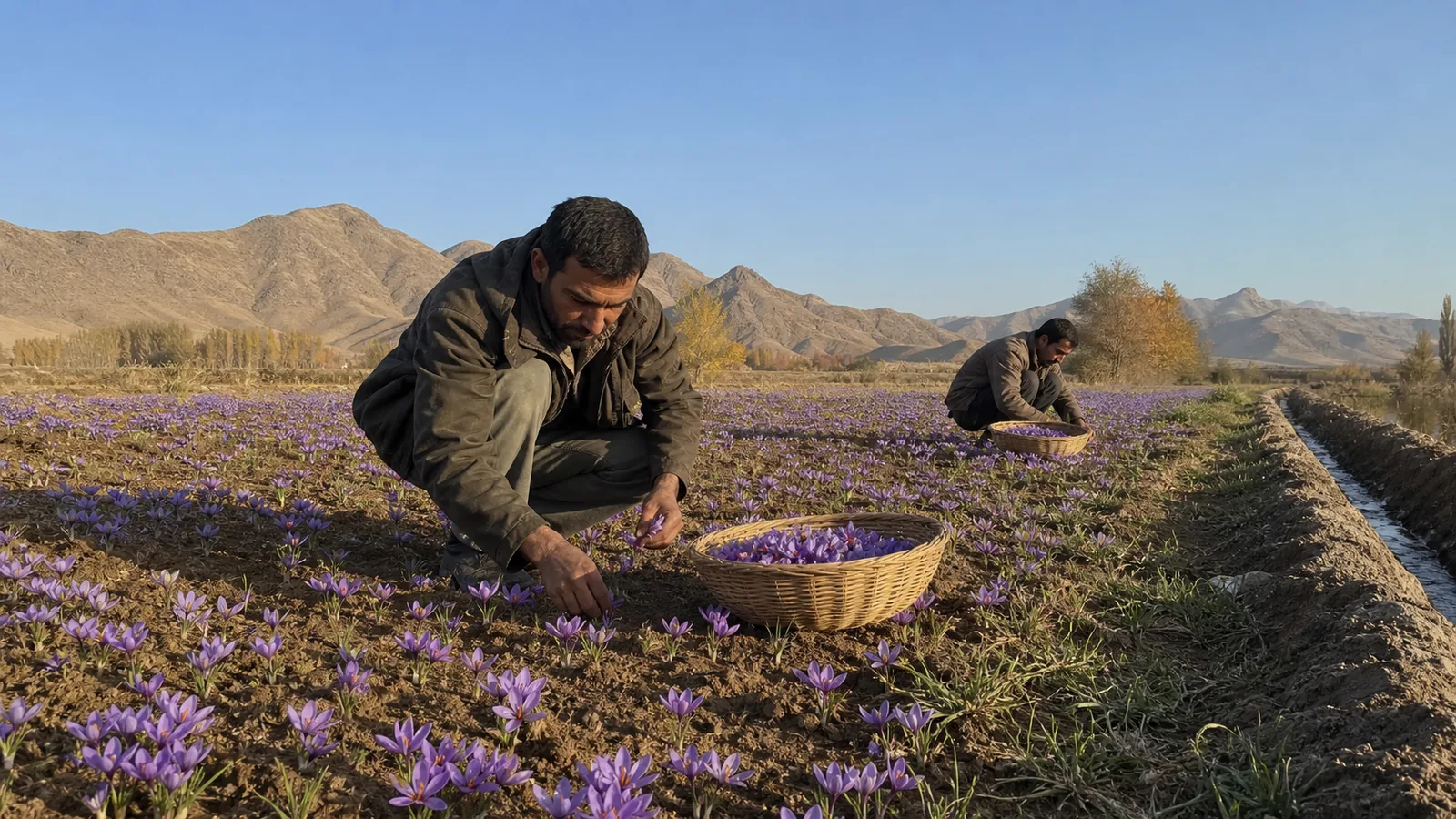
Bafgh reported a 16% increase in saffron harvest after producing 280 kilograms of dried saffron. The season’s account also recorded 92 hectares under the crop, 70 hectares at the bearing stage and more than 700 growers involved in planting and harvest across the county.
What increased by 16 percent
Ali Akbar Rahmatian, director of the Bafgh Agriculture Department, announced the increase after the saffron harvest had ended. He said the county’s farms produced 280 kilograms of dried saffron, about 16 percent more than the previous year.
If both figures were calculated on the same basis, a 16 percent rise would put the preceding harvest at roughly 241 kilograms. That is derived arithmetic, not a separately published total. The original account did not provide the exact previous-year weight or explain whether the percentage had been rounded.
The distinction between forecast and result is important here. Unlike many harvest announcements made before flowers are collected, this one described the season as complete and presented 280 kilograms as harvested output.
Seventy of 92 hectares were bearing
Rahmatian placed Bafgh’s total saffron area at 92 hectares. Of that, 70 hectares had reached the bearing stage; the other 22 hectares were planted with saffron corms and were expected to become productive over the following one or two years.
That age split helps explain why total planted area and productive area should not be treated as the same denominator. New fields can occupy land before they contribute a mature harvest.
The report said saffron stands may remain in the ground for seven to ten years and begin producing from their second or third year, depending partly on planting material. Those ranges describe the local account, not a guarantee for every field. Corm condition, planting density, soil, water and weather can all change establishment and flowering.
The yield figures need two denominators
The same report quoted an average yield of 2.6 kilograms per hectare. Yet 280 kilograms divided by all 92 planted hectares equals about 3.04 kilograms per hectare. Divided by the 70 bearing hectares, it equals 4 kilograms.
Neither calculation reproduces 2.6 kilograms. The source may have used a different productive-area figure, averaged several years, or rounded data from another reporting set. It did not say which.
The figures should therefore stay together with an explicit caveat: Bafgh reported 280 kilograms, 92 total hectares, 70 bearing hectares and a separate 2.6-kilogram yield. Quietly changing one number to make the arithmetic fit would erase part of the historical record.
Training and field management were credited
Rahmatian attributed the increase to farmer training, distribution of selected corms, repeated farm visits by agricultural specialists and better timing of field work. The translated report referred to winter irrigation, timely weed control in spring and summer, and appropriate fertilisation.
These are categories of management, not a field recipe. No irrigation volume, fertiliser product, dose, soil analysis or treatment threshold was published. Applying inputs simply because an old news report mentioned them would be unsafe and may not suit another field.
The reasonable takeaway is that the local programme linked higher output with closer extension support and timely work. Specific decisions still require current field conditions and qualified local advice.
Saffron and water use in Bafgh
The announcement promoted saffron as a relatively low-water crop and described cultivation in parts of Bafgh as having a history of about 35 years. It also said the crop was irrigated in winter. That sentence should not be read as proof that every field needs only one irrigation or that timing is identical across sites and seasons.
Bafgh’s wider agricultural area was reported at 6,290 hectares, supplied by 117 deep and semi-deep wells and 120 qanats. An official report on irrigation in Bafgh repeats the 6,290-hectare total and says about 30 percent was covered by modern irrigation at that time.
That broader context explains why water efficiency mattered locally. It does not establish a universal saffron schedule, and the later irrigation article’s savings claims should not be applied to a field without knowing the original system and measurement method.
Sabzdasht and Bafgh’s colder villages
The colder villages of Sabzdasht district were identified as Bafgh’s principal saffron-growing area. Harvest was said to have run from the beginning to the end of November.
Rahmatian linked the expansion of saffron and its relatively early returns with families coming back to villages they had previously left. That is a significant social claim, but the report did not provide a household count or migration study. It should remain attributed to the local director rather than presented as a measured population trend.
More than 700 farmers were described as active in saffron planting and harvesting. As with other participation figures, this does not necessarily mean 700 full-time jobs. It may include farm owners, family labour and seasonal workers across different stages.
Markets, research and the next fields
The report said Bafgh saffron was sold in domestic markets and sometimes sent to neighbouring countries. It did not name the destinations, quantities, grades or sales channels, so those exports cannot be quantified from this source.
Rahmatian also announced a five-year memorandum of understanding with the country’s saffron research institute. The planned cooperation covered research and training in planting, field care and harvest for the region’s growers. No completion report or measured outcome was included, so the agreement should be described as a programme commitment at that point in time.
Later provincial data show why Bafgh’s historical figures need dates. A official 2023 Yazd harvest report referred to about 4,000 kilograms from 750 hectares of bearing fields across the province. It is a different geographic and seasonal dataset, not a replacement for Bafgh’s 280 kilograms.
Reading the Bafgh increase accurately
The strong part of the record is straightforward: Bafgh finished the season with 280 kilograms of dried saffron, reported a 16 percent increase, had 92 planted hectares with 70 bearing, and counted more than 700 people involved in the crop.
The reported 2.6-kilogram yield does not reconcile with either the total or bearing acreage. The previous year’s output is only an estimate when calculated from 16 percent, and the return-migration, export and research statements lack measured follow-up.
Keeping those limits visible makes the account useful. It records a growing saffron sector in Bafgh, the role assigned to training and field management, and the importance of water and village livelihoods without turning local statements into universal promises.

![Exporting Saffron to Turkey + Price Guide [Complete 0 to 100]](https://img.rowhanisaffron.com/20260827003933/saffron-export-turkey-quality-inspection.webp)



