


“22 kg of saffron is harvested from agricultural lands of Ilam province” was the headline forecast for Iran’s 1400 crop year. Babak Afraz, then horticulture director at the provincial Agricultural Jihad Organization, said harvesting had begun across 20 hectares.
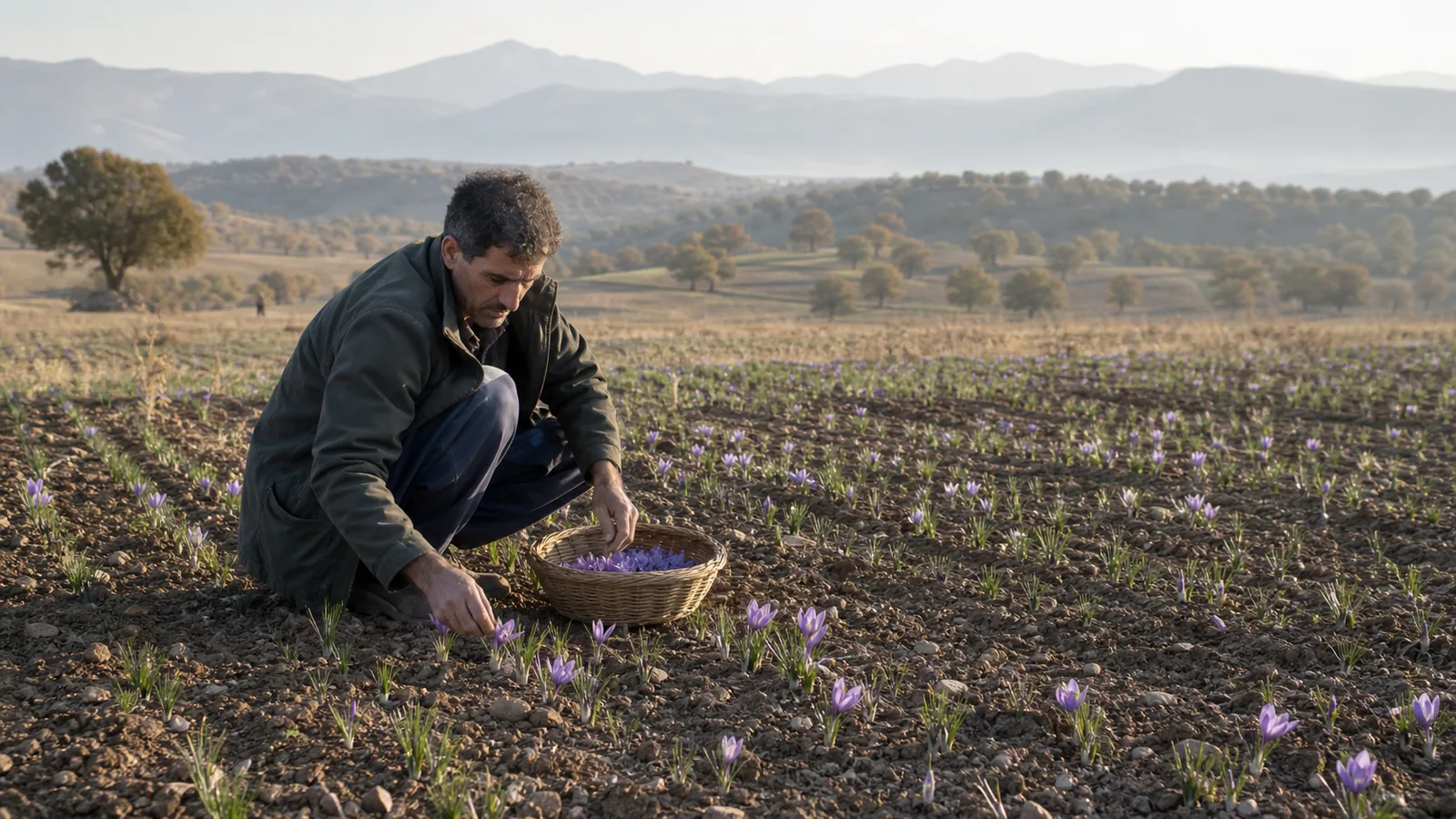
The 22-kilogram figure was a forecast
The original report used both future and present-tense language. Its most precise statement was that officials expected 22 kilograms of dried saffron from Ilam province during crop year 1400, which ran across 2021 and early 2022 in the Gregorian calendar.
It did not publish a final post-harvest total. The 22-kilogram figure should therefore remain labelled as a prediction, not a verified outcome. The harvest was expected to continue until early December, leaving the final result dependent on flowering, picking and drying through the rest of the season.
Twenty hectares were under saffron
Afraz placed the province’s saffron area at 20 hectares. If all 22 kilograms had been obtained from that full area, the implied average would have been 1.1 kilograms per planted hectare.
That calculation is useful for understanding scale, but it is not a published field-performance figure. Ilam’s saffron plantings were still new, and young fields may not have been at the same productive stage. The report did not separate bearing from non-bearing hectares or give a final measured yield.
Chardavol, Sirvan and Badreh led the early plantings
At the time, farmers in Chardavol, Sirvan and Badreh were the province’s named saffron growers. The reference to “saffron onions” in the old translation means saffron corms, the underground planting material from which the crop grows.
An earlier official IANA report on saffron in Badreh described six hectares and a 12-kilogram forecast there. It also said those plots were only in their first or second year. That local record supports the broader picture of a small, developing crop rather than an established large-scale industry.
Suitability was an ambition, not a province-wide soil test
Afraz said Ilam’s agricultural land had potential for saffron corm cultivation and that expansion was on the provincial horticulture agenda. This was a development assessment from the agricultural authority, not evidence that every field in Ilam was suitable.
Saffron performance varies with local soil, drainage, elevation, temperature, water timing, corm health and field age. The report did not provide site surveys, trial results or a county-by-county suitability map, so its expansion language should not be turned into a universal planting recommendation.
A buyer and packer had been approached
The provincial office had corresponded with a purchasing and packaging company in Razavi Khorasan. According to Afraz, the aim was to buy Ilam’s crop at an economically reasonable price and prepare it for the consumer market.
The company was not named, and the report did not publish a signed contract, price, grade specification, purchased quantity or payment schedule. The talks may have reduced market uncertainty, but they did not establish a guaranteed sale for every grower.
Quality and branding were separate questions
Afraz described Ilam saffron as high quality and said selling it was not expected to be a problem. No laboratory results, sensory assessment or grade data were included, so the quality statement remains attributed to him rather than presented as an independently measured conclusion.
Branding had not started because the cultivated area and harvest were still small. Officials hoped that a larger crop could eventually support an Ilam identity and make saffron one of the province’s flagship products. That was a future programme goal, not a brand already operating in the market.
Harvest timing completed the early-season picture
The saffron harvest was expected to run until early December. For a young production area, that calendar involved more than picking flowers: the crop also had to be separated, dried, handled and moved to a buyer while maintaining consistent quality.
The small 22-kilogram forecast explains why outside purchasing and packaging capacity mattered. It offered a route to market before Ilam had enough volume to justify a mature local branding and processing system.
Reading the Ilam saffron report accurately
This article records an early stage in Ilam province’s saffron development. Officials forecast 22 kilograms from 20 hectares, identified Chardavol, Sirvan and Badreh as the active areas, and were exploring a buyer in Razavi Khorasan while planning future expansion.
The numbers are historical and prospective. They do not establish the final 1400 harvest, current acreage, present-day quality or today’s market arrangements. Keeping the forecast label intact preserves what the original report actually said.

![Exporting Saffron to Turkey + Price Guide [Complete 0 to 100]](https://img.rowhanisaffron.com/20260827003933/saffron-export-turkey-quality-inspection.webp)



