


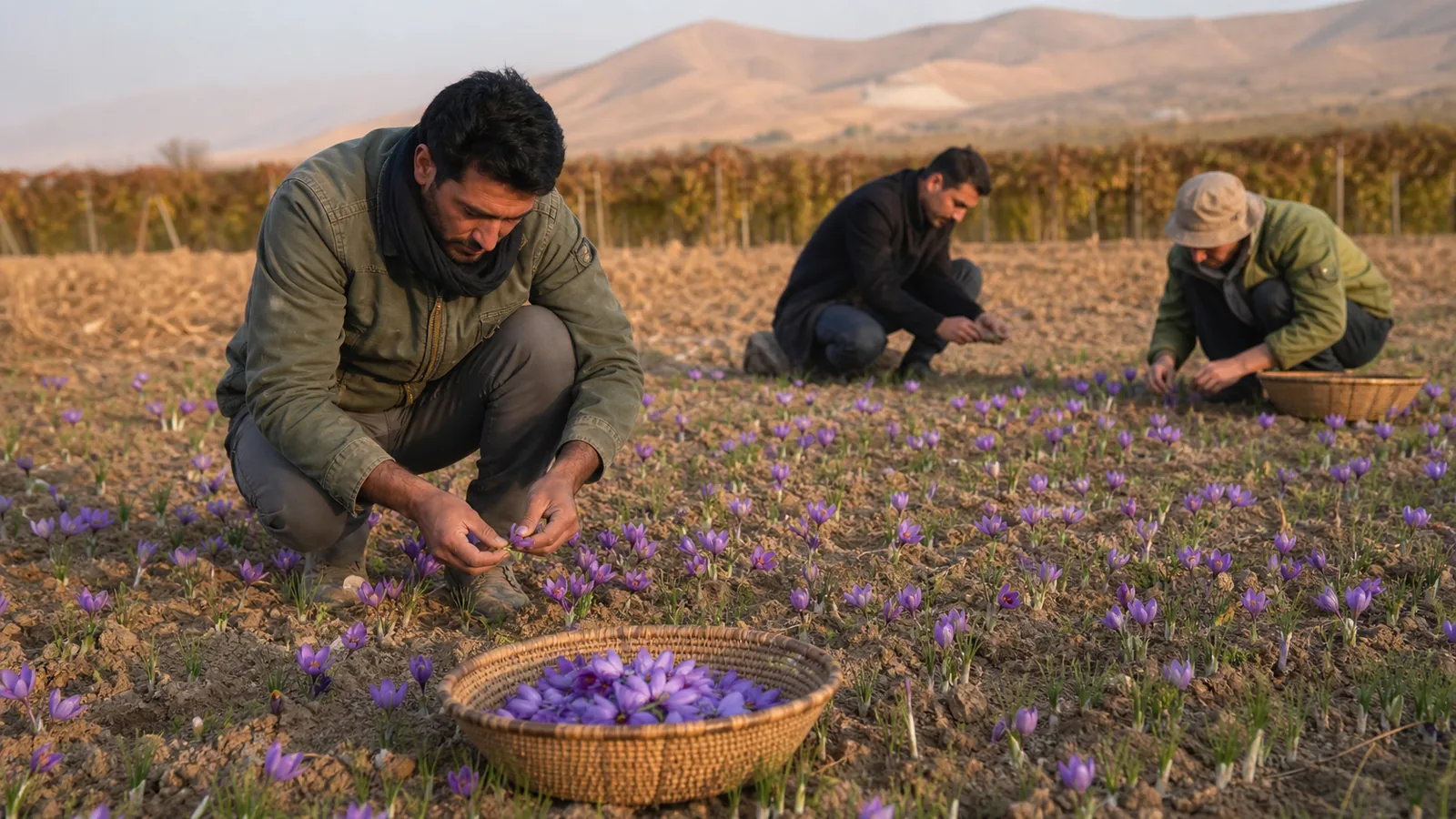
Saffron harvest began across 4,300 hectares in Khalilabad city with a forecast of about 10 tonnes of dried product. The announcement also recorded the unusual conditions of that season: labour was being organised under COVID-19 precautions, prices had weakened and a Rural Cooperative purchase route was offered to growers.
What the 4,300-hectare forecast meant
Mahmoud Shaban, director of Khalilabad Agricultural Jihad in Khorasan Razavi, gave the area and production estimate at the start of harvest. Dividing 10,000 kilograms by 4,300 hectares gives an implied average of about 2.33 kilograms of dried saffron per hectare.
That is planning arithmetic, not a measured result for every farm. Field age, corm condition, weather, irrigation and the speed of flower collection can all change the final output. The announcement did not publish a post-harvest total, so the 10 tonnes should remain labelled as a forecast.
The large area also did not mean that all farms flowered on one day. Saffron is collected over a short seasonal window, with new flowers picked repeatedly. That pattern concentrates demand for workers even when individual holdings are small.
About 220 working days per hectare
Shaban associated one hectare of saffron with roughly 220 working days across planting, crop care and harvest. The largest demand for labour came during flower picking and the immediate work of separating stigmas.
The unit needs care: 220 working days means person-days, not 220 permanent jobs or 220 different workers on each hectare. One person working for several days contributes several person-days. The figure describes how labour-intensive the production cycle was considered, especially at harvest, without turning seasonal work into a full-time employment count.
For Khalilabad’s stated 4,300 hectares, multiplying 220 by the entire area would produce 946,000 person-days across all stages. That is only a rough scale calculation. The source did not say that every hectare had the same age, management or labour input, so it should not be presented as a measured payroll.
The harvest took place under COVID-19 precautions
The announcement belongs to the coronavirus period. Growers were asked to use masks and gloves while picking and separating stigmas, keep about 1.5 metres between workers, and wash or disinfect hands before handling flowers.
Those instructions explain the season in which the report was written. They are not a substitute for current public-health or food-handling guidance. Their practical purpose at the time was to reduce close contact during a process that often brings several people together in fields and separation rooms.
The hygiene point remains broader than the pandemic: hands, surfaces, containers and drying space need to be clean when flowers and stigmas are handled. The specific mask, glove and distancing rules, however, should stay clearly dated rather than being presented as an active local order.
After-harvest irrigation and nutrition
Shaban also reminded growers that work on the field did not finish with the flowers. The older account called for timely irrigation after harvest and mentioned urea, potassium chloride and micronutrients under the direction of Agricultural Jihad specialists.
That wording does not support a standard fertiliser recipe. It gave no dose, soil result, field age or nutrient analysis. Applying a named product simply because it appeared in an old news item could waste money, harm the crop or add unnecessary salts. The safe interpretation is the one already present in the source: any input should follow field-specific expert advice.
Post-harvest care matters because the leaves continue supporting the underground corms after flowering. Irrigation and nutrition decisions therefore belong to the next production cycle as well as the season just harvested.
Why a support-purchase centre was mentioned
The report said lower saffron prices had discouraged growers from establishing new fields that year. It directed those who wished to use the support route to obtain an introduction letter from Khalilabad Agricultural Jihad and deliver their saffron to a Rural Cooperative Organization purchase centre.
A separate official Khorasan Razavi report from that period described ten support-purchase centres across saffron-growing counties and two possible routes: commodity storage with access to a loan, or delivery under a staged-payment arrangement after assessment.
Those details provide useful historical context but are not current terms. A grower cannot assume that the same centre, introduction process, grades, payment schedule or finance remains available now. The old announcement records why the route existed: to give farmers another option during a weak harvest-time market.
Saffron within Khalilabad’s wider farm economy
Khalilabad was described as having about 18,000 hectares of agricultural and horticultural land and producing roughly 238,000 tonnes of livestock, field and orchard products. Grapes, saffron, pomegranates and pistachios were named among its important marketable products.
Saffron was therefore significant but not the county’s only export-oriented crop. A later official report on Khalilabad’s grape harvest recorded 5,770 hectares of vineyards and forecast 200,000 tonnes of grapes, much of it intended for raisin production. That separate figure helps explain the scale of the 238,000-tonne agricultural total without mixing grape tonnage into the saffron forecast.
The combination of vineyards, orchards and saffron also helps explain why market access and seasonal labour mattered locally. Each crop creates its own peak, processing needs and exposure to price changes.
Reading the Khalilabad announcement accurately
The report’s central record is a dated one: harvest starting on 4,300 hectares, a 10-tonne forecast, an estimate of 220 person-days per hectare, pandemic precautions and a support-purchase option during a price decline.
Its production forecast should not be converted into a guaranteed yield. Its labour figure should not be called 220 jobs. Its fertiliser names are not a prescription, and its COVID and purchase-centre instructions are not current rules.
Read within those limits, the announcement still shows why saffron mattered in Khalilabad city. It brought a large area into a short, labour-heavy harvest and connected field work with hygiene, post-harvest care and a route to market.

![Exporting Saffron to Turkey + Price Guide [Complete 0 to 100]](https://img.rowhanisaffron.com/20260827003933/saffron-export-turkey-quality-inspection.webp)



