


A forecast put saffron production in Yazd province at 1,500 kilograms from 420 hectares. The announcement, made at the beginning of harvest by provincial agriculture chief Seyed Jamal Sajjadipour, also identified Bahabad as the largest local growing area and described roughly 4,000 people as involved in production and harvest.
What the 1,500-kilogram forecast covered
Sajjadipour said 420 hectares of Yazd farmland were under saffron and forecast 1,500 kilograms of dried product for the season. In the language of the original report, the crop was “red gold,” a familiar description of saffron’s high value relative to its weight.
The 1,500 kilograms was a prediction at the start of harvest, not a measured final total. Flowering, picking conditions, field age and losses during separation and drying could still influence the amount of saleable saffron. No end-of-season result was included in the account.
Dividing 1,500 kilograms by 420 hectares gives an implied average of about 3.57 kilograms per hectare. That arithmetic helps readers understand the forecast, but it also reveals an inconsistency in the reported numbers.
Why the yield figures do not fully reconcile
The same announcement said Yazd produced 4.5 kilograms of saffron per hectare. Applied to all 420 hectares, that rate would imply 1,890 kilograms, not 1,500.
There are several possible explanations. Some hectares may have been newly planted or not yet productive; the 4.5-kilogram statement may have referred only to bearing fields; or one of the figures may have been rounded or drawn from a different reporting period. The source did not define the acreage base or provide a district breakdown that would settle the difference.
It would therefore be unsafe to “correct” one figure by silently discarding the other. Both belong to the historical report, and the gap between them should remain visible. The province forecast works out to 3.57 kilograms per total stated hectare, while 4.5 kilograms was the separately quoted yield.
Bahabad held the largest share
Bahabad accounted for 265 of the reported 420 hectares. That is just over 63 percent of the province’s stated saffron area, making the county central to the 1,500-kilogram forecast.
The remaining 155 hectares were spread elsewhere in Yazd province, but the original account did not name each county or assign production to them. It did, however, rank Yazd seventh among Iran’s saffron-producing provinces at that point and describe the local crop as relatively high quality.
Those rankings and areas are time-sensitive. They describe the reporting period, not Yazd’s permanent position. A later official Yazd agriculture report described the province as sixth, placed the area at 850 hectares after an intended 104-hectare expansion and forecast output of about 3,000 kilograms. It identified Bahabad, Bafq, Mehriz and Abarkuh as the main growing counties and gave Bahabad’s area as 400 hectares.
That later snapshot cannot be combined with the older 420-hectare dataset as though the figures came from one season. It is useful because it documents subsequent growth and confirms Bahabad’s continuing importance.
What the report said about expansion and water
Sajjadipour connected interest in saffron with the province’s water constraints and referred to an additional 50 hectares. The surviving English sentence is broken, so it is unclear whether 50 hectares had just been added, were planned for that season or represented an annual target.
The safe conclusion is narrower: the organisation expected saffron acreage to expand and presented the crop as relatively low in water demand. That does not mean saffron needs no irrigation, nor does it prove that every piece of Yazd farmland is suitable for it. Soil, salinity, drainage, water quality, temperatures, corm health and access to labour and buyers still matter.
The later 850-hectare report supports the direction of expansion, but it should not be used to assign a precise meaning to the unclear 50-hectare sentence. The original target remains unresolved.
Four thousand people and a demanding harvest
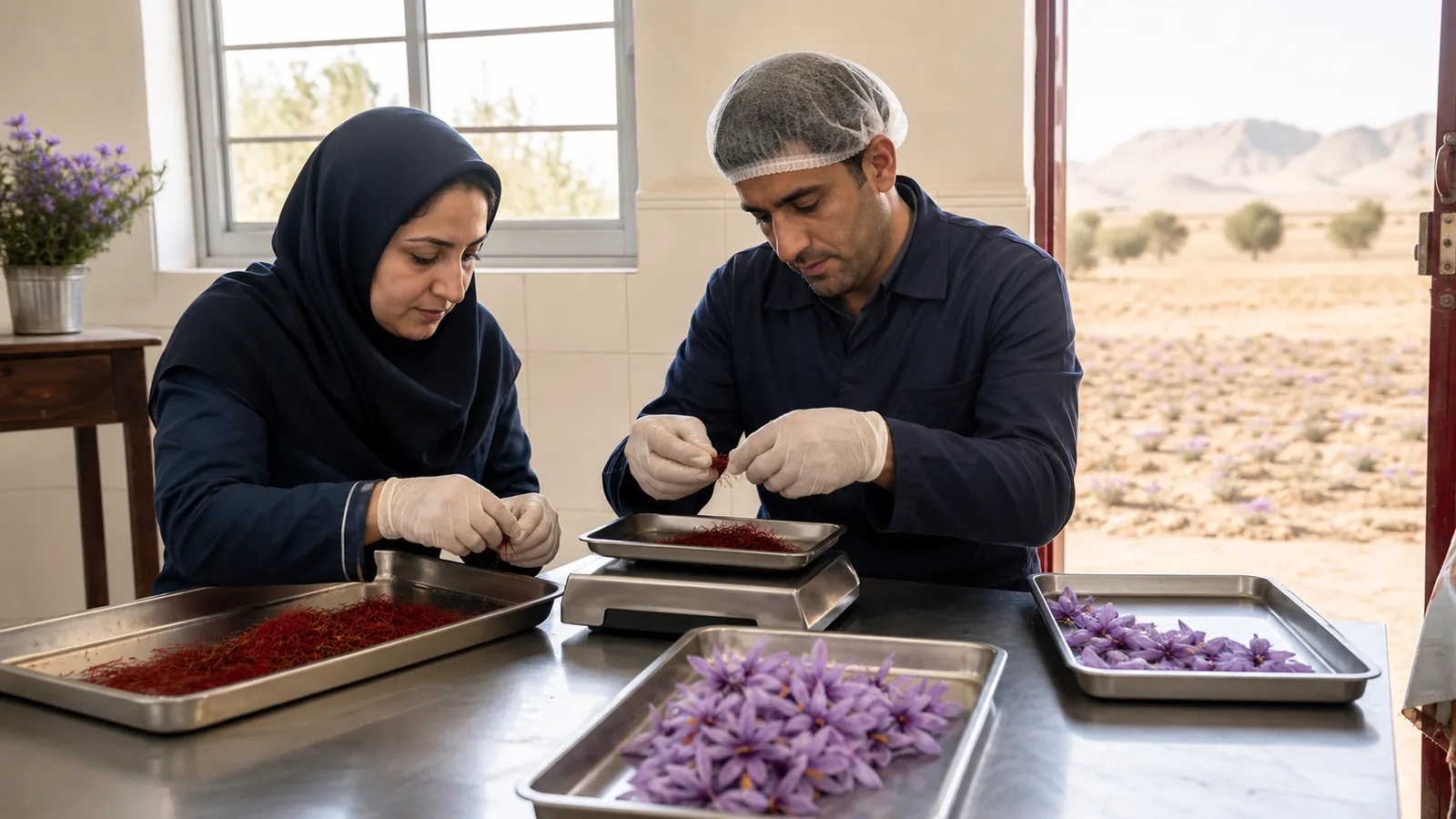
The announcement estimated that about 4,000 people in Yazd province were engaged in saffron production and harvesting. It also described harvest as difficult work.
That description is understandable. Flowers emerge over a concentrated period and need prompt collection. Their stigmas are then separated and dried, creating a burst of careful manual work even though the finished crop weighs very little.
The 4,000 figure should not be converted into 4,000 permanent full-time jobs. The source did not define whether it counted growers, family members, seasonal pickers, processing workers or everyone who took part at any stage. It is best read as a broad participation estimate for the production-and-harvest chain.
Later figures show why dates matter
Yazd’s saffron sector did not remain at the 420-hectare stage. An separate official report from 2023 referred to about 4,000 kilograms from 750 hectares of bearing fields and an average of 5 to 5.5 kilograms per hectare.
That does not prove the earlier forecast was right or wrong. The later report used a bearing-field denominator, came from a different season and reflected whatever acreage and field ages existed then. It does show why a date and a definition belong beside every production statistic.
The 2023 source also offered handling advice for that season. Its recommendations should not be retroactively attached to the older forecast, and unrelated health claims in the later news item are not needed to explain Yazd’s production record.
Reading Yazd’s red-gold forecast accurately
The historical announcement’s core points remain clear: 1,500 kilograms were forecast from 420 hectares; Bahabad held 265 hectares; Yazd was described as the country’s seventh-largest producer at that time; 4.5 kilograms per hectare was quoted separately; and about 4,000 people were said to participate in production and harvest.
The forecast and yield do not produce the same total, the 50-hectare expansion sentence is incomplete, and the employment count is not defined. Keeping those limits in view makes the article more useful, not less. It preserves what the report actually said while preventing a dated production estimate from becoming a false current statistic.

![Exporting Saffron to Turkey + Price Guide [Complete 0 to 100]](https://img.rowhanisaffron.com/20260827003933/saffron-export-turkey-quality-inspection.webp)



