


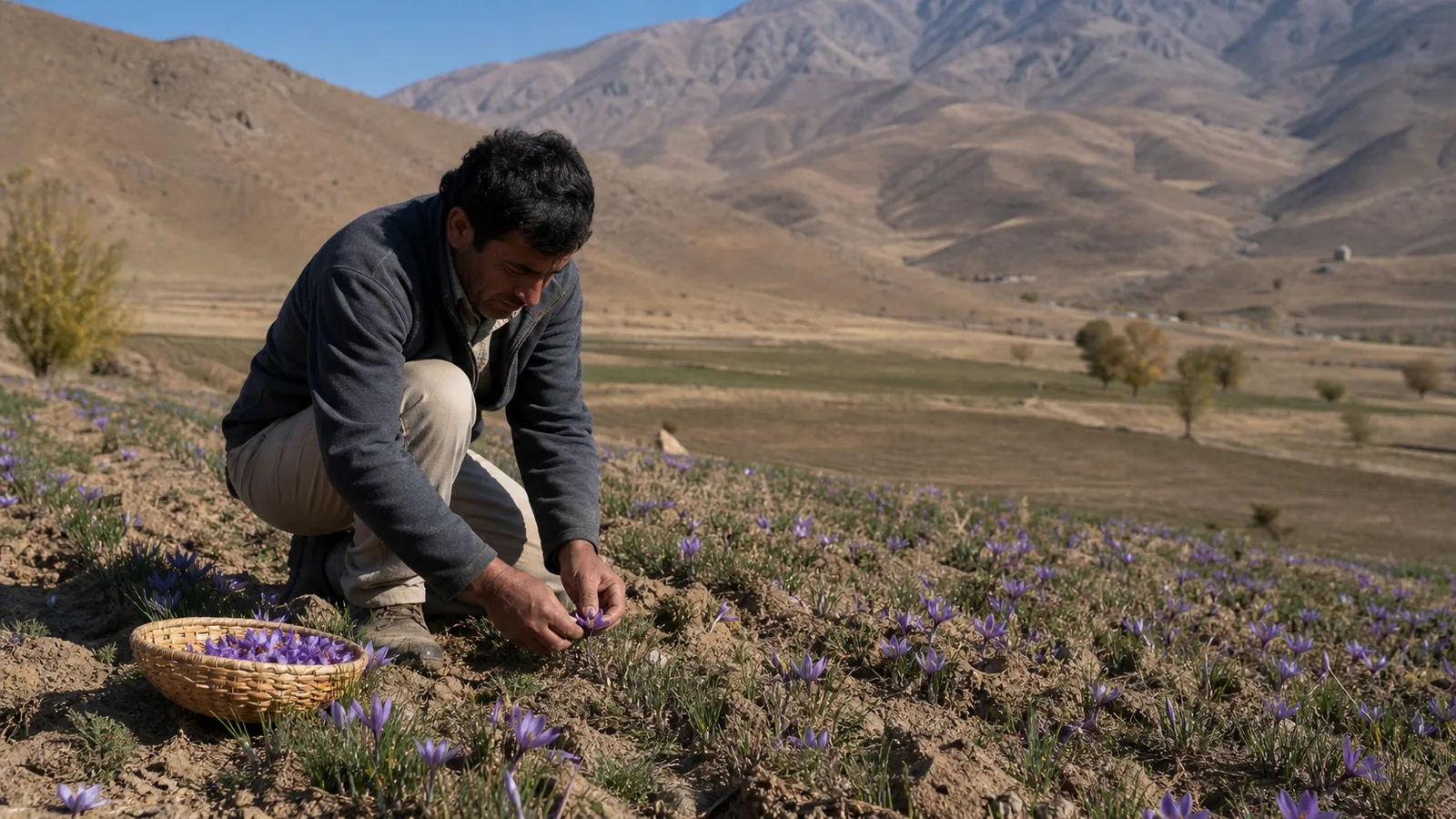
The Tafresh saffron harvest was part of a wider series of small cultivation projects beyond Iran’s best-known saffron districts. Historical agricultural reports from Tafresh in Markazi Province, Hashtrood in East Azerbaijan, Kowsar in Ardabil and Bijar in Kurdistan describe how local growers tested the crop on modest plots, received planting material or finance, and learned what production looked like in cooler, mountainous areas.
These reports are snapshots, not current production statistics. Read together, however, they show the practical questions behind regional saffron development: how much land was planted, what yield was expected, who joined, and whether the economics justified expanding the next season.
Tafresh saffron harvest: eight hectares and a 40 kg forecast
In the Tafresh report, Mansour Karimi of the local Agricultural Jihad office said harvesting had begun across eight hectares. The forecast was about 40 kilograms of dried saffron with a stated value of 1.6 billion rials. That works out to an expected average of five kilograms per hectare and an implied reported value of 40 million rials per kilogram.
Karimi also said more than 70 Tafresh farmers were involved in saffron production. During September and October, the local office had supplied 1,500 kilograms of saffron planting corms. The older article called them “onions,” but saffron’s underground planting units are corms.
The official linked yield improvement to weed control and appropriate crop nutrition. That is a more useful conclusion than treating the 40 kg forecast as a guaranteed result: it was a pre-harvest estimate, and the report did not provide a later measured total.
Why these districts were testing saffron
Each report places saffron within a local attempt to adjust cultivation patterns during water scarcity. The officials described the crop as relatively low in water demand and potentially valuable on small areas. That does not mean saffron needs no water or succeeds in every field. Soil, drainage, corm health, temperature, irrigation timing, labor and post-harvest handling all affect the result.
The scale is also important. These were not claims that Tafresh, Hashtrood, Kowsar or Bijar had replaced Iran’s established production centers. They were early or expanding local projects, often supported by training, corm distribution or credit.
Saffron development in Hashtrood, East Azerbaijan
Hashtrood’s report described two stages of development. In the earlier stage, six hectares reportedly produced 15 kilograms of dried saffron and supported work for 12 people. The stated output is equivalent to 2.5 kilograms per hectare, although the report did not explain whether all six hectares were equally mature.
A later update said cultivation had reached 20 hectares and that 35 growers had enrolled to develop saffron planting and obtain corms. It also recorded 200 million tomans in low-interest bank facilities paid to saffron growers during that year. These are historical figures in the source report; no audited repayment, final harvest or current-area data were supplied.
Hashtrood lies in East Azerbaijan between the Miyaneh and Maragheh areas. The source characterized it as mountainous, with cold winters and mild summers. The agricultural argument was that a crop with autumn growth and a compact cultivated area could form part of a water-conscious local plan. Actual suitability still has to be assessed field by field.
Kowsar’s proposed three-ton corm programme
In Kowsar, local Agricultural Jihad director Khyber Ali Jalili said saffron had been planted in seven plots during the previous season. The report attributed two kilograms of harvested saffron and employment for seven people to that first stage. It did not state the combined area of the plots, so a per-hectare yield cannot be calculated responsibly.
For the following crop year, the office planned to plant three tons of saffron corms in the region. Jalili promoted the crop because of water constraints and its economic potential. He also compared the economic value of one hectare of saffron with roughly 40 hectares of dryland wheat.
That 40-to-one comparison should be read as the official’s local economic claim, not as a universal conversion. Neither commodity prices nor full production costs were included. Saffron is labor-intensive at flowering and stigma separation, and the purchase of healthy corms creates a substantial establishment cost.
Bijar’s first reported cultivation in Dolat Kand
Mohammad Abbasi, identified as Bijar’s Agricultural Jihad director, described what the report called the city’s first saffron cultivation. The consistent area stated in the title and body was 5,000 square metres—half a hectare—in Dolat Kand village. The forecast was about 800 grams of dried saffron, equivalent to 1.6 kilograms per hectare if both estimates refer to the same plot.
The source said planting ran from September 26 to October 25 and that harvesting began on November 2 for about one week. It estimated a corm requirement of about one tonne per hectare and identified the purchase price of corms as the main concern for growers.
Its wording that corms had a “five-year shelf life” is misleading. In context, the statement appears to describe a multi-year field cycle in which planted corms remain and multiply in the soil, not five years of storage on a shelf. The report did not document storage conditions or a universal productive lifespan, so no stronger claim is made here.
The Bijar office also used training to introduce the crop. Three farmers reportedly attended the first promotion class, and further sessions were planned for Hassanabad and Yasukand. Training mattered because first-time cultivation requires more than distributing corms: growers need locally appropriate guidance on planting depth, irrigation, disease, flower picking and drying.
What the four reports show when compared
- Tafresh had the largest stated grower group: more than 70 farmers across eight hectares, with a 40 kg forecast.
- Hashtrood reported expansion from six to 20 hectares, alongside credit and 35 enrolled growers.
- Kowsar described seven initial plots, a two-kilogram harvest and a plan to plant three tons of corms.
- Bijar documented a half-hectare pilot, an 800 g forecast and introductory training.
The numbers are not directly comparable. Some are harvested amounts, others are forecasts, and the reporting years and field maturity differ. A new saffron field may not perform like an established one, while a district-wide total cannot be compared with a single pilot plot without knowing area and age.
Questions that determine whether expansion is sound
Before treating a pilot as a model for wider cultivation, a local programme should record the harvested dry weight rather than only the forecast, the productive area and field age, labor hours, corm and irrigation costs, drying losses, quality test results and the price actually received by growers. It should also distinguish temporary harvest work from permanent employment.
Those measurements would answer what the news reports could not: whether the crop produced a durable margin after costs, whether quality remained consistent, and whether expansion reduced water pressure in practice. Without them, hectare and corm-distribution figures describe activity, not success.
A regional record, not a current production ranking
The Tafresh, Hashtrood, Kowsar and Bijar stories preserve a useful record of saffron being tested outside its traditional heartland. Their value lies in the local detail—eight hectares in Tafresh, the staged Hashtrood expansion, Kowsar’s corm plan and Bijar’s first half-hectare plot.
They do not establish today’s planted area, prove every economic comparison or show that a crop suited to one village will succeed in another. Used carefully, the reports offer a starting point for evaluating regional saffron projects: retain the figures, label forecasts and attributed claims, correct broken units, and look for measured harvest and cost data before drawing conclusions.

![Exporting Saffron to Turkey + Price Guide [Complete 0 to 100]](https://img.rowhanisaffron.com/20260827003933/saffron-export-turkey-quality-inspection.webp)



