


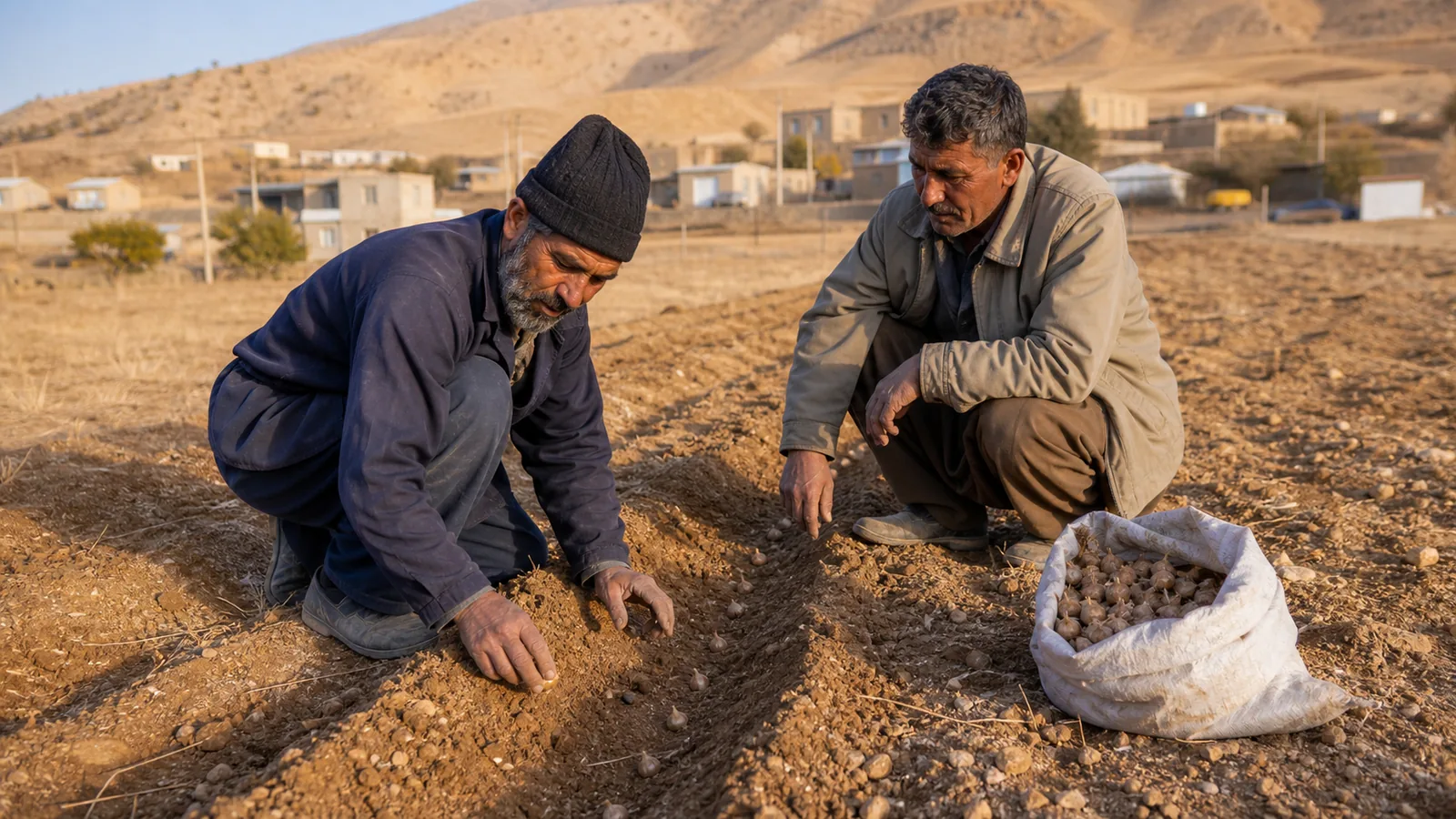
Saffron cultivation in Lande began with a one-hectare trial supported by the local Agricultural Jihad office. In the same province, a village project in Gachsaran distributed saffron corms with support from rural-development organisations. Together, the two reports show an attempt to test the crop before promoting expansion.
They do not report final yields, farmer income or a later survey of planted area. Their employment, cost and profitability statements were expectations made during establishment. This combined account preserves what the officials announced while separating those plans from results that were never supplied.
The first one-hectare saffron trial in Lande
Mukhtar Mashhadi-Zadeh, identified as the head of Agricultural Jihad in Lande, said his office had supported one hectare of saffron cultivation on a trial basis. The original report called it the first such project in the city. Without an earlier land-use record, that wording is best understood as the official programme’s first supported trial rather than proof that no resident had ever planted saffron before.
The hectare was meant to answer a local question: could saffron establish, flower and produce marketable dried stigmas under Lande’s conditions? Mashhadi-Zadeh hoped a successful result would encourage more cultivation and contribute to employment and farm income. He did not report a harvested quantity or measured return.
Why officials considered saffron
The Lande announcement described saffron as valuable and relatively low in water demand. That made it appealing where agricultural water was constrained. The economic case was conditional, however. A high selling price per kilogram says little by itself because dried yield is small, harvest and separation require concentrated labour, and saleable grade depends on handling and drying.
Saffron’s seasonal water pattern can suit some dry regions, but the source’s claim that it needs water only once or twice a year is not a universal prescription. Irrigation requirements vary with rainfall, soil, temperature, field age and production goal. A peer-reviewed study of irrigation and corm-planting intensity in a semi-arid region illustrates why water and establishment decisions need to be assessed together.
Saffron flowers in a season, not several times a year
The translated Lande source says a successful field will “flower several times a year.” Cultivated saffron normally has one autumn flowering season. Individual flowers emerge over successive days or picking rounds within that season, which may have caused the mistranslation. It should not be read as several separate annual crops.
The plant is sterile and propagated by corms. Daughter corms develop below ground and support later seasons; a peer-reviewed botanical review of Crocus sativus describes that vegetative cycle. A trial therefore needs more than one observation date. Establishment, first flowering, corm development and performance in later years are different measurements.
A parallel corm-distribution project in Gachsaran
The second report described saffron cultivation beginning in a Gachsaran village through distribution of planting material. Its phrase “saffron onions” is a literal translation; the correct agricultural term is saffron corms. No source evidence supports the title’s apparent reading of “two onions,” so the rewrite does not invent a count.
An official identified as Omidvar said the operation had started and would continue until November. The post does not name the reporting year clearly, give the number or weight of corms, identify the village, or state how many growers participated. November is therefore retained as the programme’s historical establishment timeline, not a recurring application deadline.
Who participated in the Gachsaran scheme
The Gachsaran project was presented as a sustainable rural-development effort involving several organisations:
- the Islamic Revolution Housing Foundation;
- Agricultural Jihad;
- the Omid Entrepreneurship Fund in Kohgiluyeh and Boyer-Ahmad; and
- other provincial bodies responsible for rural development.
The partnership suggests the project covered more than the physical act of planting. Rural programmes can combine corm supply, finance, training and local coordination. The source does not specify which institution funded each element, so those responsibilities should not be assigned without programme records.
The claim about dry areas and poor soils
Elias Taj al-Dini said saffron could be productive in the province’s arid areas because of its relatively low water demand and ability to grow in poor soil. That statement needs a boundary. Saffron may tolerate conditions unsuitable for some crops, but it is not indifferent to drainage, salinity, compaction, disease pressure or soil preparation.
A field with low fertility may be manageable; a waterlogged or badly compacted site can still fail. Before distributing corms, a programme should assess drainage, soil texture, salinity, water quality and previous crop problems. “Poor soil” is too broad to serve as planting advice.
Low cultivation cost and good income were projections
Taj al-Dini also described saffron as having low cultivation cost, a good selling price and the potential to create income. Those were the project’s rationale, not its audited financial result. Establishment can require substantial spending on sound corms, land preparation and labour before a grower knows the field’s productive capacity.
A useful farm budget would separate first-year establishment from later annual costs and include:
- the number, size, health and price of corms;
- soil preparation and irrigation;
- weeding and plant-health losses;
- flower picking and same-day stigma separation;
- drying, testing, packaging and storage; and
- the actual route and price available to the grower.
Sale price must be applied to realistic dry yield, not to the weight of fresh flowers or a best-case field from another province. Our broader review of Iranian saffron production challenges explains why yield definitions and value-chain costs matter.
Gachsaran and Dogonbadan in the provincial context
The archived source describes Gachsaran, whose administrative centre is Dogonbadan, as being in the southwest of Kohgiluyeh and Boyer-Ahmad and roughly 150 kilometres from Yasuj. It gives an area of 4,683 square kilometres and describes drier tropical conditions in the west and a temperate, dry zone in the east.
Those details help explain why a single recommendation cannot cover the whole county. Elevation, temperature and water availability can change across a relatively short distance. The field itself, not the county label, determines whether a trial is comparable with Lande or another Gachsaran village.
What the Lande and Gachsaran projects tested differently
The Lande account centres on a defined one-hectare pilot supported by an agricultural office. The Gachsaran account centres on corm distribution through a multi-agency rural-development programme. One tested a crop at a named scale; the other tested an implementation model involving growers and institutions.
They belong in one article because they ask the same regional question, but their figures should not be added together. The Gachsaran post gives no planted area, while the Lande post gives no corm-distribution count. Treating both as a single hectare total would erase what each source actually contributes.
Evidence needed before expansion
A pilot becomes useful when it produces records that a later grower can examine. Before either programme supports larger acreage, it should document:
- site, elevation, soil and water conditions;
- corm source, size, planting density and planting date;
- irrigation dates and amounts;
- flower and dry-stigma yield from a defined area;
- lab or buyer quality results for identified batches;
- labour hours and all establishment and annual costs; and
- the price and channel through which the crop was actually sold.
That information would show whether the field merely flowered or created a repeatable production model. It would also help distinguish a technical failure from a marketing or finance problem.
A cautious conclusion from two early projects
The Lande and Gachsaran reports record genuine local interest in saffron as a crop for water-constrained rural areas. They identify a one-hectare trial, corm distribution, partner institutions and the hopes attached to the work. They do not establish later acreage, profit, employment or long-term field performance.
That is not a reason to dismiss the projects. It is a reason to judge them by measurements rather than slogans. As with the regional expansion recorded in Nazarabad and Malayer, the valuable next step is a dated follow-up showing what was planted, what was harvested and what growers were able to sell.

![Exporting Saffron to Turkey + Price Guide [Complete 0 to 100]](https://img.rowhanisaffron.com/20260827003933/saffron-export-turkey-quality-inspection.webp)



