Saffron for eye health has attracted interest because a few small human studies have reported changes in visual measurements after people took standardized saffron supplements. That is promising enough to study, but it does not mean saffron is proven to improve everyone’s vision, reverse an eye disease or replace an eye examination.
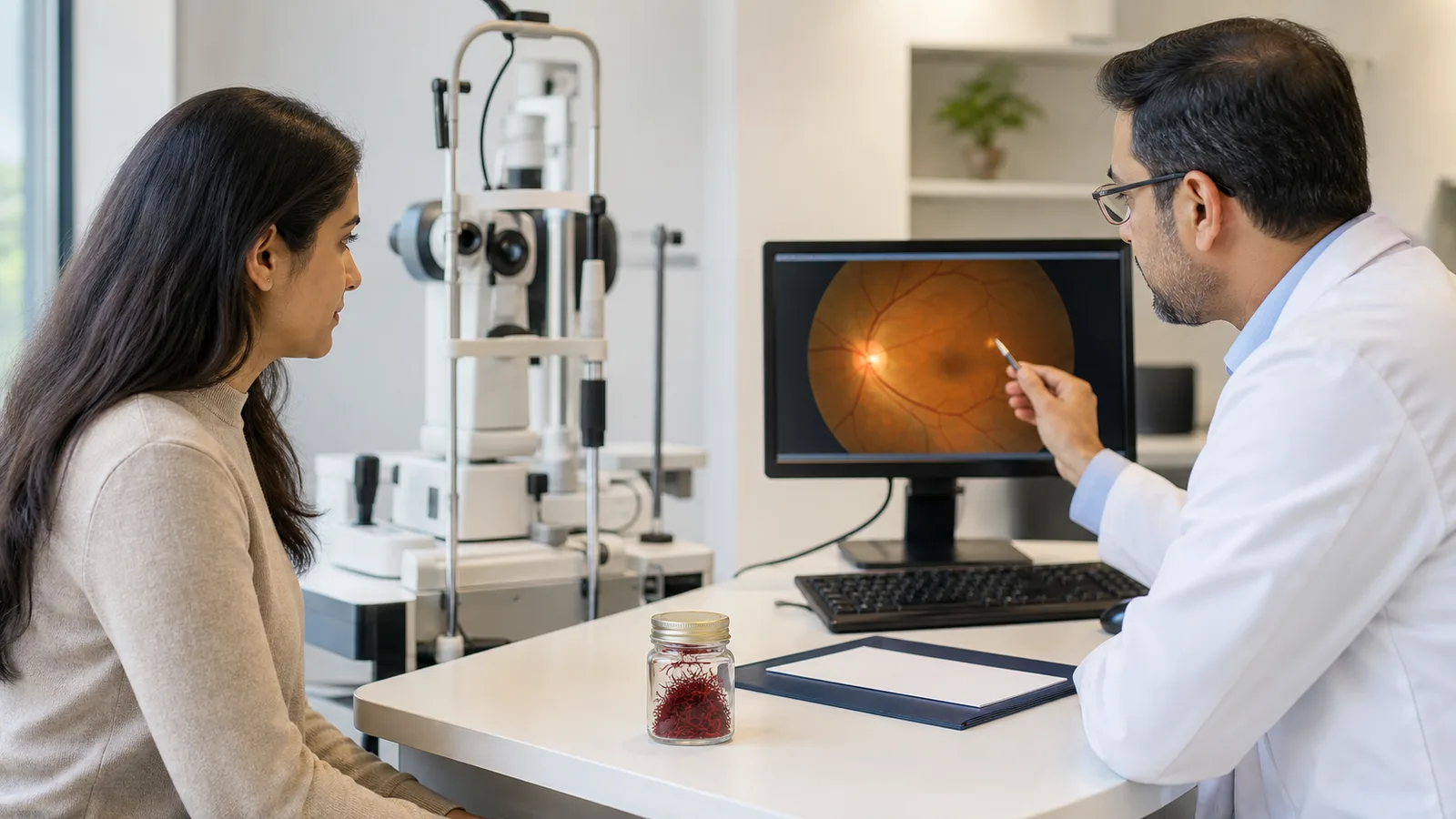
It also matters how saffron was used. The clinical studies involved oral supplements with measured doses. They did not test kitchen saffron placed in the eye, homemade saffron eye drops or a cup of saffron tea as an eye treatment.
Is saffron good for your eyes?
The careful answer is that saffron may affect some aspects of retinal function, but the evidence is still preliminary. Saffron contains crocin-related pigments, crocetin and safranal. Laboratory research explores their antioxidant and inflammatory effects, yet a plausible mechanism is not the same as a demonstrated benefit for a person with an eye condition.
A 2020 review of saffron and eye health found nine clinical studies alongside a much larger body of laboratory and animal research. The authors described encouraging findings but also called for further trials. That balance is important: there is a signal worth investigating, not a universal vision remedy.
What has research on saffron and vision tested?
Age-related macular degeneration, or AMD, has received most of the clinical attention. The macula is the central part of the retina used for detailed vision. In one randomized study of 60 people with dry AMD, an oral saffron supplement taken for six months improved one visual-acuity measure and some retinal-response measurements. Other endpoints did not change significantly, and the study was too small to settle whether the effect would last or alter the course of the disease.
A later 12-month extension involving 93 adults with mild or moderate AMD reported stable visual-acuity and retinal-response measures. Because this extension was open-label and did not include a matching control group, it cannot show how much of that stability was caused by saffron.
A small randomized trial in 31 people with Stargardt disease also tested an oral saffron supplement. Its results were described as preliminary. These studies do not establish that saffron strengthens normal eyesight, removes the need for glasses or restores vision already lost to retinal disease.
Saffron for eyesight is not the same as proven AMD care
Someone with AMD should not replace monitoring or recommended treatment with saffron. The National Eye Institute’s guidance on AREDS2 supplements explains that a specific vitamin-and-mineral formula can reduce the risk of progression for some people with intermediate or late AMD. It does not prevent early AMD from developing, and it is not simply a general eye vitamin.
Saffron is not part of the AREDS2 formula. If an eye specialist has recommended AREDS2, injections, monitoring with imaging or another treatment, a saffron product is not an interchangeable alternative. The diagnosis and stage of disease determine what is appropriate.
Saffron eye drops: do not make them at home
Searches for saffron eye drops often lead to recipes involving threads, saffron tea, extracts, milk or honey. None of those mixtures belongs in the eye. A product made in a kitchen is not sterile, and straining out visible particles does not remove bacteria, fungi or other contaminants.
The US Food and Drug Administration’s eye-drop guidance explains that medicines used in the eye must be sterile because eye drops bypass some of the body’s natural defences. The agency specifically says honey is not appropriate for use in the eyes and warns that contaminated or unapproved products can cause infection, partial vision loss or blindness.
The human saffron studies discussed above used oral supplements, not homemade drops. We found no comparable clinical evidence showing that putting saffron directly in the eye improves eyesight. Use only legitimate eye products intended for that purpose, follow their directions and ask an ophthalmologist or pharmacist when the product or symptoms are uncertain.
What about dry eye, eye strain and tired eyes?
Dryness, burning, grittiness and fluctuating vision can have several causes, including the tear film, eyelids, medicines, contact lenses and the surrounding environment. Eye fatigue after prolonged close work can feel similar but needs a different response. A saffron tea or supplement should not be expected to identify or correct the cause.
An ongoing registered study is examining an oral saffron tablet for dry-eye symptoms. A trial being registered is not evidence that the treatment works, and the intervention is still not a saffron eye drop. Persistent pain, marked redness, light sensitivity, discharge or a change in vision deserves professional assessment rather than another home remedy.
Saffron for dark circles and the skin around the eyes
Saffron, milk and honey masks are sometimes promoted for dark circles, puffiness or brighter skin. There is no good clinical evidence that this mixture treats the causes of under-eye darkness, and applying it close to the lash line creates an avoidable chance of irritation or migration into the eye. Do not use food mixtures on the eyelids or around an already irritated eye.
Dark circles may relate to normal pigmentation, visible blood vessels, shadows from facial structure, allergies, rubbing or lack of sleep. Persistent one-sided swelling, a new skin change or symptoms affecting the eye itself should be assessed on its own merits.
How to take saffron for eyesight safely
There is no established saffron dose that everyone should take for eyesight. Amounts used in a trial are research interventions, not personal instructions, and commercial extracts can differ in composition. A clinician or pharmacist should review a supplement first if you are pregnant, have a medical condition, take prescription medicines or already receive treatment for an eye disease.
Using saffron as a spice is a separate choice. A small amount can add colour and aroma to rice, soup, vegetables and other meals. Our guide to using saffron in cooking explains how to bloom the threads without confusing culinary use with a studied supplement.
- Do not put saffron threads, tea, powder, extract, milk or honey in the eye.
- Do not stop prescribed eye treatment or replace an eye examination with a supplement.
- Keep the product label and report any new symptom that starts after taking a supplement.
- Seek urgent eye care for sudden vision loss, severe eye pain, trauma or a chemical splash; new flashes, many floaters or a curtain-like shadow also need prompt assessment.
A realistic view of the benefits of saffron for eyes
Saffron and vision research is interesting because small oral-supplement studies have reported changes in certain retinal and visual measurements. Possible saffron benefits for eyesight remain preliminary: the findings are not proof that saffron improves normal vision, cures AMD or works as an eye drop. Larger, longer and better-controlled studies are still needed.
Enjoy saffron in food if you like its flavour. If your goal is to protect sight, regular eye care and treatment matched to the actual diagnosis remain the dependable foundation. Any supplement belongs in that conversation—not in the eye and not in place of proven care.