


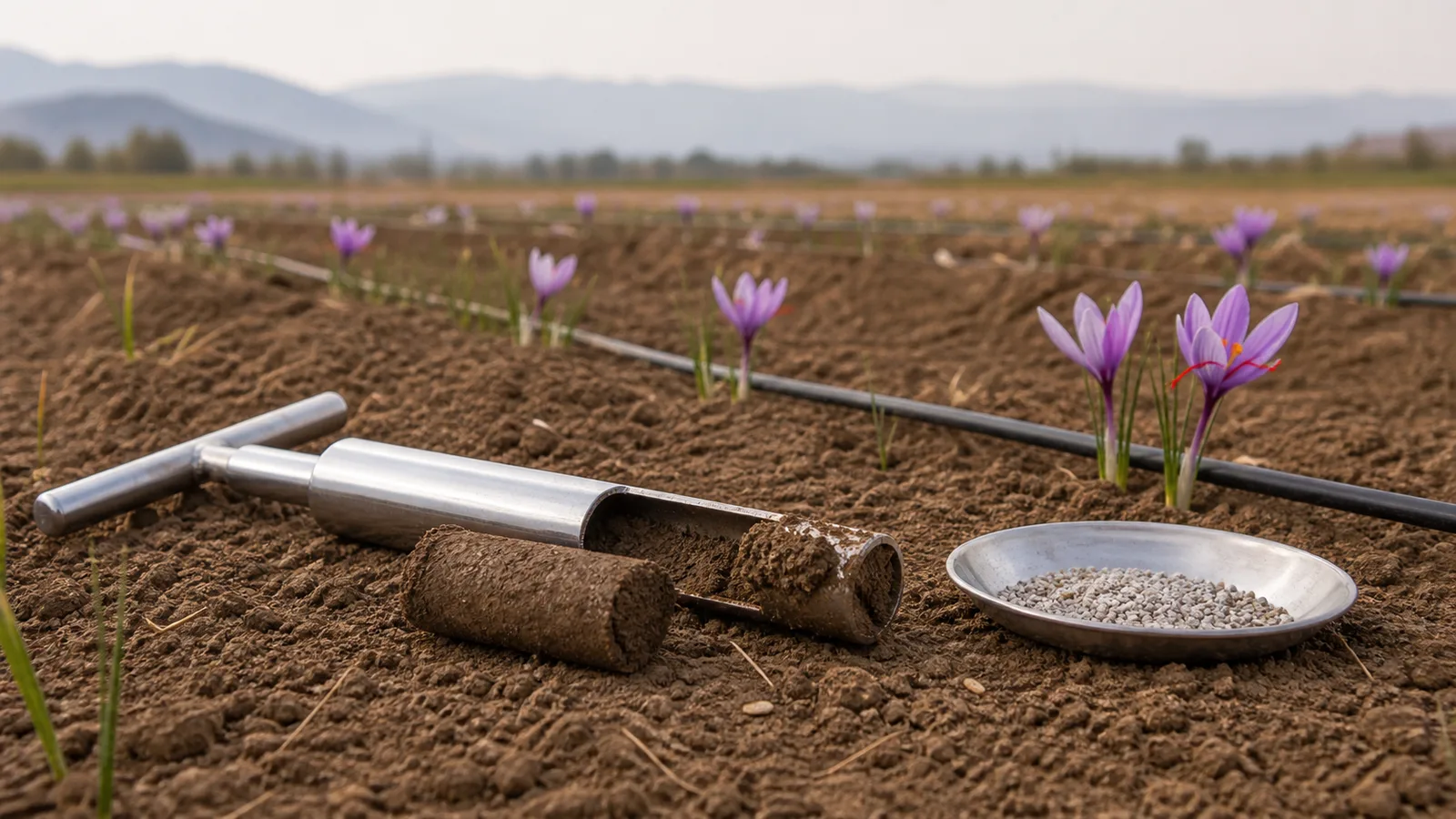
Choosing the right fertilizers is crucial for maximizing saffron crop yield. The safest choice, however, is not a particular bag color or a universal NPK formula. A good saffron fertilizer plan begins with a representative soil test, includes nutrients already supplied by manure or compost, and matches each application to the crop’s growth stage.
Saffron fertilizers can support leaf growth, daughter-corm development, and future flowering when the field is actually short of those nutrients. Excess fertilizer can waste money, raise soil salinity, upset nutrient balance, and encourage growth that does not translate into more dry stigma. Treat the soil-test recommendation as the starting point and adjust it with local agronomic guidance.
Why fertilizing saffron matters
Saffron stores much of its seasonal reserve in the corm. After flowering, the leaves continue feeding the new daughter corms that will support the next crop. Nitrogen is involved in vegetative growth, phosphorus in energy transfer and root processes, and potassium in water regulation and many plant functions. That does not mean every field needs all three in equal amounts.
Corm size matters too. A field experiment at Ferdowsi University of Mashhad found that mother-corm size affected nitrogen and phosphorus acquisition and use. In the same study, composted cattle manure produced higher nutrient-use efficiency than the tested chemical-fertilizer treatment. The result is useful evidence, but its rates should not be copied into another soil without testing.
Fertilizer options for optimal saffron growth
Start with the guaranteed analysis, not the product’s appearance. In some markets growers use informal names such as “white fertilizer” or “black fertilizer.” Those are not standardized nutrient specifications. Two products with the same color can contain very different materials, so ask for the label and identify the actual percentages of nitrogen, phosphate, and potash.
- Mineral NPK fertilizer: useful when a soil test or crop recommendation identifies a nutrient requirement. Choose the analysis and rate for that deficit rather than assuming a balanced blend is always best.
- Potash fertilizer: supplies potassium. It can correct a potassium need, but it does not automatically make saffron disease-resistant or drought-proof.
- Composted animal manure: adds organic matter and nutrients. Its nutrient and salt content varies, so mature manure should be analyzed and counted in the total nutrient plan.
- Foliar fertilizer: may help with a diagnosed, label-supported need when soil uptake is limited. It is a supplement, not a replacement for sound soil and root-zone management.
What “white fertilizer” and “black fertilizer” tell you
A white granular product might be urea, an NPK blend, potassium sulfate, or something else. A dark product might be compost, humic material, or a coated mineral fertilizer. Color alone says nothing reliable about nutrient content, release rate, salt index, contaminants, or suitability for saffron.
If a supplier recommends one of these products, ask for its guaranteed analysis, application directions, batch information, and any local registration details. That turns a vague color name into a decision you can compare with the soil report.
Fertilization timing for saffron
Timing follows the saffron growth cycle and the behavior of the chosen nutrient source. It should also fit the field’s irrigation timing; applying soluble fertilizer just before avoidable runoff or deep drainage defeats the purpose.
Before planting
Sample the soil early enough to receive and interpret the results. If mature compost or manure is needed, incorporate it during field preparation rather than placing concentrated material directly against the corms. Account for its nitrogen, phosphorus, potassium, organic matter, soluble salts, and moisture. “Aged” is not a nutrient analysis.
Autumn growth and flowering
Do not apply fertilizer simply because flowers are expected. Nutrients applied at this stage must match the crop recommendation and reach the active root zone without waterlogging it. Record the product, analysis, rate, area, and irrigation or rainfall that followed.
After flowering
The post-harvest leaf period is important because leaves remain active while daughter corms develop. This is why the old advice associated post-harvest feeding with the next season’s crop. Keep that seasonal logic, but choose the nutrient from evidence. A nitrogen-and-phosphorus product is not automatically the best post-harvest choice if the soil already contains enough phosphorus.
Winter and spring
Where research or local recommendations call for split applications, winter or early spring may be part of the plan while leaves are green. A four-year Italian field study tested NPK 15-15-15 at different seasonal timings and found higher yield parameters under its split autumn-winter-spring treatment. Those results belong to the tested field and rate. They show that timing can matter; they do not establish one prescription for every saffron farm.
The old guide suggested a water-soluble fertilizer in November or December. That timing may coincide with active leaves in some climates, but the month alone is not enough. Confirm the nutrient need, soil moisture, weather, and product label before using a soluble feed.
Stop routine feeding as the leaves naturally yellow and the crop enters dormancy. Late fertilizer is not stored simply because it was applied. It can remain unused, move with water, or contribute to salt and nutrient problems.
Using animal manure in saffron cultivation
Properly composted cattle manure can improve soil organic matter and supply plant nutrients. It can also add more phosphorus, potassium, sodium, or soluble salts than a field needs. Raw or unfinished manure may contain high ammonium, weed seeds, or pathogens and can injure plants.
Analyze the material before setting a rate. University nutrient-management guidance recommends combining a manure test with the soil-test recommendation and calibrated spreading equipment. After application, keep a record so those nutrients are not counted twice when mineral fertilizer is planned.
How to choose the best fertilizer for a saffron field
- Divide fields that differ in soil, slope, crop history, or management, and sample them separately.
- Review pH, organic matter, available phosphorus and potassium, salinity, and the laboratory’s locally calibrated crop recommendation. Include nitrogen guidance where the local testing system provides it.
- List every nutrient source already going onto the field, including compost, manure, irrigation water, and previous applications.
- Select a product whose guaranteed analysis fills the documented gap. Check the label for placement, compatibility, protective equipment, and legal use.
- Apply it uniformly, record the application, and compare flowering, dry-stigma yield, leaf growth, and daughter-corm performance over time.
Yellowing leaves, weak growth, or low yield are not proof of a fertilizer deficiency. Waterlogging, drought, corm disease, poor planting material, soil compaction, salinity, and uneven irrigation can produce similar symptoms. Diagnose the field before adding more nutrients.
A practical saffron fertilizer rule
The best saffron fertilizer is the one that supplies a measured need at a useful time, in a form the crop can use, without leaving the soil worse for the next season. Keep the plan specific to the field. Test first, read the label, count every nutrient source, and review the result after harvest.
Research and guidance: 2024 field study of saffron nutrient inputs and timing; field study of corm size and nitrogen/phosphorus use efficiency; Penn State Extension manure-sampling guidance; and University of Minnesota Extension guidance on excess compost and manure.

![Exporting Saffron to Turkey + Price Guide [Complete 0 to 100]](https://img.rowhanisaffron.com/20260827003933/saffron-export-turkey-quality-inspection.webp)



