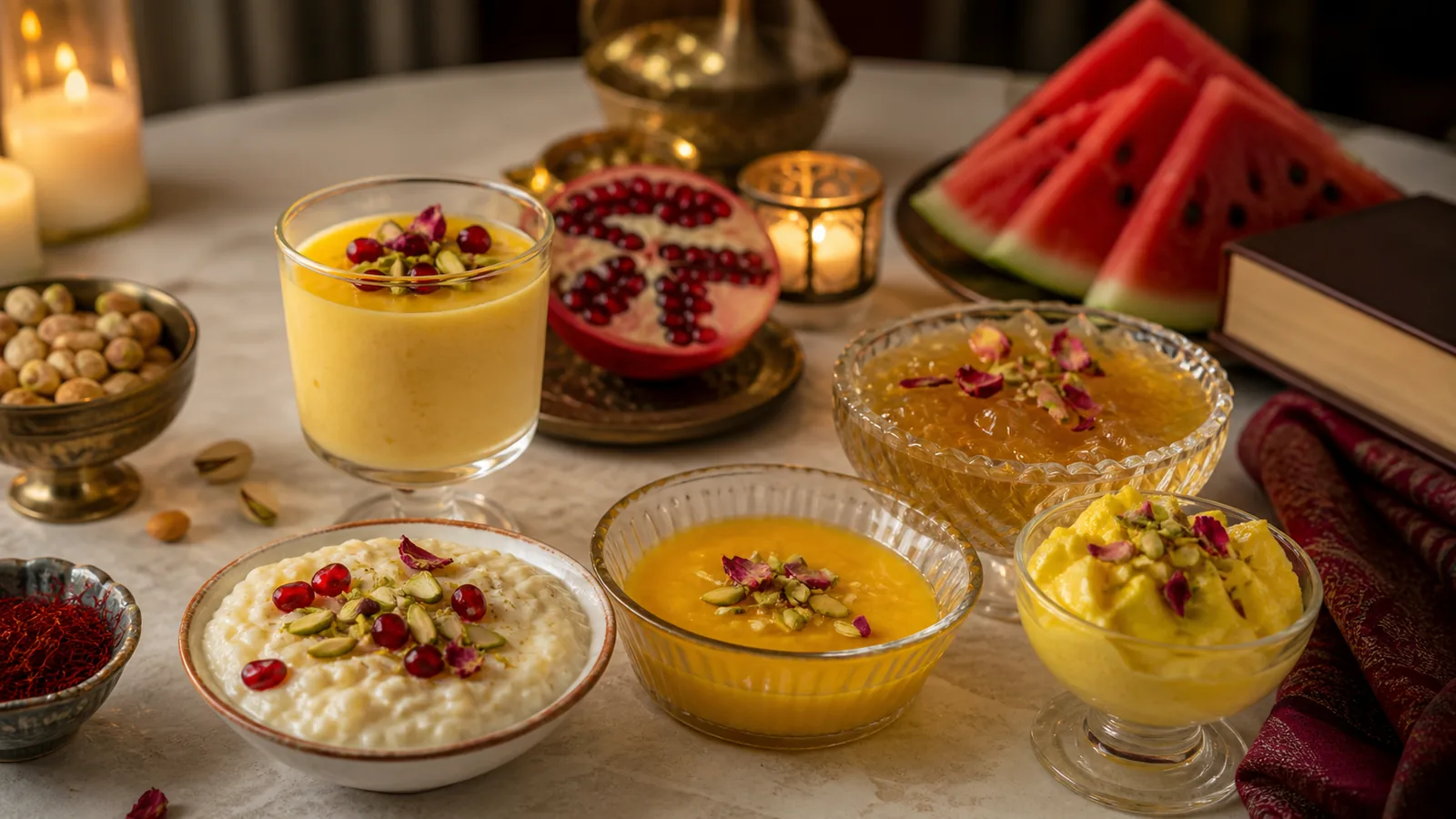
Saffron desserts for Yalda Night bring a warm golden note to a table filled with pomegranate, watermelon, nuts and tea. The five recipes below range from softly set panna cotta to Persian rice-flour pudding and saffron maqout. Each is written for six small servings, with measured quantities and make-ahead guidance so you can spend the evening with your guests instead of watching the stove.
Why saffron desserts suit a Yalda table
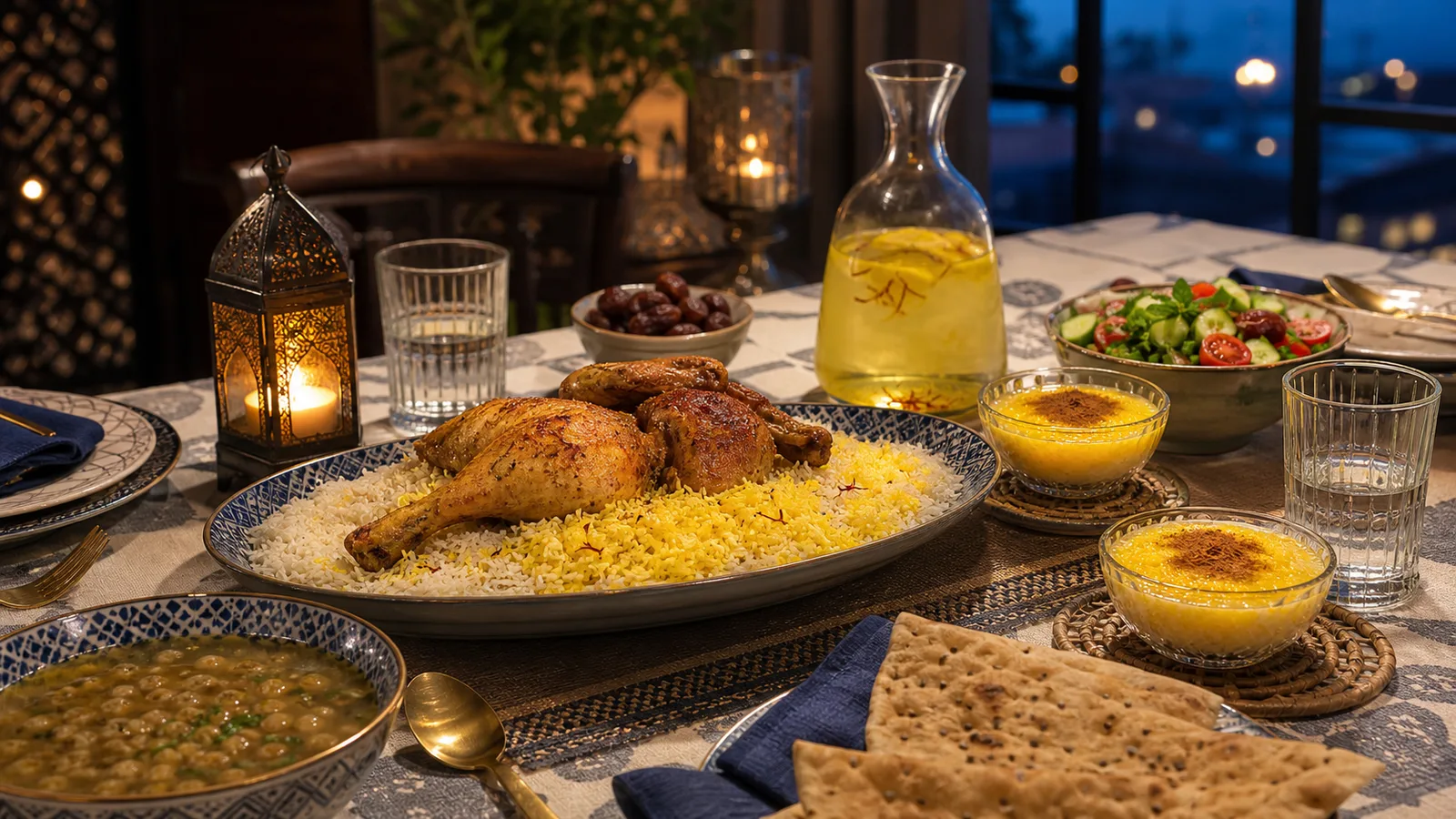
Yalda, also called Chella, is observed on the last night of autumn. Families traditionally gather, often at an elder’s home, and share red fruits, nuts, stories and poetry as the year turns towards longer days. UNESCO’s account of Yalda/Chella describes the celebration in Iran and Afghanistan and the place of symbolic foods such as pomegranates and watermelon.
Saffron is not the only flavour on a Yalda spread, but it works beautifully alongside rosewater, cardamom and pistachios. Its floral, honeyed aroma also keeps a milk pudding from feeling plain. Use it with restraint. More threads do not automatically make a finer dessert; too much can leave an earthy or bitter finish.
Choose your dessert before you begin
- Saffron panna cotta: creamy and gently set; make it the day before.
- Saffron rice pudding (fereni): comforting, egg-free and easy to serve warm or cold.
- Saffron custard (mashkufi): glossy and sliceably soft, with cornstarch rather than rice flour.
- Saffron mousse: the lightest option, made with a safely heated meringue.
- Saffron maqout: a translucent, dairy-free wheat-starch dessert that carries rosewater especially well.
If you are serving several sweets, use small tea glasses or 90–120 ml dishes. Panna cotta and mousse are rich enough for modest portions; fereni and maqout can be offered in slightly larger bowls.
Prepare one strong saffron infusion
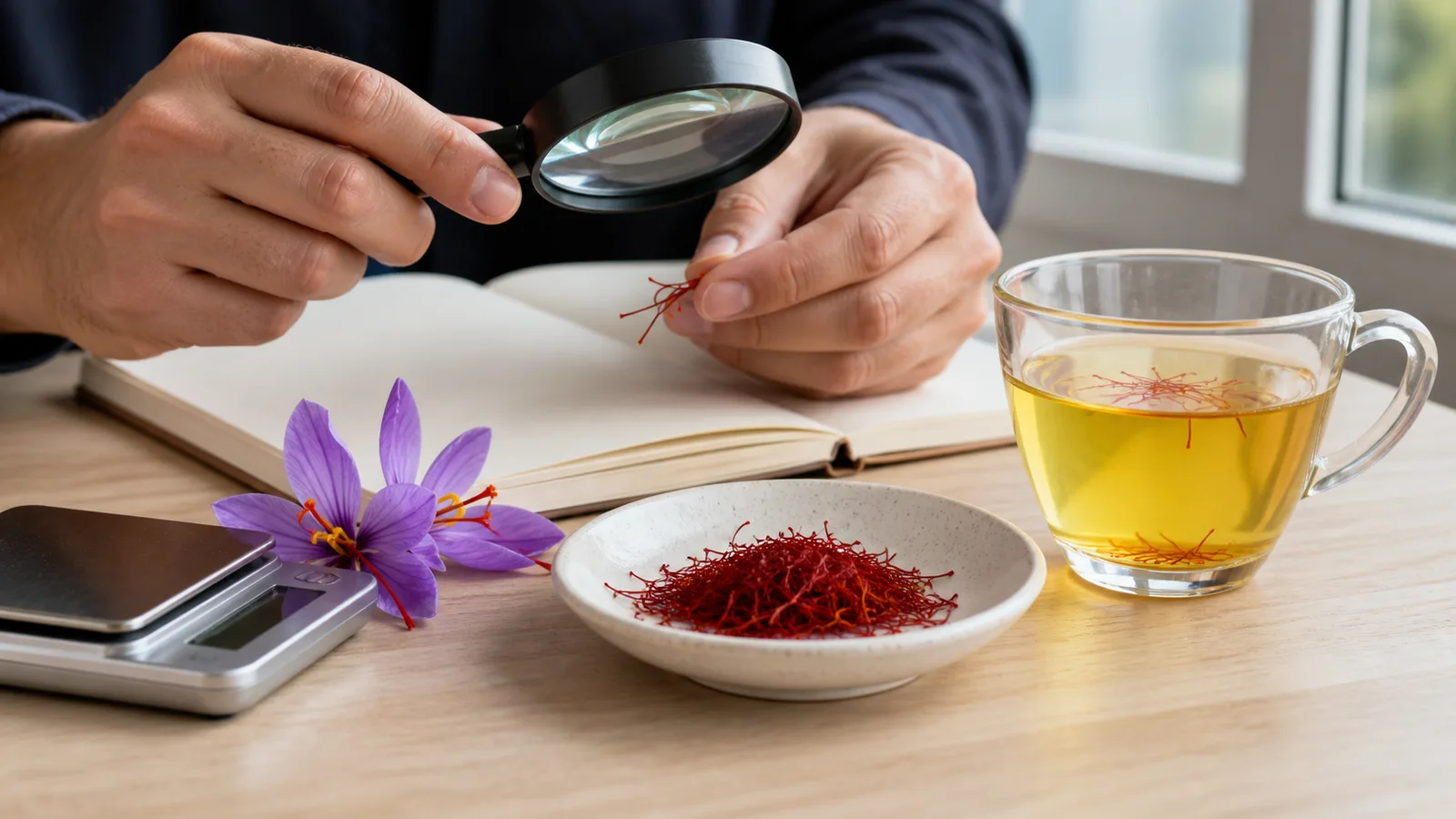
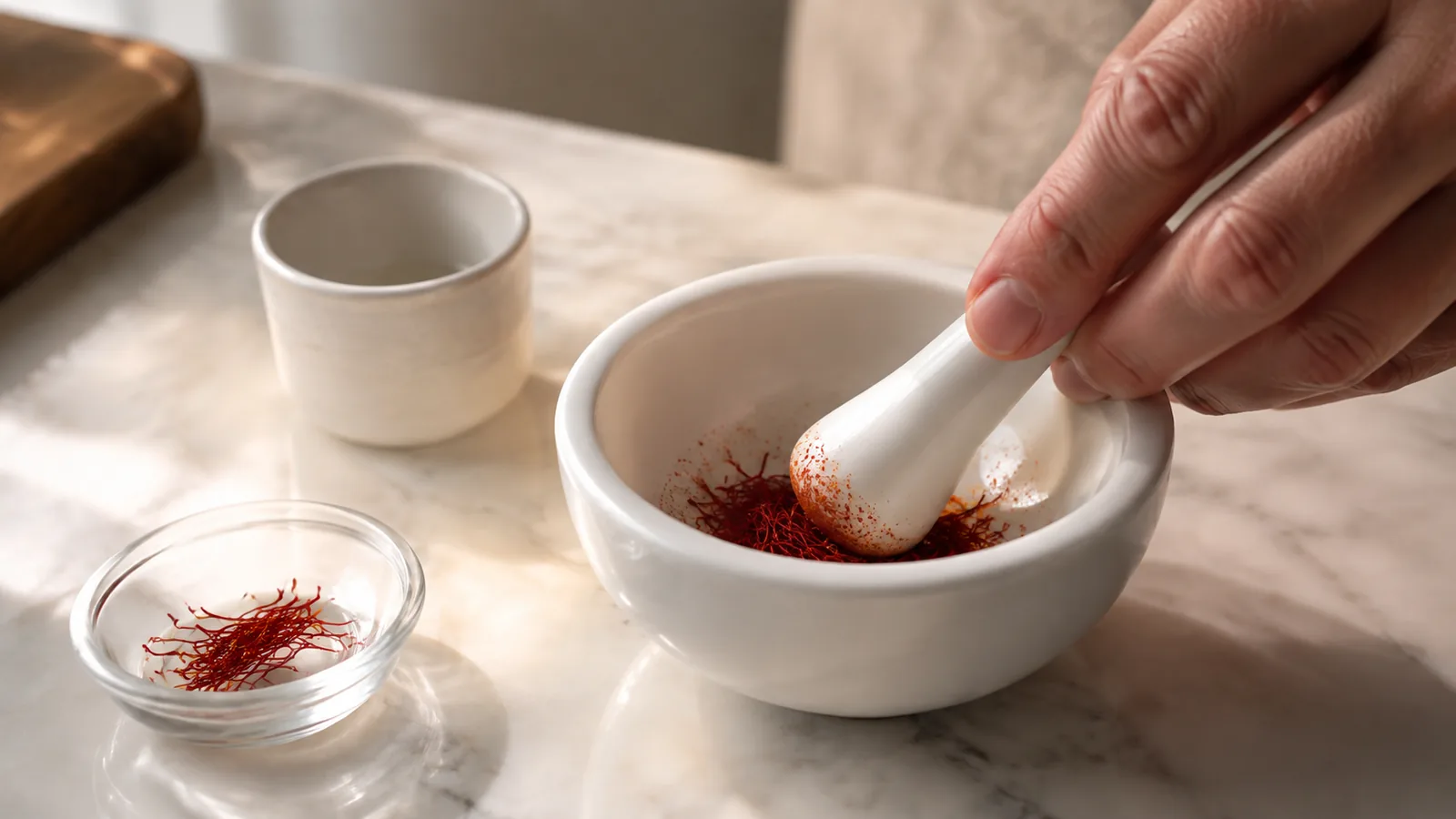
Lightly grind 1 teaspoon of saffron threads. Add 6 tablespoons of hot water, cover, and leave for 15 minutes. You now have enough strong brewed saffron for all five recipes. If you are making only one dessert, grind about 1/4 teaspoon of threads with a pinch of sugar and steep them in 1 1/2 tablespoons of hot water.
Measure the infusion into a recipe near the end of cooking whenever possible. Prolonged hard boiling flattens saffron’s aroma. Our guide to brewing and storing saffron for cooking covers the method in more detail.
1. Saffron panna cotta with rosewater
This saffron panna cotta is softly set rather than rubbery. Whole milk lightens the cream, while a small amount of rosewater lifts the saffron without masking it.
Ingredients
- 400 ml heavy cream;
- 200 ml whole milk;
- 75 g granulated sugar;
- 7 g unflavoured powdered gelatin, about 2 1/4 teaspoons;
- 3 tablespoons cold water;
- 1 1/2 tablespoons strong saffron infusion;
- 2 teaspoons rosewater, or less if highly concentrated;
- chopped pistachios and pomegranate arils for serving.
Method
- Put the cold water in a small bowl, sprinkle the gelatin evenly over it, and leave for 5–10 minutes. It should absorb the water and swell.
- Warm the cream, milk and sugar in a saucepan over medium-low heat. Stir until the sugar dissolves and steam begins to rise. Do not let the mixture boil.
- Remove the pan from the heat. Add the bloomed gelatin and stir until no granules remain.
- Stir in the saffron infusion and rosewater. Taste once the mixture has cooled slightly; add a few more drops of rosewater only if needed.
- Divide among six lightly oiled moulds or serving glasses. Cool, cover and refrigerate for at least 5 hours, preferably overnight.
Serve it in the glass for the easiest presentation. To unmould, dip only the outside of each mould in warm water for 5–8 seconds, loosen the edge and invert onto a chilled plate. If it slumps, the water was too hot or the dessert warmed for too long.
2. Saffron rice pudding (fereni)
Persian fereni is a smooth milk pudding thickened with rice flour. It is not the grain-based rice pudding found in many other cuisines: the flour gives it a fine, velvety texture with no whole rice in the bowl.
Ingredients
- 500 ml whole milk, divided;
- 40 g fine rice flour;
- 55 g granulated sugar;
- 1 tablespoon strong saffron infusion;
- 2 teaspoons rosewater;
- 1/8 teaspoon ground cardamom, optional;
- ground cinnamon, pistachios or dried rose petals for garnish.
Method
- Whisk the rice flour with 150 ml of the cold milk until perfectly smooth.
- Warm the remaining milk and sugar in a heavy saucepan over medium-low heat.
- Whisk in the rice-flour slurry. Cook gently for 8–12 minutes, stirring across the base and into the corners, until the pudding coats the spoon.
- Lower the heat and add the saffron, rosewater and optional cardamom. Cook for one more minute, then remove from the heat.
- Pour into six dishes. Serve warm, or cool for 20 minutes before covering and chilling.
Fereni continues to thicken as it cools, so stop while it still flows slowly from the spoon. If it becomes too firm, whisk in a little warm milk. If you see lumps, press the hot pudding through a fine sieve before portioning it.
3. Saffron custard (mashkufi)
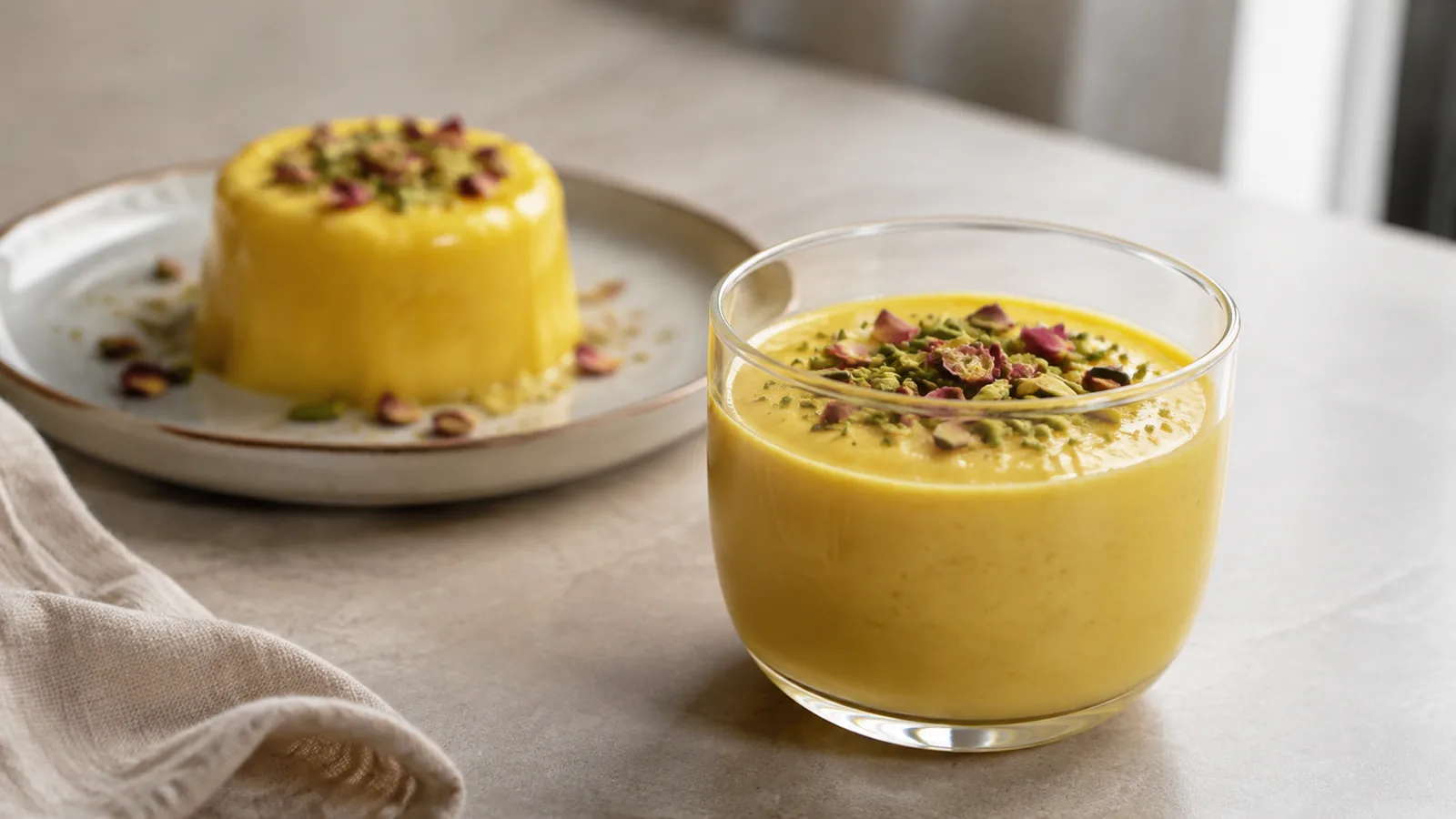
Mashkufi is a Persian starch pudding associated particularly with northern Iran. Cornstarch gives this version a glossier, more delicate set than rice-flour fereni. It contains no eggs, despite the English word “custard.”
Ingredients
- 500 ml whole milk;
- 45 g cornstarch;
- 65 g granulated sugar;
- 15 g unsalted butter;
- 1 1/2 tablespoons strong saffron infusion;
- 2 teaspoons rosewater;
- a small pinch of vanilla, optional;
- slivered almonds or pistachios for serving.
Method
- Whisk the milk, cornstarch and sugar together in a cold saucepan. Continue until no dry starch remains around the edge.
- Set the pan over medium-low heat. Stir continuously as the mixture warms; it will thicken quickly once it approaches a simmer.
- When wide bubbles begin to break the surface, lower the heat and cook for 90 seconds, stirring all the time so the starch loses its raw taste.
- Remove from the heat and stir in the butter, saffron, rosewater and optional vanilla.
- Pour into six small dishes. Cool, cover and chill for at least 3 hours.
For a cleanly unmoulded mashkufi, lightly oil the dishes and increase the cornstarch to 50 g. For a spoonable custard, keep the 45 g measure. Avoid adding extra starch after the pudding has thickened; it is difficult to disperse without lumps.
4. Light saffron mousse
The old-fashioned way to make mousse with uncooked egg whites carries an avoidable food-safety risk. This recipe uses a Swiss-meringue method: pasteurised egg whites and sugar are heated together to 71°C/160°F before whipping. The FDA’s egg-safety guidance recommends pasteurised eggs or egg products for recipes served raw or undercooked.
Ingredients
- 90 g pasteurised liquid egg whites, about 3 large whites;
- 90 g granulated sugar;
- 200 ml cold heavy cream;
- 4 g unflavoured powdered gelatin, about 1 1/4 teaspoons;
- 2 tablespoons cold water;
- 1 1/2 tablespoons strong saffron infusion, cooled;
- 1 teaspoon rosewater;
- pomegranate arils for serving.
Method
- Sprinkle the gelatin over the cold water and leave it to bloom for 5 minutes.
- Put the egg whites and sugar in a clean heatproof bowl over a saucepan of barely simmering water. The bowl must not touch the water.
- Whisk constantly until the sugar has dissolved and the mixture reaches 71°C/160°F on a food thermometer. Remove the bowl from the heat.
- Add the bloomed gelatin and whisk until dissolved. Beat with an electric mixer until the meringue is glossy, holds medium peaks and has cooled close to room temperature.
- Whip the cream in a separate bowl to soft peaks. Stir the saffron and rosewater into one-quarter of the cream, then fold this back into the rest.
- Fold the saffron cream into the meringue in three additions. Spoon into six glasses, cover and chill for at least 4 hours.
Warm meringue will melt the whipped cream, so do not combine them until the bowl feels barely cool. Fold with a broad spatula and stop as soon as the colour is even. Aggressive stirring knocks out the air that makes this a mousse.
5. Saffron maqout with wheat starch
Maqout—also written as maqut—is a simple saffron dessert thickened with wheat starch and water. It is translucent rather than creamy, naturally dairy-free, and especially good beside tea after a rich Yalda meal.
Ingredients
- 50 g wheat starch;
- 600 ml cold water;
- 100 g granulated sugar;
- 1 1/2 tablespoons strong saffron infusion;
- 1 tablespoon rosewater;
- 1 teaspoon lemon juice, optional;
- slivered almonds and pistachios for garnish.
Method
- Whisk the wheat starch into 200 ml of the cold water. Let it stand for 5 minutes, whisk again, then strain into a heavy saucepan.
- Add the remaining water and sugar. Cook over medium-low heat, stirring continuously, until the cloudy liquid turns glossy and noticeably thicker, about 12–18 minutes.
- Lower the heat and cook for another 3 minutes. The spoon should leave a brief path across the base of the pan.
- Stir in the saffron, rosewater and optional lemon juice. Cook for 30 seconds, then remove from the heat.
- Divide among six dishes, garnish and chill for at least 3 hours.
Wheat starch is not the same as wheat flour. Flour makes the dessert opaque and gives it a cooked-dough taste. Cornstarch can thicken the liquid, but it produces a different texture and belongs in the mashkufi recipe above.
How to arrange the five desserts for Yalda Night
Choose two contrasting textures rather than making all five unless you are feeding a large gathering. Panna cotta with maqout gives you creamy and translucent; mousse with fereni gives you airy and comforting. Arrange the glasses on a tray with fresh pomegranate arils, pistachios and a few dried rose petals added shortly before serving.
Keep garnishes restrained so the desserts remain easy to eat. A spoonful of pomegranate on each serving is enough. Whole saffron threads look attractive, but a large dry tangle is unpleasant on the tongue. Crush a few threads or use pistachio slivers instead.
A practical make-ahead plan
- The day before: make the panna cotta and maqout; cover once cold.
- On the morning of the gathering: prepare the mashkufi and fereni.
- Four to six hours before serving: make the mousse so it has time to set.
- Just before guests arrive: add nuts, rose petals and pomegranate; do not leave cut fruit on dairy desserts overnight.
Refrigerate dairy and egg-based desserts promptly and keep them chilled until serving. For best texture, eat panna cotta, mousse, fereni and mashkufi within three days. Maqout keeps for about three days too, although its surface can firm and release a little water as it sits.
Common saffron-dessert mistakes
The saffron flavour disappears
A weak infusion or prolonged boiling is usually responsible. Grind the threads lightly, steep them covered and add the liquid late in the process. Do not try to compensate with a large amount of dry saffron at the end.
The pudding has lumps
Disperse rice flour or starch in cold liquid before applying heat, then stir across the entire pan. A fine sieve can rescue a hot pudding before it sets. Once chilled, lumps are much harder to correct.
The dessert tastes strongly of rosewater
Rosewater brands differ greatly in concentration. Start with half the listed amount if the bottle is unfamiliar, taste the warm mixture, and add more by drops. Rosewater should sit behind the saffron, not cover it.
The set dessert is rubbery
Measure gelatin by weight when possible and never boil it. A panna cotta should wobble when the dish is nudged. If your gelatin has a different bloom strength, follow the package conversion rather than adding an extra spoonful “for insurance.”
A warm finish to the longest night
These saffron dessert recipes are meant to make Yalda Night easier to host, not busier. Pick the texture your family enjoys, prepare it early, and leave space on the table for the fruits and nuts that define the evening. Whether you choose panna cotta, fereni, mashkufi, mousse or maqout, careful heat and a measured saffron infusion will do more for the final flavour than elaborate decoration.