


Saffron cultivation in Khomein was described in a 2020 local report as patient, labour-intensive work whose rewards did not always reach the farmer. Growers valued saffron for its fit with the area’s dry summers, yet said high harvesting costs, bulk sales and weak local branding left them exposed to intermediaries.
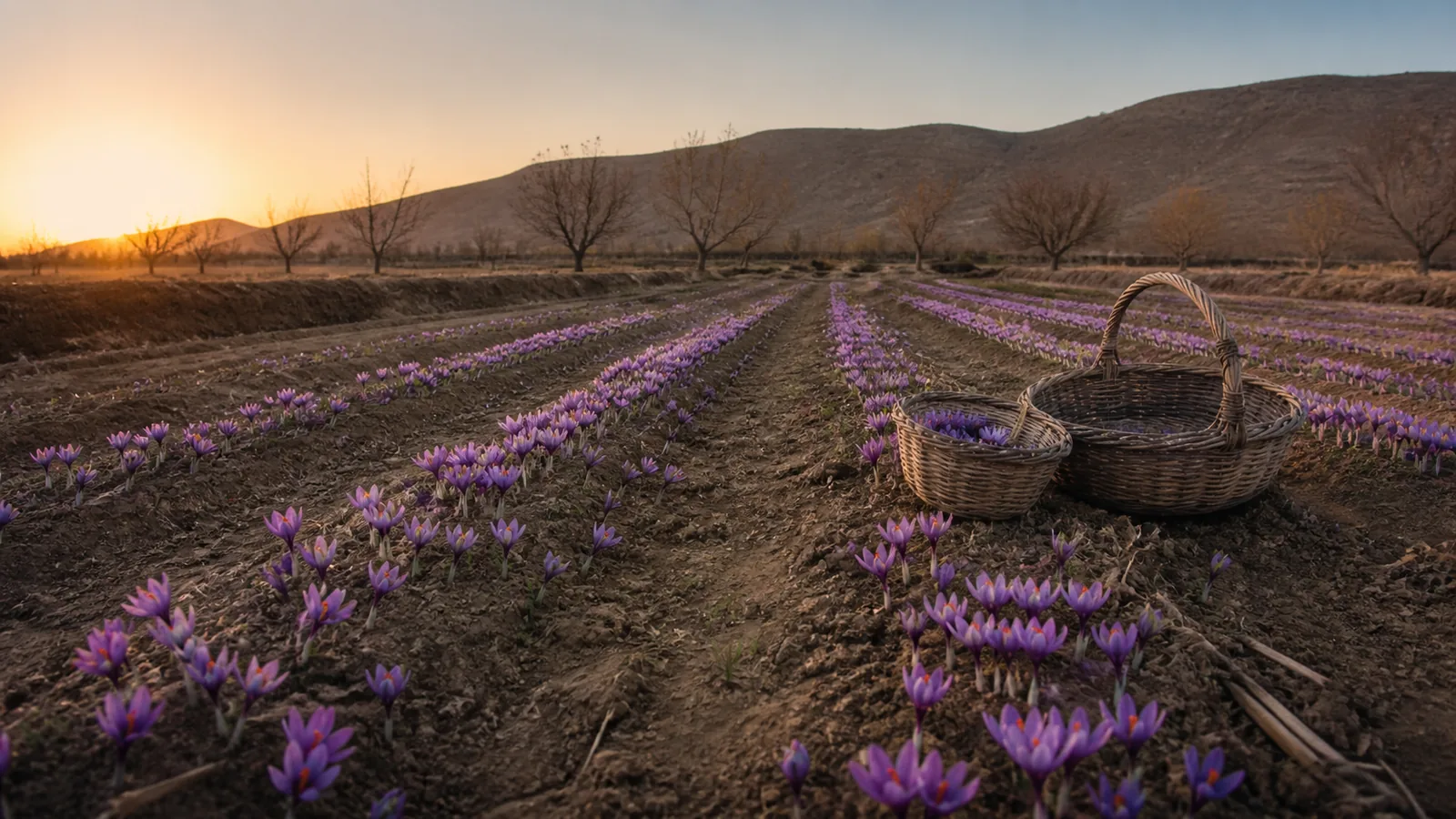
The names, area and harvest figures below belong to that report and should not be read as current Khomein statistics. Its central lesson is still clear: choosing a lower-water crop solves only one part of a farm’s economic problem.
Why Khomein farmers turned to saffron
Khomein is in the south of Markazi Province. The report described its climate as having mild winters and hot, dry summers, with suitable soils in several local areas. Growers had planted saffron around Ghorchi Bashi and in the villages of Shahabieh, Varcheh and Khogan.
Effat Jalali, an experienced grower with 11 years in saffron cultivation, said water scarcity was the reason she moved towards a crop that does not require irrigation during summer dormancy. That does not make saffron water-free. Establishment, autumn growth, flowering and local soil conditions still require careful field management.
The report’s opening speaker, whose name is unclear in the stored English translation, made the same point: drought encouraged an alternative crop, but the familiar marketing problem returned as soon as harvest began.
The work did not end at harvest
Saffron flowers arrive in a short window and must be picked and processed quickly. That creates seasonal employment, but it also concentrates labour costs into a few demanding weeks.
Hamed Eslami said the harvest provided seasonal work for rural women and girls, supporting household income. At the same time, he noted that labour was expensive and that many growers still sold the dried product unpackaged and in bulk.
The result was a difficult balance. Higher wages mattered to workers, while growers needed a market price that covered those wages. Without coordinated selling or access to buyers, an individual farmer often had little leverage during the most crowded part of the season.
Why harvest-season prices worried growers
Jalali said saffron prices weakened when flowers entered the market, then rose again several months later. Retail sales brought her a better return, but immediate household costs sometimes forced her to sell to brokers.
Ruhollah Behdari described the same seasonal pressure. In the report, harvest began in early November, when intermediaries bought unbranded saffron, packaged it and later sold it for more. He wanted cheaper finance and a stronger body representing producers.
These statements record growers’ experience; they do not prove that every broker behaved the same way or that later price rises were guaranteed. Storage cost, quality risk, testing, packaging and finding customers also affect the final margin. The useful question is whether the grower can compare offers and choose when and how to sell.
Effat Jalali’s home-business problem
Jalali, described as a recognised saffron grower in Markazi Province and the head of her household, supported herself and her daughter through the crop. She believed proper packaging and a health code could let her retain more value.
She also described regulatory obstacles. A compliant workspace and required hygiene conditions were beyond what she could provide at home, so she continued as a home producer. Her account shows why telling a grower simply to “package and brand” is incomplete advice: legal facilities, food-safety systems, equipment and working capital have to exist as well.
Quality claims and the loss of the Khomein name
Growers and officials in the report praised Khomein saffron for its soil, climate and aromatic quality. Those are attributed local assessments, not an independent comparison proving it superior to saffron from every other region.
Ahmad Reza Jafari, then director of Khomein Agricultural Jihad, said intermediaries sometimes arranged purchases months before harvest. Drought and immediate living costs could push farmers towards advance sales or bulk deals. The saffron was then distributed without the Khomein name.
Modern origin branding needs evidence behind it: lot records, consistent drying, verifiable grade, safe handling and honest labels. FAO’s current work with Iranian partners similarly emphasises authenticity testing and post-harvest guidance as foundations for a transparent value chain.
The 24-hectare and 108-kilogram harvest
Jafari put Khomein’s saffron area at 24 hectares in the reporting period. He said those fields produced 108 kilograms of dried saffron, an average of about 4.5 kilograms per hectare.
The arithmetic is consistent: 108 divided by 24 equals 4.5. Yield can vary from one season and field to another, however, so the figure is a historical snapshot rather than a guaranteed expectation for a new farm.
The report placed Khomein first within Markazi Province for saffron production at the time. It did not provide a current provincial comparison, and that ranking should not be projected into later years without updated official data.
Why officials warned against planting everywhere
Jafari recommended saffron as an alternative in suitable low-water areas but warned against turning it into a universal answer. He said the crop should not be planted everywhere and cautioned that single-crop farming could fail.
That qualification is important. A farmer needs to consider soil drainage, frost, irrigation access, corm health, disease history, available labour, drying capacity and a realistic buyer before expanding. A crop can use less water in one season and still be a poor choice for a particular field or household.
What a Khomein producer organisation could do
Growers repeatedly asked for a union, company or other coherent organisation. Jafari argued that combining scattered capital could help members obtain finance, package saffron properly and market it inside and outside Iran under the Khomein name.
A useful producer organisation would need practical responsibilities:
- publish clear membership and quality rules;
- record each lot from grower through drying and sale;
- provide shared hygienic processing and packaging;
- arrange independent testing without overstating quality;
- compare buyer offers and contract terms transparently;
- report fees, finance costs and sale proceeds to members.
Support should not mean hiding commercial risk or promising a price. It should give farmers more reliable information, legal routes to market and the ability to keep their origin visible.
The Khomein growers were not describing an easy red-gold success story. They were explaining why cultivation, harvest labour, compliance, finance and marketing have to work together. Saffron can suit a dry region; only a functioning value chain can make that suitability worthwhile for the people doing the work.

![Exporting Saffron to Turkey + Price Guide [Complete 0 to 100]](https://img.rowhanisaffron.com/20260827003933/saffron-export-turkey-quality-inspection.webp)



