


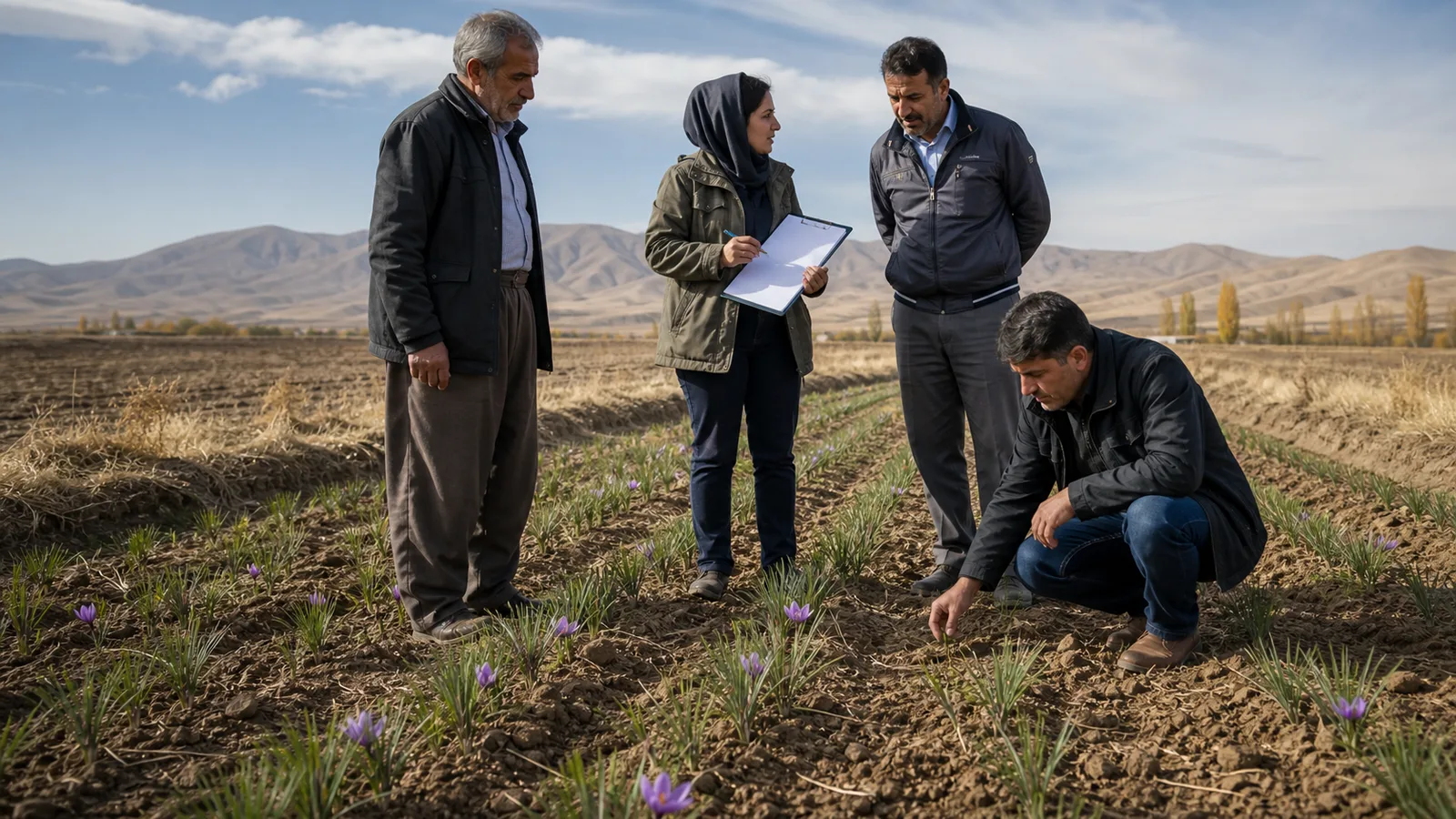
Small saffron trials in Mianeh and Asadabad tested the same idea under different conditions: could a high-value autumn crop diversify farms while reducing pressure on groundwater? Mianeh’s programme had passed four hectares after several years of training. Asadabad reported a two-hectare trial on rainfed land, supported by promotional corm purchases. Both were early development reports, not proof that saffron would become profitable across either county.
The original title’s “central city” is a translation error. The destination report concerns Mianeh County in East Azerbaijan Province. The additional source concerns Asadabad in Hamedan Province. Keeping the locations separate is essential because their rainfall, soil, temperature and farm systems are not interchangeable.
Four hectares of saffron cultivation in Mianeh
Jalal Rahimzadeh, identified in the report as the local Agricultural Jihad director, said extension experts had offered saffron classes and workshops in Mianeh for four years. In the reported crop year, farmers planted more than four hectares. The programme was presented as part of a broader effort to adjust the crop pattern toward products with lower seasonal water demand.
Rahimzadeh linked the trial’s prospects to Mianeh’s temperate climate, soil and earlier field performance. The translated report gives conflicting yield wording—one sentence points below four kilograms per hectare while another expects more than four kilograms as fields mature. It is safer to record the expectation as roughly four kilograms per hectare, not as a measured county average.
What the local plan expected
The programme expected commercial performance to improve after the young beds established and daughter corms multiplied. It also said a saffron field could remain productive for more than seven years. That refers to the life of a managed planting, not the age of one bulb: the original mother corm is replaced by daughter corms as the field develops.
The source placed planting between July and October and harvest in early November. It also claimed harvest came 40 days after planting ended, which cannot be a general biological rule. Flowering depends on corm condition, actual planting date, autumn temperature and moisture. A late-planted or first-year field may flower weakly or not at all.
Corm quantity, water and labour claims
Rahimzadeh cited about 3.5 tonnes of planting corms per hectare and recommended stock from a similar climate. The mass can be a useful planning figure for that local layout, but required corm tonnage changes with corm size, spacing and planting density. Health and identity matter too; moving uninspected corms can move rot and pests between farms.
The report said saffron needed no more than three irrigations a year in the Mianeh system. That is a period local claim, not a universal schedule. Rainfall, soil water storage, bed age and spring daughter-corm growth all affect need. The sound water-saving comparison is the full seasonal water use per hectare and per unit of farm income—not simply the number of times water is applied.
It also described one permanent and seasonal job for around 30 people per hectare. The translation does not define unique workers, workdays or peak harvest labour. Saffron certainly concentrates hand work into flower picking and stigma separation, but the figure should not be quoted as 30 full-time jobs.
Dryland trial in Asadabad, Hamedan
Nasser Fattahi, then director of Agricultural Jihad in Asadabad, reported that farmers had trialled saffron on two hectares of the county’s rainfed or dryland ground in the previous year. He said dryland planting would begin in August and that interest from applicants meant the final expansion area was not yet known.
The organization planned to obtain corms on a promotional basis for participating farmers. This was an extension measure intended to encourage a change in cropping pattern, not evidence that every applicant received free material or that the resulting crop was commercially successful.
Why the Asadabad trial was experimental
Fattahi described saffron as a potentially profitable crop with relatively modest water needs and connected the project to groundwater protection. The source’s phrase “low-yielding and high-cost” appears to be a poor translation; the surrounding context is clearly low water demand and high value.
Rainfed saffron still needs moisture at critical stages. A trial should record when rainfall arrived, whether any supplemental water was used, emergence, flowering corms, dried stigma yield, daughter-corm growth and losses. Without those observations, “dryland” is a planting description rather than a tested water-saving result.
What should be compared after a pilot
Hectares planted are an input, not an outcome. A useful review of the Mianeh and Asadabad programmes would compare:
- healthy emergence and the share of corms that flowered;
- dried stigma yield by field age, not one blended average;
- rainfall, irrigation volume and timing;
- corm survival, disease and daughter-corm multiplication;
- harvest and separation labour in work-hours;
- saleable grade, price received and route to market;
- total costs, including corms, land preparation and seasonal labour.
A low-water crop can still fail if planting stock is poor, autumn moisture is late, labour is unavailable or buyers will not pay for the grade produced. Conversely, a modest first harvest may be acceptable when the field is healthy and developing toward better later yields.
Two pilots, one cautious lesson
Mianeh’s four hectares represented a training-led expansion in a county already testing the crop. Asadabad’s two hectares represented a smaller rainfed experiment supported through corm procurement. Their common value lies in local evidence: each county can measure how saffron behaves before promoting it at scale.
The reports support continued trials, not a blanket promise. Groundwater protection and farm income should be demonstrated through recorded water, yield, labour, quality and sales data over several seasons. That is the evidence needed before saffron becomes a main crop rather than another attractive announcement.

![Exporting Saffron to Turkey + Price Guide [Complete 0 to 100]](https://img.rowhanisaffron.com/20260827003933/saffron-export-turkey-quality-inspection.webp)



