


The cultivation of more than 3800 hectares of saffron in Iran in Lorestan was a seven-year development plan, not 3,800 hectares already under saffron. A 2019 provincial statement set a target of 3,848 hectares and discussed public support alongside thyme and Damask rose. Several money and yield figures were damaged in translation, so the plan has to be read with its uncertainties intact.
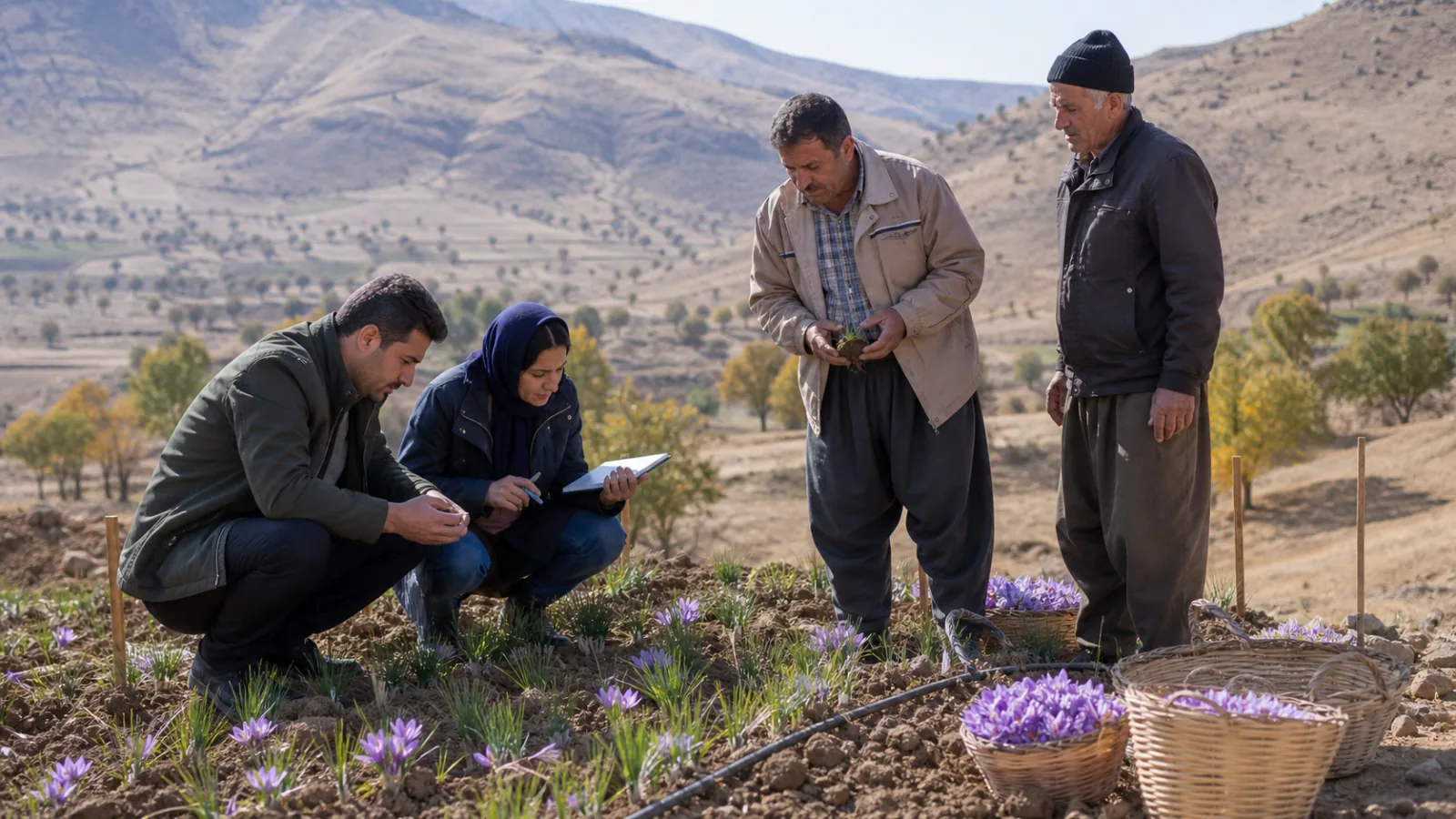
The 3,848-hectare Lorestan saffron plan
The source quoted Alireza Ahmadvandi, director of horticulture at the Lorestan Agricultural Jihad Organization. It said the organization and a research centre intended to establish 3,848 hectares of saffron across the province over seven years.
That wording is crucial. The figure described a cumulative target, not the area planted in one season and not the area producing dry saffron in 2019. For readers researching “saffron in Iran in Lorestan,” the reliable record is the target, responsible institutions and seven-year horizon.
The announcement belongs to the wider story of saffron cultivation in Iran: provinces outside the traditional Khorasan production centre were testing whether the crop could support water-aware diversification and rural income. Each new saffron farm in Iran still needed local evidence on climate, soil, water, labour and buyers.
The financing figures are not usable as US dollars
The translated report said “about 5 million USD” would be paid by the state and then mentioned “20 million USD” without clearly naming the second contributor or purpose. Those dollar labels are not credible in context, and the source does not provide the original Persian currency, loan terms or programme document.
The amounts must therefore remain unresolved financing figures. They should not be converted into rials, tomans or dollars by guesswork. A useful funding record would identify whether each amount was a grant, credit line, grower contribution or total investment; who qualified; the interest and repayment conditions; and what expenditure it covered.
That distinction affects the economics of Iran saffron farms. Subsidized planting material may lower the first-year cost, but debt can magnify risk if fields are expanded before yield and demand are demonstrated.
Why a seven-year rollout needs stages
Moving from trials to 3,848 hectares should not be a single area target. A phased programme can test representative locations first, follow them over several seasons and expand only where measured performance supports it.
For each site, the research and extension record should include:
- field location, elevation, soil texture, drainage and salinity;
- corm source, health, size distribution and planting density;
- irrigation timing and volume, plus rainfall;
- field age, flowers harvested and dry stigma yield;
- labour for picking, separation and drying;
- quality results connected to a named lot; and
- sale price, buyer requirements and unsold inventory.
A province can reach its hectare target while creating weak farms if those measures are ignored. The goal should be productive, marketable area rather than planted area alone.
What makes a Lorestan field suitable for saffron?
Lorestan contains varied terrain and local climates. A result from one county cannot establish suitability across the province. Saffron needs an annual cycle that supports corm dormancy, autumn flowering and winter–spring vegetative growth, along with soil that does not leave the corms waterlogged.
Water demand must be considered by volume and timing. The crop may fit some dry-region systems, but low-water language should not replace a field water budget. Salinity, drainage and access to the first irrigation can be as important as the number of irrigations.
New growers also need a realistic labour plan. Flowers emerge over a short period and must be collected repeatedly. Expanding area faster than local picking and stigma-separation capacity can reduce quality even when field yield is good.
Harvest quality has to scale with area
A large production programme needs clean containers, rapid transport, hygienic separation, controlled drying and moisture-protective storage. Shared facilities can help small farms, provided each lot remains identifiable and is not mixed before its quality is known.
ISO 21983:2019 gives current guidelines for harvesting, transporting saffron flowers, separating stigmas, drying and storage before packing. The current ISO 3632-1:2025 specification covers dried saffron in filament, cut-filament and powder forms.
Standards do not guarantee a buyer. They give growers, processors and buyers a common way to describe the product and compare lots.
The Aligudarz thyme figures
The second half of the source shifted from saffron to thyme in Aligudarz. Its English text said thyme was harvested at “9 and 280 kilograms per hectare” and that the result was 3,780 kilograms of dry matter. The first area figure is grammatically incomplete, so the total and per-hectare result cannot be reconciled safely.
It then valued each kilogram at “10 thousand USD” and the total at 37–38 million USD. Those currency labels are plainly unreliable. They likely originated as local-currency values, but the underlying unit is absent. Preserving the numerical strings does not make them valid dollar revenue.
The report also said an early thyme harvest was 4,530 kilograms and would later double. It does not define the area, year, fresh-or-dry basis or method behind that projection. Any investment comparison between thyme and saffron would need those missing definitions.
The “Mohammad flower” result was probably Damask rose
Ahmadvandi was also quoted as reporting 1,274 kilograms in the first year from one hectare of “Mohammad’s flowers.” This is almost certainly a literal translation of gol-e Mohammadi, the Persian name commonly used for Damask rose.
The source referred to rain-fed, supplementary-irrigation and “blue irrigation” conditions. “Blue” is likely a machine-translation error for fully irrigated or water-supplied production, but the sentence does not show which treatment produced the 1,274-kilogram result. The figure is therefore retained as an attributed first-year, one-hectare statement without assigning it to a specific water regime.
Thyme, Damask rose and saffron are all high-value aromatic or medicinal crops, but their harvest material, water calendar, labour, processing and market are different. They should not be compared using a single price-per-kilogram headline.
How to judge the Lorestan programme
A later review should begin with the 2019 target and ask how much was actually planted each year, how much reached productive age and how much dry saffron met a stated specification. It should publish water, labour and economic results from representative farms rather than only a provincial total.
Funding should be traceable to outcomes: healthy corms established, growers trained, harvest facilities operating and lots sold. Thyme and Damask rose results should be reported separately with their own area, fresh-or-dry basis and currency.
The Lorestan announcement was ambitious and worth recording. Its lasting value depends on turning a seven-year hectare target into reliable farms, not retroactively treating 3,848 planned hectares as an accomplished 2019 saffron area.

![Exporting Saffron to Turkey + Price Guide [Complete 0 to 100]](https://img.rowhanisaffron.com/20260827003933/saffron-export-turkey-quality-inspection.webp)



