


Hamadani drink jam from saffron petals referred to a 2019 Hamadan proposal to turn the purple petals left after stigma separation into a local jam or preserve. The source announced product development; it did not publish a recipe, safety assessment or confirmed retail launch. Its wider message was that better standards, packaging and grower coordination were needed before Hamedan saffron could build a stronger regional brand.
The Hamedan announcement behind the title
The original article quoted Qassim Asadian, director of the Agricultural and Natural Resources Research Center of Hamadan Province. His surname also appeared later in the translation as “Asidean,” the only visible search query recorded for the page. Both spellings refer to the same speaker in the source.
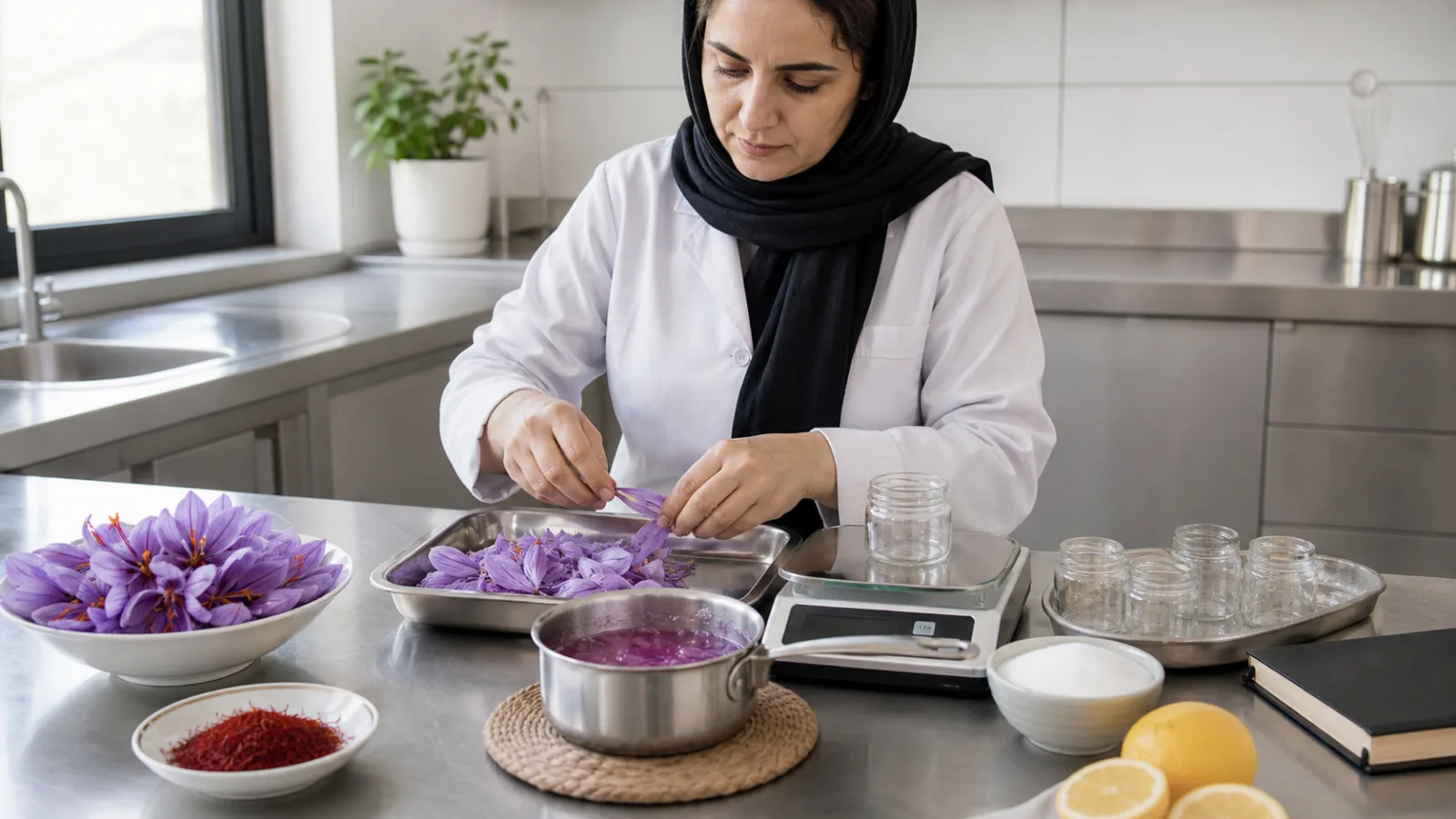
Asadian said the organization planned, for the first time in the province, to use saffron petals to prepare jam. The English headline’s phrase “drink jam” is unclear. It may reflect a combined reference to a drink and jam, or simply a damaged translation of a petal preserve. Without the Persian announcement or formula, it should not be converted into a specific recipe.
The proposal addressed a real by-product. Saffron spice is made from the flower’s red stigmas, while the much larger mass of purple petals is normally separated during processing. Finding a safe, attractive use for those petals could add value, but the finished food must be developed as its own product.
What the 2019 Hamedan saffron figures said
Asadian reported 145 hectares of saffron in Hamedan and said there were no clear statistics on how the crop was distributed within the province. He placed Iran’s total production at 250–300 tonnes and Hamedan’s contribution at 725 kilograms.
Those numbers are historical statements with unlike levels of precision: a national range and an exact provincial figure. The article does not identify the crop year, reporting table or whether Hamedan’s number was forecast or final production. They should not be presented as current totals.
The absence of district-level distribution data was an important weakness. A credible provincial record would separate planted and productive area, identify field age, record dry stigma rather than fresh flower weight and name the reporting season.
Why one kilogram can require so many flowers
The official said approximately 170,000 saffron flowers were picked for each kilogram of dry saffron. The exact ratio varies with flower size, stigma cut, moisture and processing loss, but the figure conveys the labour concentration accurately: only three stigmas are taken from each flower.
Asadian linked that work to high labour cost and said the province lacked specialized harvesting machines. Picking is only one bottleneck. Large numbers of flowers also have to reach a clean separation area quickly, and the stigmas then need consistent drying.
Petal products do not remove that labour requirement, but they may create a second saleable stream from material already gathered. The additional cleaning, storage and processing cost has to be included before calling the by-product profitable.
Petals are not the saffron spice
The culinary spice called saffron is the dried stigma of Crocus sativus. Petals have a different composition, colour, flavour and regulatory identity. A petal jam should not be labelled or priced as though it contains the same quantity of saffron spice.
Research has identified anthocyanins and flavonoids in saffron petals and has investigated possible food applications. A study of petal extracts reported antibacterial activity under laboratory conditions but explicitly called for further investigation before food-industry use. A test-tube result is not proof that jam treats illness or preserves itself safely.
The botanical identity must also be controlled. Crocus sativus petals should come from known saffron fields and remain traceable to the harvest. “Autumn crocus” is also used for Colchicum autumnale, a different poisonous plant. A food process should never accept anonymous decorative flowers or material identified only by colour.
How a saffron-petal jam should be developed
Because the source supplied no formula, a responsible development project would begin with controlled pilot batches rather than a household recipe presented as the announced product. The work should define:
- species identity, field source and harvest hygiene;
- whether petals are used fresh, chilled, frozen or dried;
- cleaning, sorting and limits for soil, insects and other plant parts;
- petal, sugar, acid and water proportions by weight;
- heat process, fill temperature, container and closure;
- finished pH, soluble solids and microbiological criteria;
- sensory testing for bitterness, aroma, colour and texture; and
- validated storage conditions and shelf life.
A bright colour and a sealed jar do not prove shelf stability. The process must be appropriate to the recipe, package and intended storage. If the product is sold, the manufacturer has to meet the food rules of the market where it is offered.
Standards and packaging for a Hamedan brand
Asadian called for saffron-specific standards determined in well-equipped, validated laboratories. He also wanted packaging materials and package sizes defined as part of branding Hamedan saffron.
That is sound only if brand design follows product evidence. The current ISO 3632-1:2025 saffron specification applies to dried saffron in filament, cut-filament and powder forms. It does not certify petal jam. The jam needs its own food specification, ingredient declaration, net quantity, lot code, storage instruction and applicable nutrition or allergen information.
For the spice, packaging should protect the lot from moisture, contamination and unnecessary light exposure. Package size should match the customer’s use while allowing a traceable code to remain legible.
Grower coordination and fraud concerns
The report said Hamedan lacked a union or company able to bring saffron farmers together. Asadian connected that fragmentation with fraud and with slow development of cultivation and sales.
A cooperative cannot prevent every form of fraud, but shared services can help: verified corm suppliers, harvest training, a controlled drying facility, representative sampling, lot records and collective negotiation with buyers. Governance matters. Growers need transparent grading, fees and payment rules rather than a new middle layer they cannot audit.
Petals add another traceability question. The processor should know which flower lots supplied them and should keep petal-food production separate from material exposed to unsuitable handling or chemicals.
Claims about climate, water and medicinal value
Asadian called Hamedan a natural saffron habitat and cited its semi-arid conditions, elevation and unpolluted soils. He also said saffron could grow in varied climates, needed very little water and had medicinal value. The translation included a place or phrase rendered as “Deliza,” which cannot be identified confidently.
These statements are better treated as reasons for local trials than universal conclusions. Soil and water should be tested field by field. Saffron’s seasonal water pattern can be useful, but the crop still requires timely moisture and drainage. “Unpolluted” needs analytical evidence, not landscape appearance.
Laboratory or traditional-use evidence about saffron and its petals must not be turned into treatment claims for jam. A sweet preserve is a food, with serving size and sugar content that belong in the product decision.
Support offered to Hamedan growers
The Agricultural Jihad Organization’s actions were described as directing farmers to approved places for buying saffron “bulbs,” providing horticultural guidance and making a relevant specialist available. The correct planting term is corm.
Approved sourcing can reduce the risk of weak, injured or misidentified planting material, but records should still identify the corm lot and recipient field. Advice is most useful when it follows the crop beyond planting through irrigation, harvest, drying, testing and sale.
What success would look like
The petal-jam idea can support a Hamedan saffron brand if it begins with the correct species, uses petals handled as food, passes process and shelf-life validation and is described honestly. A launch announcement is only the first step.
At provincial level, success would also mean clear statistics for the 145-hectare base, traceable dry saffron, lower quality loss after harvest and grower coordination that improves bargaining without hiding grades or payments. Petal products then become one part of a stronger system—not a substitute for the work needed to make the saffron itself consistent.

![Exporting Saffron to Turkey + Price Guide [Complete 0 to 100]](https://img.rowhanisaffron.com/20260827003933/saffron-export-turkey-quality-inspection.webp)



