


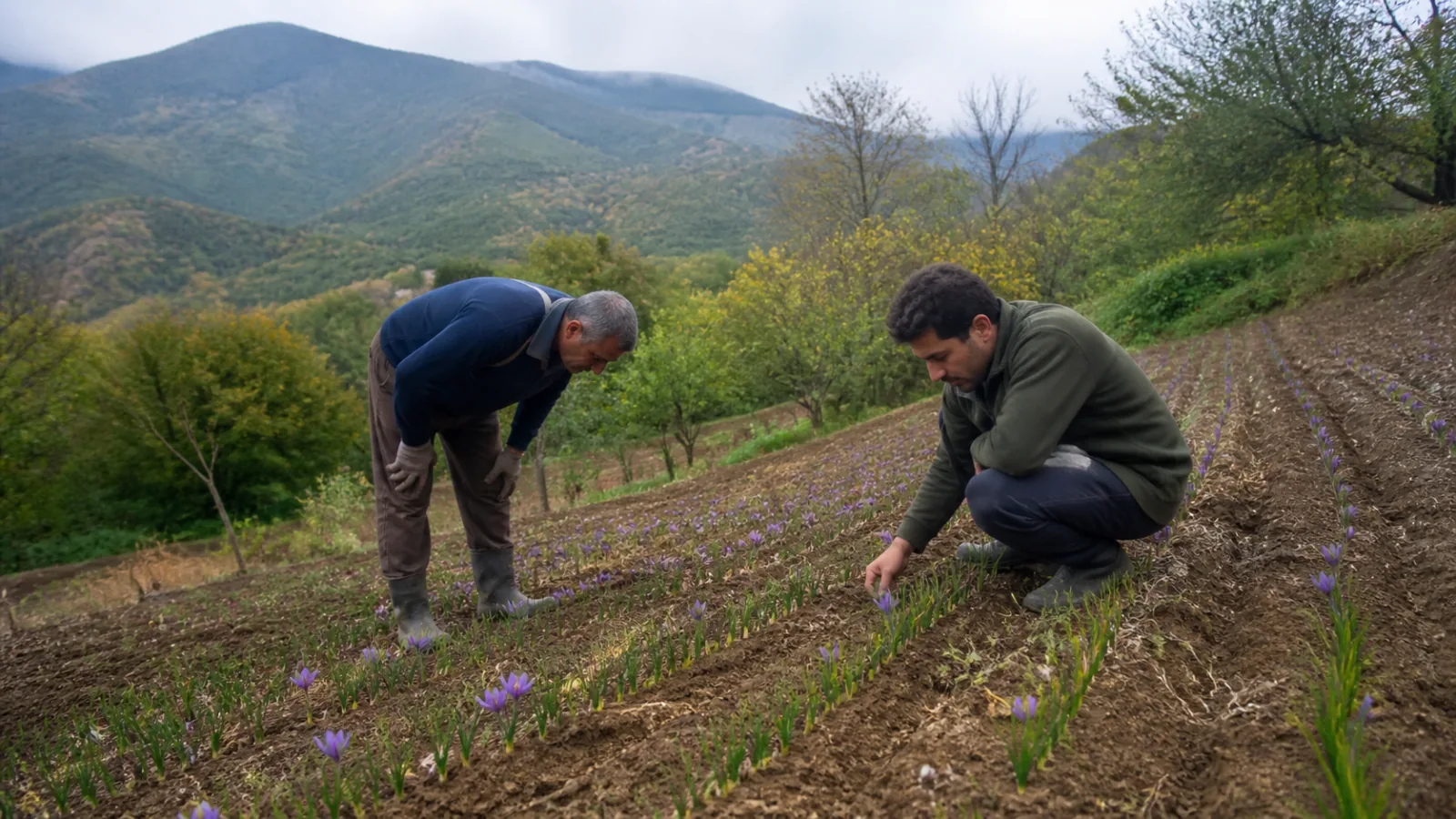
Saffron cultivation for agriculture in Dodanje Sari in Iran described a small upland programme in Mazandaran’s Dodangeh District. The 2019 report said local farmers had grown saffron there for more than ten years and that the area planned to expand beyond six hectares. Its most useful lesson is not that saffron needs no water or farm inputs. It is that a new crop should be tested against the actual soil, slope, rainfall, labour and market of each village.
Why saffron was introduced in Dodangeh
Sari is part of green, rainy Mazandaran Province, but its farming conditions are not uniform. Dodangeh lies in the county’s upland interior, where elevation, slope and distance from markets create a different set of choices from the Caspian plain.
The report described Dodangeh as a disadvantaged area that had lost young residents because work was scarce. It credited grape and saffron cultivation with helping some of the remaining young people stay in farming.
That social aim was linked to rural production and employment policy, sometimes translated as the “resistance economy.” The article hoped growers could use expert advice, market their crops and obtain reasonable prices. It did not provide farm-income records showing that those outcomes had already been achieved.
The reported area and cultivation history
Mohammad Sadeghi, identified in the report with Mazandaran’s Agricultural Jihad organisation and the Dodangeh pilot project, said saffron cultivation in the district had continued for more than ten years.
He said the programme began with “a thousand metres.” The source does not specify whether that meant 1,000 square metres of land, elevation or another measure, so it should not be silently converted into hectares. The same account said more than six hectares of saffron cultivation were then on Sari’s agenda.
The wording matters. An area placed on a programme or agenda is not necessarily all planted, mature and harvested. A later assessment should separate trial plots, newly planted fields and productive stands.
Dodanje and Dodangeh refer to the same local topic
“Dodanje” is retained in this page’s historical title and URL because that is how the original English article was published. Dodangeh is the more familiar English spelling for the district in Sari County. The two spellings should not be treated as different cultivation projects.
Saffron does need water
The original article made the absolute claim that saffron’s water requirement was zero. That is incorrect. Saffron has a summer dormant period and may need less irrigation than some alternatives in a suitable climate, but corm establishment, autumn flowering and later leaf growth still depend on available moisture.
In rainy Mazandaran uplands, the problem may be timing and drainage rather than annual rainfall alone. Waterlogged soil can damage corms, while a dry period at a critical stage may still require irrigation. A field trial should record rainfall and irrigation together instead of calling rain-fed production water-free.
The report connected saffron with falling rainfall, pressure on groundwater and a change in the local crop pattern. Those concerns justify comparison. They do not prove that saffron is suitable for every slope or that it will always use water more productively.
Fertiliser and crop protection are not automatically unnecessary
The source also said saffron did not need “poison and fertilizer.” A better rule is to avoid routine inputs that the field does not need.
Soil testing, corm condition, previous crops and visible field problems should guide decisions. A clean trial may require no pesticide, but weeds, rodents, corm rot or other problems can still occur. Fertility should be based on the soil and crop, not a universal promise of zero fertiliser.
Growers should begin with correctly identified, sound corms. Our practical guide to saffron corm selection explains why source, condition, size and storage history matter more than calling planting material a particular commercial grade.
What happens in the first years of a saffron field
Sadeghi said the first and second years were associated with corm growth and that multiplication became important from the third year. Daughter corm formation is part of the crop’s continuing cycle, but the exact development and flower yield vary with planting material, density and field conditions.
The article also suggested moving or replanting the crop after about ten years because crowding and reduced nutrient access could lower flowering. Ten years is a local management horizon, not a fixed biological expiry date.
A grower should watch the stand rather than the calendar alone. Declining flower counts, crowded corms, disease pressure, weed problems and soil condition can all influence the decision to lift, sort and replant. Unhealthy corms should not be spread into a new field.
Can low-productivity sloping land be used?
The project aimed to use sloping land that produced little under existing systems. That can be worth testing, but “low productivity” does not mean “unused” or “risk-free.” Slopes may have shallow soil, erosion, awkward access and uneven moisture.
A sensible pilot starts with a mapped plot. Farmers should record slope, soil depth, drainage, access, previous use and erosion after heavy rain. Planting rows and field traffic should be planned so they do not channel water downhill or strip topsoil.
Harvest logistics matter too. Saffron flowers need repeated collection over a short season. A field that is difficult to reach in wet weather may create more labour and handling risk than its planted area suggests.
Quality has to be demonstrated lot by lot
The report said saffron produced in Dodangeh had been evaluated as high quality, but it gave no sample size, laboratory result or grading method. The statement should remain an attributed historical assessment rather than a guarantee about every local lot.
ISO 3632-1:2025 specifies requirements for dried saffron from Crocus sativus in filament, cut-filament and powder forms. ISO 21983:2019 gives guidance for harvest, flower transport, stigma separation, drying and storage before packing.
For a small new region, lot records are especially valuable. They connect the result to a particular village, field, harvest period and drying batch, allowing growers to learn which conditions actually produce a better product.
Market access determines whether the crop supports rural jobs
Planting saffron does not by itself prevent migration. A grower needs a buyer, a transparent product specification, enough seasonal labour and a price that covers corms, field work, flower picking and post-harvest handling.
Dodangeh’s small scale could support a shared approach. Farmers can coordinate training and clean handling while keeping each lot identifiable. They can compare saleable yield and realised price rather than relying on planted hectares as the measure of success.
How the programme should be evaluated
A useful follow-up would report the number and area of trial, young and mature fields; dry yield; rainfall and irrigation; labour hours; corm losses; tested quality; and the price farmers actually received. It should also say how many participants continued after several seasons.
Saffron cultivation for agriculture in Dodanje Sari in Iran opened a practical question for the district: could a carefully managed upland crop create durable work on land with limited alternatives? The answer depends on measured field performance and a functioning market, not on the false idea that saffron needs zero water, fertiliser or crop care.

![Exporting Saffron to Turkey + Price Guide [Complete 0 to 100]](https://img.rowhanisaffron.com/20260827003933/saffron-export-turkey-quality-inspection.webp)



