


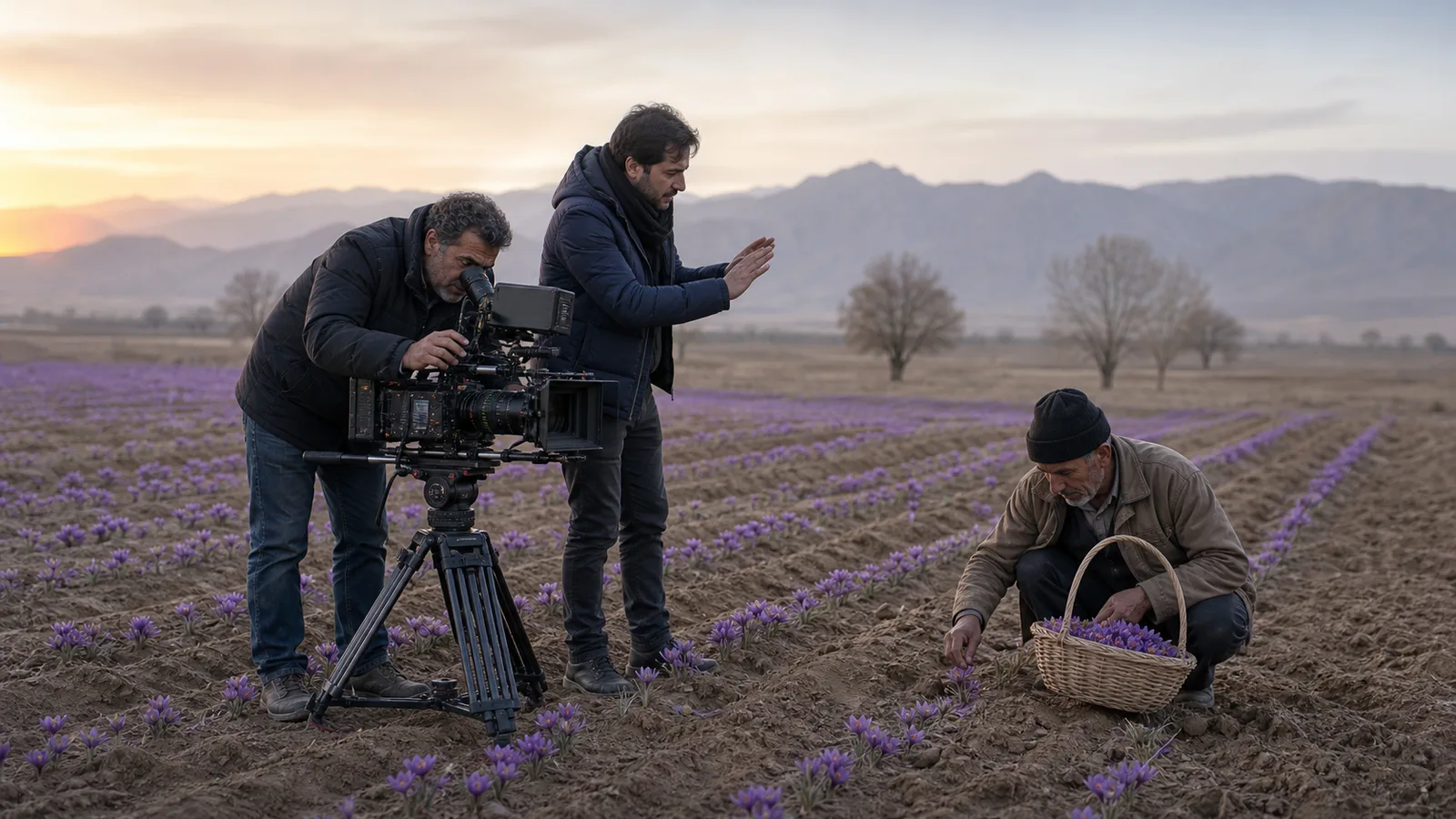
Making the first film about saffron in Iran was the ambition behind Red Treasure (Ganj-e Sorkh), a feature-film project announced in Torbat Heydarieh in 2017. The production did more than use a saffron field as attractive scenery. Its reported story placed growers, brokers, visitors and the saffron trade at the centre of the drama.
The surviving reports are valuable, but the English version previously published on this page contained mistranslated names and made an old release forecast sound current. This account separates what the production team and local officials said at the time from what can be independently confirmed today.
What was Red Treasure?
In November 2017, Mohammad Hassanzadeh, then head of Torbat Heydarieh’s Department of Islamic Culture and Guidance, introduced Red Treasure as the first Iranian feature film devoted to saffron. That description should be read as the official’s announcement of the project, rather than as an independently verified record covering every earlier Iranian film.
The film was written and directed by Omid Eshghi, a cinema graduate, and produced by Hayedeh Razmara. A Tehran-based crew travelled to Torbat Heydarieh for the production, while actors and artists from the area were also invited to take part. Contemporary local reporting said the crew expected to remain in the region for about 45 days and was auditioning local performers.
The title matters because two expressions in the earlier English account were translation errors. “The Red Trench” and “Gang Sorkh” both referred to the same production: Ganj-e Sorkh, which means Red Treasure.
A story about saffron, trade and the people around it
The original description was brief, but it established a social story rather than a documentary or a promotional film. Foreign visitors arrive in Torbat Heydarieh because of saffron. Growers, traders and brokers are part of the world they encounter, and conflict develops when brokers create conditions that push the visitors to leave.
A later production report described the subject more directly as saffron trade and smuggling. It also identified an agricultural engineer among the characters. Together, those details suggest that the film was intended to examine the human relationships and commercial tensions surrounding the crop, not simply the beauty of harvest season.
That approach gives the setting real weight. Saffron passes through many hands between a flowering field and the finished product: growers prepare and tend the land, flowers are picked during a short harvest window, stigmas are separated and dried, and merchants grade and sell the spice. A story involving farmers, intermediaries and international visitors can therefore show how value, risk and bargaining power move through the chain.
Why Torbat Heydarieh was central to the film
Torbat Heydarieh was not chosen as an interchangeable backdrop. Hassanzadeh described saffron as a strategic product for the city and said local organisations supported the production. The area’s fields and other local spaces supplied the locations the script required.
The 2017 report placed roughly 8,500 hectares of saffron in Torbat Heydarieh and cited about 32 tonnes of dried saffron production there. Those numbers belong to that reporting period and should not be treated as current agricultural statistics. They do, however, explain why a filmmaker telling a story about the crop would work in this part of Razavi Khorasan.
The landscape also carries details that are difficult to reproduce on a set. Saffron flowers close to the ground; picking is careful handwork; and the timing, light and pace of a real harvest shape how the work looks on camera. Readers who want the agricultural context can see our guide to how saffron is harvested.
Who worked on the production?
The first announcement named Eshghi as writer-director and Razmara as producer. A follow-up interview during filming listed performers Mahmoud Moghammi, Saeedeh Arab, Arash Taj, Atiyeh Sohrabi, Farzad Ramezani, Yousef Moradian and Hamed Sheikhi. Sheikhi said he played an agricultural engineer who was related to the principal character.
This mix of an outside production unit and local participation matches the earlier account: actors from Tehran worked alongside artists from Torbat Heydarieh, while the city’s cultural office and other local bodies helped the crew obtain access and practical support.
What happened during filming?
When the project was first reported, filming had begun in the saffron fields and other spaces around Torbat Heydarieh. The local official said the film would still need editing and approval from the relevant supervisory board. He expected a release the following year, but that was a forecast made during production, not a confirmed release date.
By February 2018, Hamed Sheikhi said the Torbat Heydarieh portion was substantially complete and only a few Tehran scenes remained. He also said the plan was to submit the film to international festivals before Iranian festivals and domestic presentation. That statement documents the team’s intention; it does not prove that a festival screening or public release later occurred.
We could not locate a sufficiently reliable, accessible record confirming a subsequent theatrical release or festival result. It would therefore be misleading to turn the original “next year” estimate into a claim that the film was released. The verified record supports a narrower conclusion: Red Treasure entered production, filmed extensively in Torbat Heydarieh and was reported to be close to completing principal photography.
Why a saffron film is culturally useful
Saffron is often presented only as a finished luxury spice. A narrative film can bring the less visible parts of its story into view: seasonal work, the relationship between a grower and a broker, regional identity, trade pressures and the people whose livelihoods depend on the harvest.
For customers, that context makes the product easier to understand. The dried threads in a jar begin as delicate flowers gathered in a particular place, during a demanding few weeks, before careful processing and sale. For a saffron-growing region, putting those realities on screen can preserve more than an attractive image; it can record work, language, landscape and local concerns.
Sources and record notes
This reconstruction relies on a November 2017 local report attributed to IRNA and a February 2018 interview from the production period. Names and claims are presented as reported at the time. Where the available record establishes an intention rather than an outcome, the wording remains conditional.

![Exporting Saffron to Turkey + Price Guide [Complete 0 to 100]](https://img.rowhanisaffron.com/20260827003933/saffron-export-turkey-quality-inspection.webp)



