


“Red gold saffron” is a familiar phrase for the spice’s value, but this archived industry statement argued that Iranian policy should not treat it simply as a luxury item.
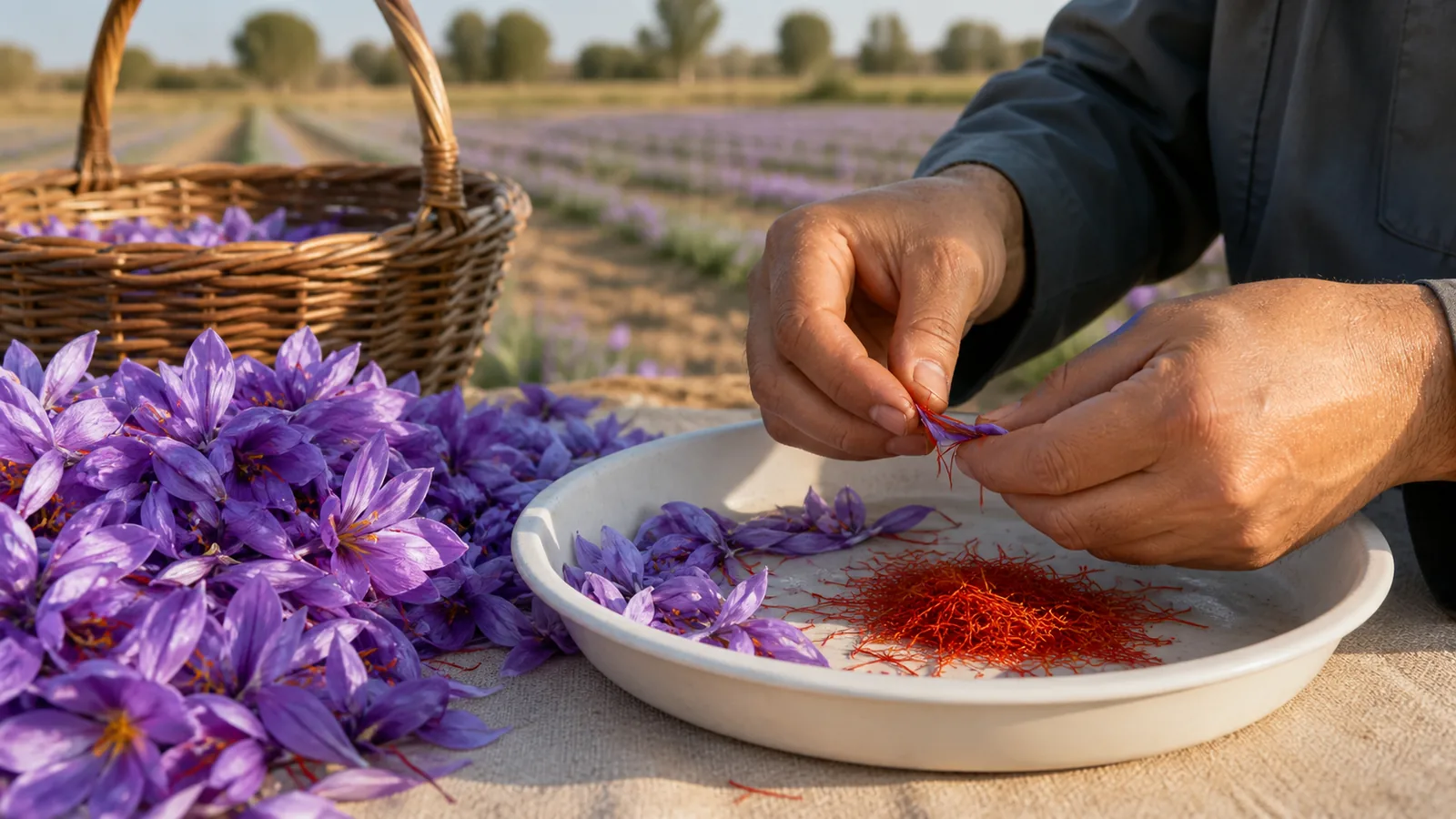
The comments were attributed to Gholamhossein Shafei, identified in the report with leadership roles in the Iranian Chamber of Commerce and National Saffron Council. His point was economic: saffron should be approached as a strategic crop with production, processing and export needs, not only as an expensive product bought in small quantities.
What “saffron is not a luxury product” meant
The original translation contains a confusing sentence about changing the view of saffron as a “super-strategic commodity.” Read with the rest of the report, the intended argument is clearer: officials should move away from viewing saffron only as a luxury and give more attention to the crop’s strategic role, from the farm through to international markets.
This was not a claim that saffron is inexpensive. Nor was it a promise about what shoppers should pay. It was a criticism of limited institutional attention to production, productivity, market development and exports.
Production had grown, but productivity remained a concern
Shafei said saffron production and the area under cultivation in Iran had increased in the preceding years. At the same time, he argued that production efficiency was lower than in other producing countries, while acknowledging that the Ministry of Agriculture Jihad had taken measures to address the issue.
The report does not define the productivity measure being compared. It could refer to dried saffron yield per hectare, labour efficiency, post-harvest loss or another metric. Without a year, dataset and common methodology, it would be unsafe to turn the comparison into a current numerical ranking. The useful point to preserve is that a larger cultivated area does not automatically produce better returns or higher-quality output.
The comprehensive saffron plan
According to Shafei, a comprehensive national saffron plan had been approved years earlier but was not mandatory. He described budget constraints as the main obstacle to implementation.
He expected the plan to improve both quantitative and qualitative production and wanted it implemented across the country quickly. In practical terms, those are separate goals. Quantity concerns how much marketable saffron reaches buyers; quality also depends on harvesting, separation, drying, storage, testing and packaging.
Where cultivation should expand
The report criticised indiscriminate expansion into every region. Shafei presented saffron as a crop suited to areas with low rainfall and water constraints, particularly in the context of Iran’s water crisis.
That statement should not be read as “saffron needs no water” or “saffron can grow anywhere.” A suitable site still depends on climate, soil, corm health, irrigation timing, labour and local agronomy. The policy argument was to align expansion with places where the crop is appropriate instead of chasing cultivated area as an end in itself.
Competition, branding and direct market access
Shafei said Iranian saffron faced newer competitors using more systematic and scientific approaches. To defend Iran’s place in the global market, he called for stronger branding and more consistent work to establish Iranian saffron in buyers’ minds.
He also argued that much Iranian saffron reached final consumers through intermediaries who exported it under their own names. The National Saffron Council had made proposals intended to connect production more directly with the end market, with support sought from the Parliamentary Agriculture Commission for a national Iranian saffron brand.
The aim was to keep more added value with Iranian growers and exporters. Direct access can help, but removing every intermediary is neither realistic nor automatically beneficial. Testing laboratories, processors, warehouses, logistics providers and distributors may perform essential work. The real concern is whether Iran retains recognition and value for origin, quality and processing.
A related archival proposal described how seasonal processing sites might later operate as exchange centres. Our explanation of that Iranian saffron exchange model separates the original claims from current evidence and explains what “exchange” meant in that context.
Why processing industries mattered
The final concern in the report was limited attention to conversion and processing industries. Shafei contrasted that gap with international presentations of products derived from two prominent Iranian crops: saffron and pomegranate.
For saffron, downstream work can include grading, authenticity testing, food-safe packaging and the development of clearly specified products. It can also include ingredients made for food manufacturers. Each step needs quality controls; turning saffron into more products is useful only when identity, safety and traceability remain clear.
What current evidence can—and cannot—confirm
Current official work supports the broad importance of these value-chain issues. In November 2025, the FAO and Iran saffron value-chain workshop addressed post-harvest handling, food safety, traceability, modern marketing, digital branding and authenticity with farmers, processors, cooperatives and traders.
Trade data also show that Iranian-origin saffron continues to reach multiple markets. The World Bank WITS page for 2024 importer-reported saffron trade from Iran lists values and quantities by reporting destination under product code 091020. These are gross trade flows, not farm income, brand value or proof that a particular national plan was implemented.
Neither source validates every historical statement in this archive. They do show why processing quality, origin recognition and market access remain more substantial questions than whether saffron carries a luxury label.
The lasting point behind the red gold argument
Saffron can be costly at retail and still be strategically important to producing communities. Those ideas are not opposites. The old statement asked policymakers to look beyond the price of a small jar and examine the whole system behind it: productivity, water-aware cultivation, processing, branding, direct access and the share of value retained in Iran.
That is the most defensible meaning of “red gold is not a luxury item.” It is an argument about how a nationally important crop should be managed, not a current price claim or a guarantee that every expansion plan will succeed.

![Exporting Saffron to Turkey + Price Guide [Complete 0 to 100]](https://img.rowhanisaffron.com/20260827003933/saffron-export-turkey-quality-inspection.webp)



