


Quality education for barberry and saffron in South Khorasan means practical, standardised training that follows each crop from the field to a saleable product. An archived provincial meeting called for that approach across agriculture, mining, tourism and handicrafts, with training tied to the work and income opportunities that actually exist in the region.
The meeting reported here took place before this article was published in 2021. Its named offices and proposed trip should therefore be read as a dated policy record, not as an announcement of a programme currently open for enrolment.
The plan for standardised vocational training
Ali Ausat Hashemi, then identified as the head of Iran’s Technical and Vocational Education Organization and a deputy minister of Cooperatives, Labour and Social Welfare, discussed the plan in a meeting with the governor of South Khorasan. He said a visit to the province would address the quality and standardisation of education in mining, barberry, jujube and saffron.
Hashemi said the technical and vocational organisation was responsible for standardising the country’s technical and skill fields. He grouped its work into four areas: industry; agriculture; services; and culture and art. The South Khorasan discussions were meant to consider how those national responsibilities could match the province’s distinctive economy.
The wording “quality of education” in the original translation can sound like a general assessment of schools. In context, the subject was narrower: occupational standards, course quality and skills training for particular local industries.
Why barberry, jujube and saffron need specialised skills
These crops are not interchangeable. Each has its own cultivation calendar, harvest risks, quality defects, handling requirements and routes to market. South Khorasan’s seedless barberry is a major regional crop, while saffron quality depends on disciplined work at several time-sensitive stages.
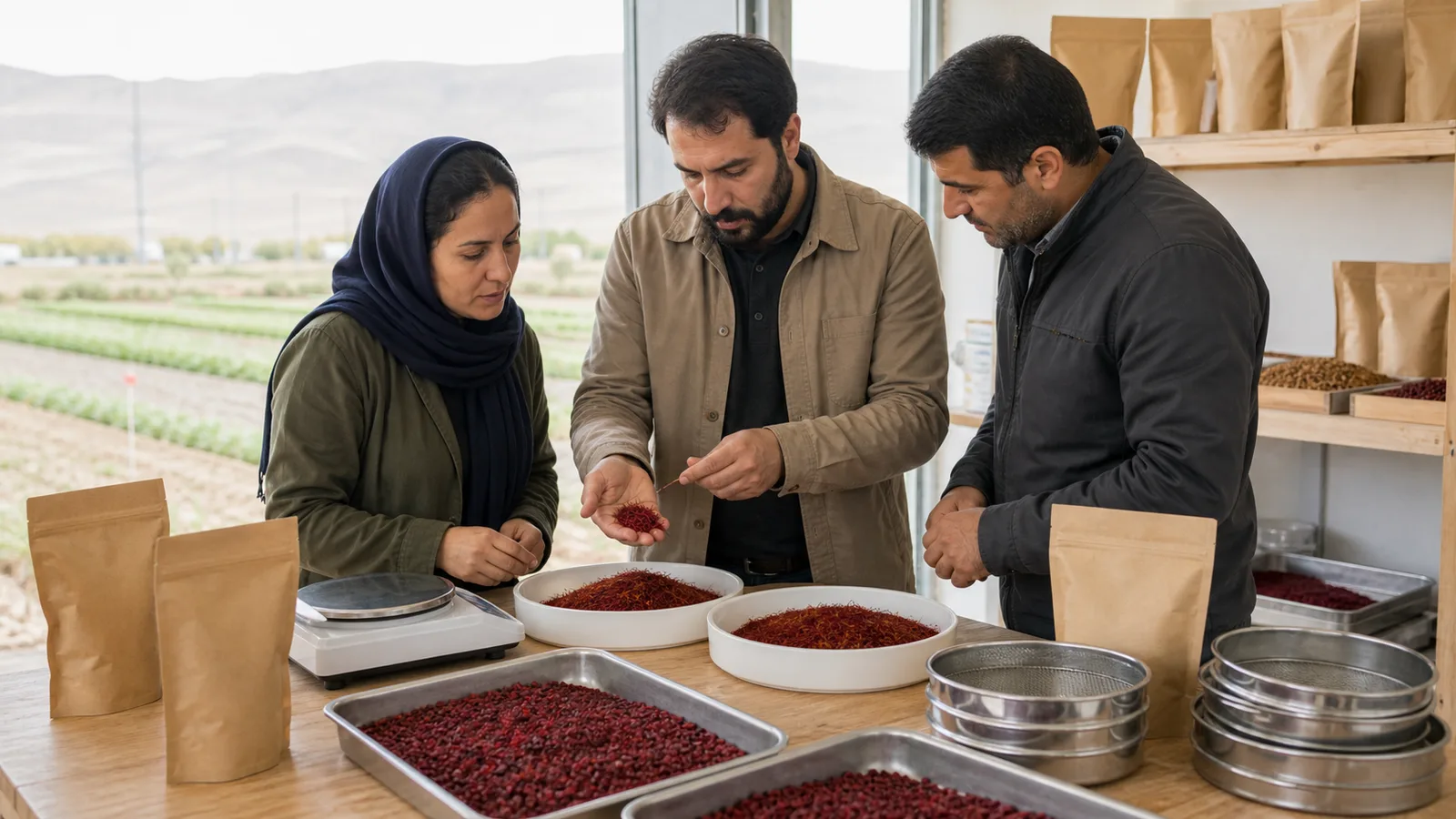
A useful saffron course should extend beyond planting. It can cover corm selection, field hygiene, irrigation decisions, harvest timing, separation of stigmas, hygienic drying, storage, grading, traceability and preparation for the buyer’s specification. Training should distinguish practices that affect colour, aroma, contamination risk and physical appearance rather than treating “saffron cultivation” as one undivided skill.
Barberry training has a different post-harvest problem. The FAO AGRIS record on Iranian seedless barberry cultivation describes the crop’s established place in South Khorasan and notes that harvest and drying practices affect production. Skills in branch handling, drying conditions, sorting and storage can therefore influence both avoidable loss and the grade a grower is able to sell.
Jujube needs its own modules rather than being added as a label to a generic agriculture class. Fruit maturity, drying, pest management, sorting and food hygiene all need locally relevant examples and equipment.
What makes vocational education useful to growers
A standard is most valuable when a learner can use it. For barberry and saffron in South Khorasan, that means training designed around the crop calendar and delivered close enough to production areas for growers and workers to attend. Demonstration, supervised practice and assessment of a real task matter more than a lecture alone.
- Start with the market requirement: explain what a processor, packer or export buyer measures and why.
- Demonstrate the task: let learners practise harvest, separation, drying, sorting, packaging or equipment use.
- Make standards observable: use examples of acceptable and defective material instead of relying only on terminology.
- Include business skills: calculate labour, loss, yield, packaging cost and sale price using local examples.
- Update the course: revise instruction when equipment, safety rules, buyer specifications or production conditions change.
This approach also helps avoid a common gap: training people in production without teaching them how to protect quality after harvest. A high-value crop can lose value quickly through poor drying, contamination, moisture, crushing or unsuitable storage.
The governor’s wider employment argument
Mohammad Sadegh Motamedian, then governor of South Khorasan, said the province was ready to use its technical and vocational capacity to realise its economic potential. He pointed to its minerals and mines, distinctive agricultural products, tourist attractions and handicrafts as resources that could benefit residents if they were managed well.
In the meeting’s account, Motamedian cited four “global natural attractions,” more than 1,000 works on the national register and more than 60 types of handicraft. The archived report does not identify those four attractions or provide a register date, so the figures are retained as his attributed statement rather than presented as a current inventory.
He also referred to work by provincial technicians and professionals during the two years preceding the meeting. One example was the creation of a specialised gemology and gem-cutting department in Ferdows. This illustrates the policy model being proposed: choose a recognised local resource, define the skills around it and build training that can lead to paid work.
Handicrafts, job clusters and 3,000 artisans
Motamedian described handicraft and job-creation clusters intended to involve 3,000 artisans and artists in the province. Skills training for the target community was one of the programme’s planned components, and he argued that cooperation with the technical and vocational organisation would be important.
The number records the scope discussed at that meeting; it should not be read as proof that 3,000 people completed training or obtained lasting work. A proper programme evaluation would need enrolment, completion, employment, income and business-survival data.
Border skills and overseas education
The governor also described South Khorasan’s border as an economic and educational capacity. He argued that overseas education could support the development and strengthening of relations and asked the technical and vocational organisation to help pursue it.
For agricultural products, cross-border training is useful only when it remains concrete: buyer specifications, packaging, documentation, food safety, logistics and communication. It should complement local production skills rather than promise export income on its own.
What success would look like
The meeting made a credible case for aligning education with South Khorasan’s resources. The next step is measurable delivery. For saffron and barberry, success is not the number of course titles created; it is whether learners perform the work more safely, reduce loss, meet a clearer quality standard and improve their access to dependable markets.
The original proposal remains relevant as a design principle: vocational education works best when national standards are translated into the real tasks, crops and businesses of the region.

![Exporting Saffron to Turkey + Price Guide [Complete 0 to 100]](https://img.rowhanisaffron.com/20260827003933/saffron-export-turkey-quality-inspection.webp)



