


A Qazvin training programme brought four Lebanese students into a practical saffron course, linking Iranian agricultural knowledge with cultivation in Lebanon.
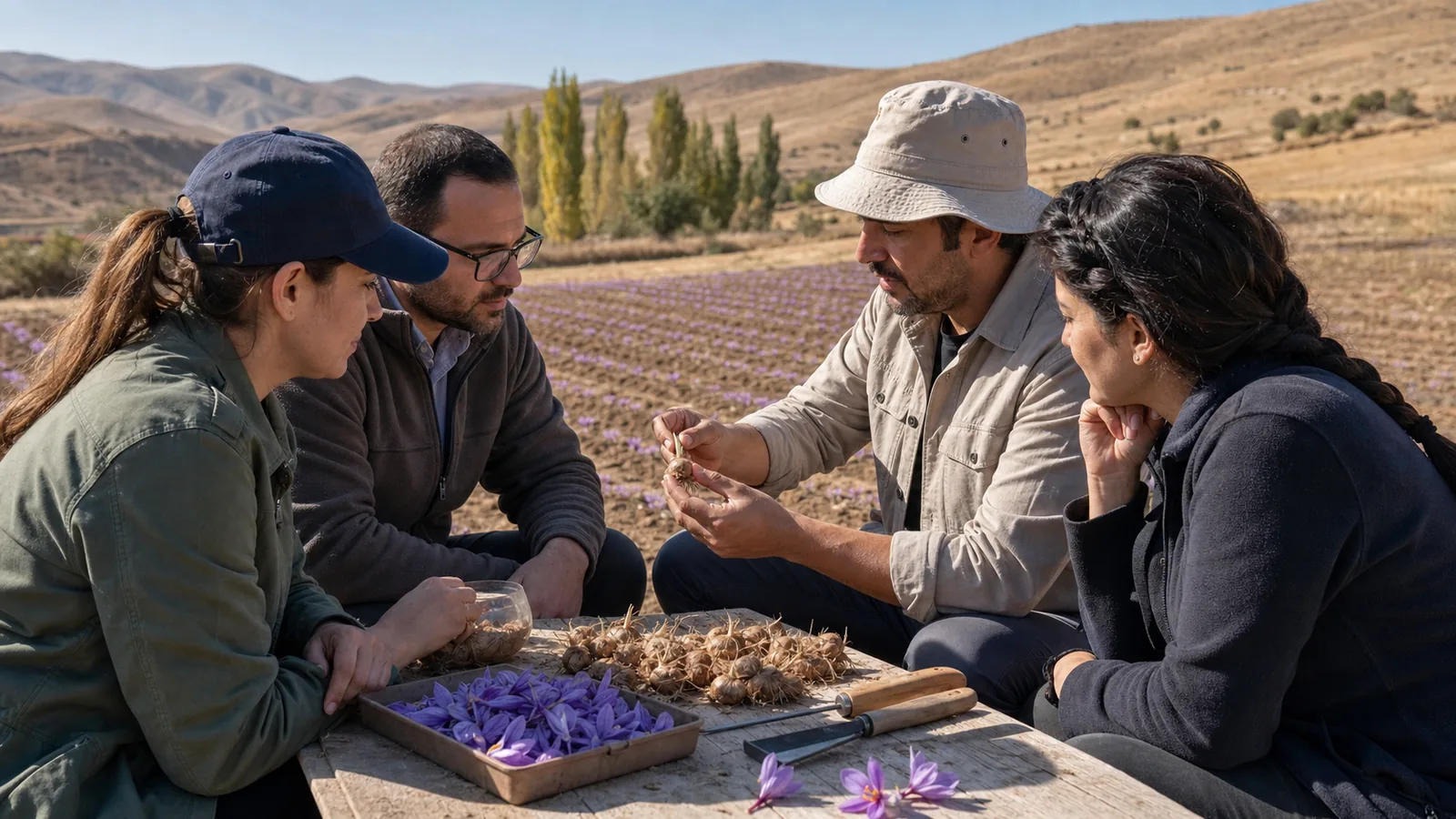
The event belongs to an earlier period, not the present academic year. Farshad Pilehchi, then education deputy of Jihad Daneshgahi in Qazvin, described it as the organisation’s second international saffron cultivation course. The four participants were reported to have begun planting saffron after returning to Lebanon.
From Qazvin saffron training to Lebanon
Pilehchi said the second course followed an international programme held the year before. Its purpose was practical: students were learning how saffron is established and managed, rather than attending a general talk about the spice.
The original report gives no names, farm locations, acreage or harvest results for the four Lebanese students. It therefore supports a modest conclusion—that they attended the course and were planting in Lebanon—not a claim that the Qazvin programme created a commercial industry or guaranteed a successful crop.
Lebanon already had its own history of saffron field research. A study published in the Lebanese Science Journal records field experiments at the American University of Beirut’s Agricultural Research and Education Center between 2000 and 2002. Researchers examined how spacing affected flower and corm production in the semi-arid Bekaa Valley. That earlier work provides useful context: the students’ training was part of a wider exchange of cultivation knowledge, not saffron’s first appearance in the country.
What the Qazvin centre was teaching
Saffron cultivation was one course in a much larger vocational programme. In the three months covered by the report, Pilehchi said the Qazvin centre had trained more than 3,500 people through 131 courses. Twenty new course subjects had been offered during the summer.
He also reported a 65% increase in the number of course titles and a 240% rise in learner participation. These percentages were comparisons made by the centre at the time; the archived story does not identify the baseline period or provide enrolment records that would allow them to be recalculated.
For the Iranian year 1396, corresponding broadly to 2017–18, the centre organised its work around two goals:
- courses intended to help people enter work or start earning, including Android programming, accounting, dental assisting, laboratory technician training, saffron cultivation and mushroom cultivation; and
- skills development for people already in employment, including specialist training for industrial workers and organisations.
The programme crossed several subject areas: computing, agriculture, medicine, engineering, industry, higher education, foreign languages, humanities and online learning. That range explains why the saffron course appeared alongside technical and professional subjects that had no direct connection to farming.
Why a course is only the beginning
Training can cover the decisions that determine whether a saffron plot has a sensible start: selecting sound corms, assessing soil and drainage, setting planting density, timing field work, controlling weeds, harvesting flowers promptly and drying stigmas carefully. Local trials are still necessary because methods cannot be copied from Qazvin to Lebanon without considering climate, soil and farm resources.
The American University of Beirut’s current saffron programme at AREC makes that local dimension clear. The centre says it has worked on saffron production, training and applied research for more than 15 years in the Bekaa Valley, with commercial production beginning in 2014. Its programme covers cultivation, harvesting, drying, storage and quality control.
Those later activities do not prove what happened to each of the four students from the Qazvin course. They do show that Lebanon has a suitable setting for serious saffron teaching and field work, and that cultivation knowledge continued to develop there.
Employment courses and access to finance
The Qazvin centre was also researching new short courses around local employment needs. The stored English text names game development and mobile-phone software and hardware repair among the examples, alongside medical, information-technology and agricultural subjects.
Pilehchi described cooperation between Jihad Daneshgahi and the province’s Basij Sazandegi organisation. Under that plan, participants could receive training and a certificate in subjects such as saffron cultivation, mushroom cultivation and medicinal-plant production. The report says graduates could then become eligible to apply for self-employment loans.
Eligibility is not the same as approval. The original article does not state loan values, interest rates, repayment terms or how many trainees ultimately received financing, so none of those details should be inferred.
Two first-time saffron courses in Qazvin
At the time of the announcement, the Short-Term Specialized Training Center had held two saffron cultivation courses described as the first of their kind in Qazvin province. One of them included the four Lebanese students and gave the programme its international connection.
The “red gold from Qazvin to Lebanon” story is therefore about knowledge transfer more than the movement of a finished product. It records a small group learning cultivation methods, a provincial centre expanding employment-oriented education, and a crop that required local Lebanese research and practice after the classroom work ended.

![Exporting Saffron to Turkey + Price Guide [Complete 0 to 100]](https://img.rowhanisaffron.com/20260827003933/saffron-export-turkey-quality-inspection.webp)



