


For farming communities along the Zagros, saffron’s red stigmas offered a high-value crop with relatively modest seasonal water needs.
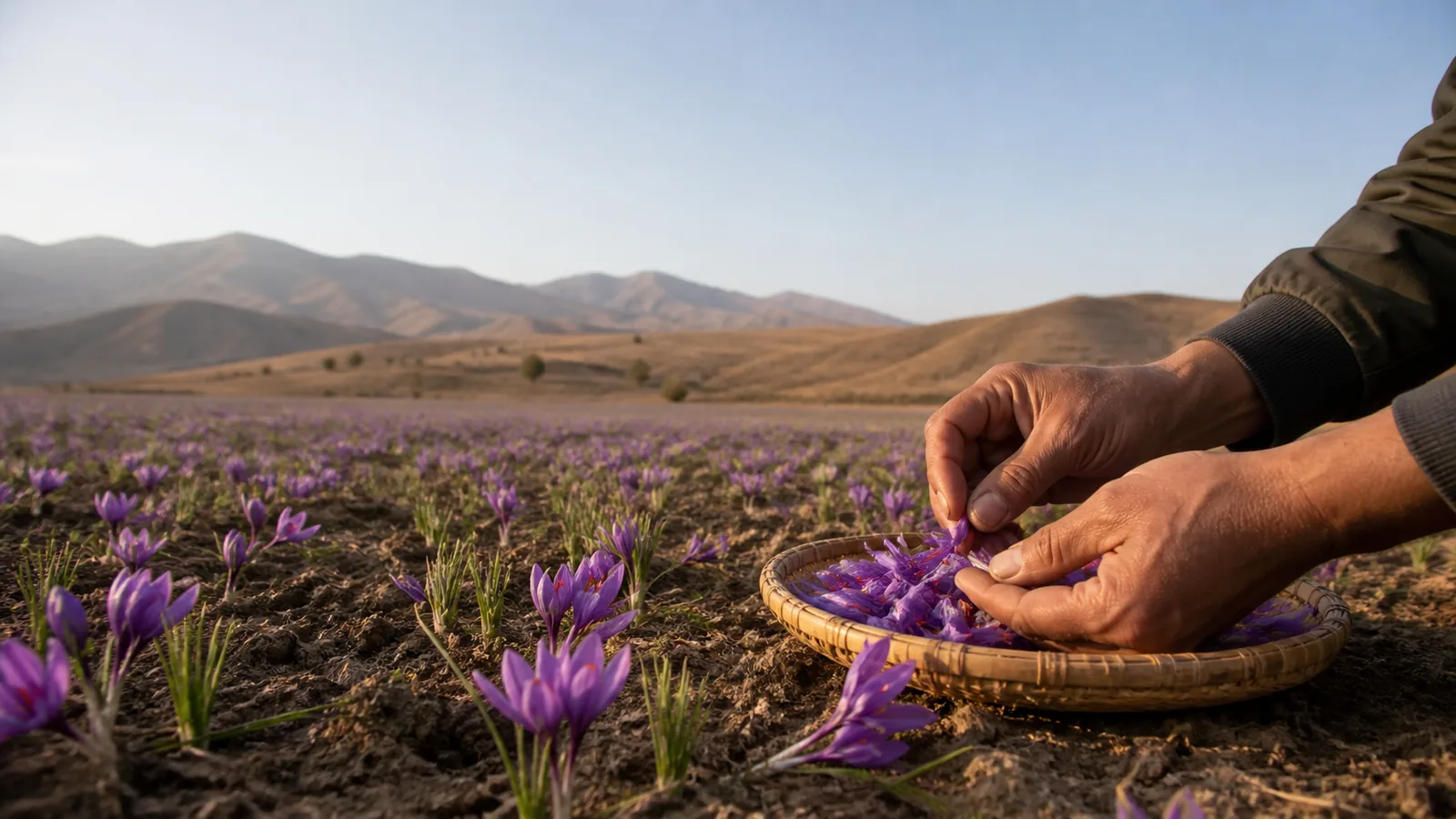
This page preserves a 2021 report about Hamedan—also written Hamadan—and the growth of saffron cultivation around the Zagros and Alvand ranges. Its acreage, production, funding and ranking figures describe that reporting period. They should not be read as current provincial statistics.
How saffron cultivation expanded in Hamedan
Hojjatollah Shahbazi, then director of horticultural affairs at the Hamedan Agricultural Jihad Organization, said organised saffron cultivation in the province began in 1383 in the Iranian calendar, corresponding to 2004–05. The reported cultivated area was 16 hectares at the start and had reached 161 hectares by the latest count cited in the story.
The production figures followed the same upward direction. Shahbazi put provincial output at 52 kg in 1383, 98 kg in 1388, 366 kg in the preceding harvest and more than 548 kg in the report’s current season. Keeping those dates attached matters: they form a historical sequence, not a forecast for every later year.
Between 1394 and 1397—roughly 2015–16 to 2018–19—the province allocated about 674 million tomans from its credit resources to support saffron cultivation. The original article says this assistance went to growers as the planted area expanded, but it does not provide the number of recipients or the terms of the support.
Malayer and Razan led the provincial figures
Within Hamedan, Malayer held the largest reported saffron area and production: 73 hectares and 261 kg. Razan followed with 16 hectares and 65 kg. The source also recorded 52 kg for Bahar, although it did not provide Bahar’s cultivated area.
The provincial average was reported as 4 kg of dried saffron per hectare, compared with a national average of 3.8 kg per hectare at that time. Yield varies from one farm and season to another, so these averages should not be used to promise an individual grower the same result.
Later figures naturally differ from this snapshot. A recent Iran Agricultural News Agency overview of Hamedan farming still identifies saffron among the lower-water crops in the province’s cropping plans. It does not validate the old 161-hectare or 548 kg totals as present-day numbers.
Water use and the appeal of “red gold”
Saffron is often called red gold because a small weight of dried stigmas requires a large amount of careful field and processing work. For Zagros residents considering crop choices, its value and autumn growth cycle helped make it attractive.
Shahbazi estimated water use at 3,000 cubic metres per hectare and described it as very low. That figure is retained as his estimate for local conditions. Actual water demand depends on climate, soil, corm density, irrigation method and rainfall, and saffron should not be described as needing no water.
He also called saffron a crop with few pests and diseases. A more useful reading is that saffron may face a different pressure profile from some annual field crops. Corm rot, rodents, mites and other problems can still damage a planting, particularly when drainage, storage or field hygiene is poor.
Drying, processing and a Hamedan identity
Expanding the planted area was only part of the opportunity. The province had formed a saffron growers’ association, but the report said much of the crop was still dried traditionally. Shahbazi wanted a local processing unit so saffron could be handled consistently and offered under a provincial brand.
That distinction is important. Harvested flowers are highly perishable, and the stigmas need prompt separation and controlled drying. A regional name cannot compensate for weak handling; it gains value when growers and processors can deliver repeatable quality, clean packaging and traceable batches.
The original official also believed saffron could be supplied throughout the year and did not expect a market or price problem. Saffron can be stored and sold beyond harvest when it is properly dried and protected from moisture, light and contamination. The statement about price, however, was an assessment made at the time—not a guarantee against later market changes.
Did saffron originate in the Zagros?
The archived report says scientific sources identified the Zagros region, particularly the Alvand foothills, as a place of origin or habitat for saffron. There is a genuine historical connection: written and archaeological discussions place saffron use and cultivation in ancient Persia, including areas near the Zagros and Alvand ranges.
Botanical domestication is a narrower question. A 2022 peer-reviewed review of saffron history and genetics found that genetic evidence most strongly supports an origin of cultivated Crocus sativus from the wild species Crocus cartwrightianus in the Attica region of Greece. The same review discusses old records of saffron cultivation around Zagros and Alvand.
Those ideas are compatible when expressed precisely. The Zagros can be part of saffron’s long cultural and agricultural history without being presented as the proven botanical site where the sterile cultivated plant first arose.
What the historical report records
At the time of the report, Hamedan ranked 14th among Iranian provinces by saffron cultivation area and 13th by production. Officials described the development programme as being at an early stage and expected the province eventually to produce saffron corms as well as dried stigmas.
The lasting story is not simply that Zagros residents were “lucky” with saffron. Growers responded to local climate and water pressure, public support helped expand planting, and Malayer and Razan emerged as important provincial centres. The next challenge was to turn a larger harvest into reliably dried, processed and recognisable Hamedan saffron.

![Exporting Saffron to Turkey + Price Guide [Complete 0 to 100]](https://img.rowhanisaffron.com/20260827003933/saffron-export-turkey-quality-inspection.webp)



