


The headline calls saffron the king of plants, yet the old market commentary beneath it asks why many growers remained financially vulnerable.
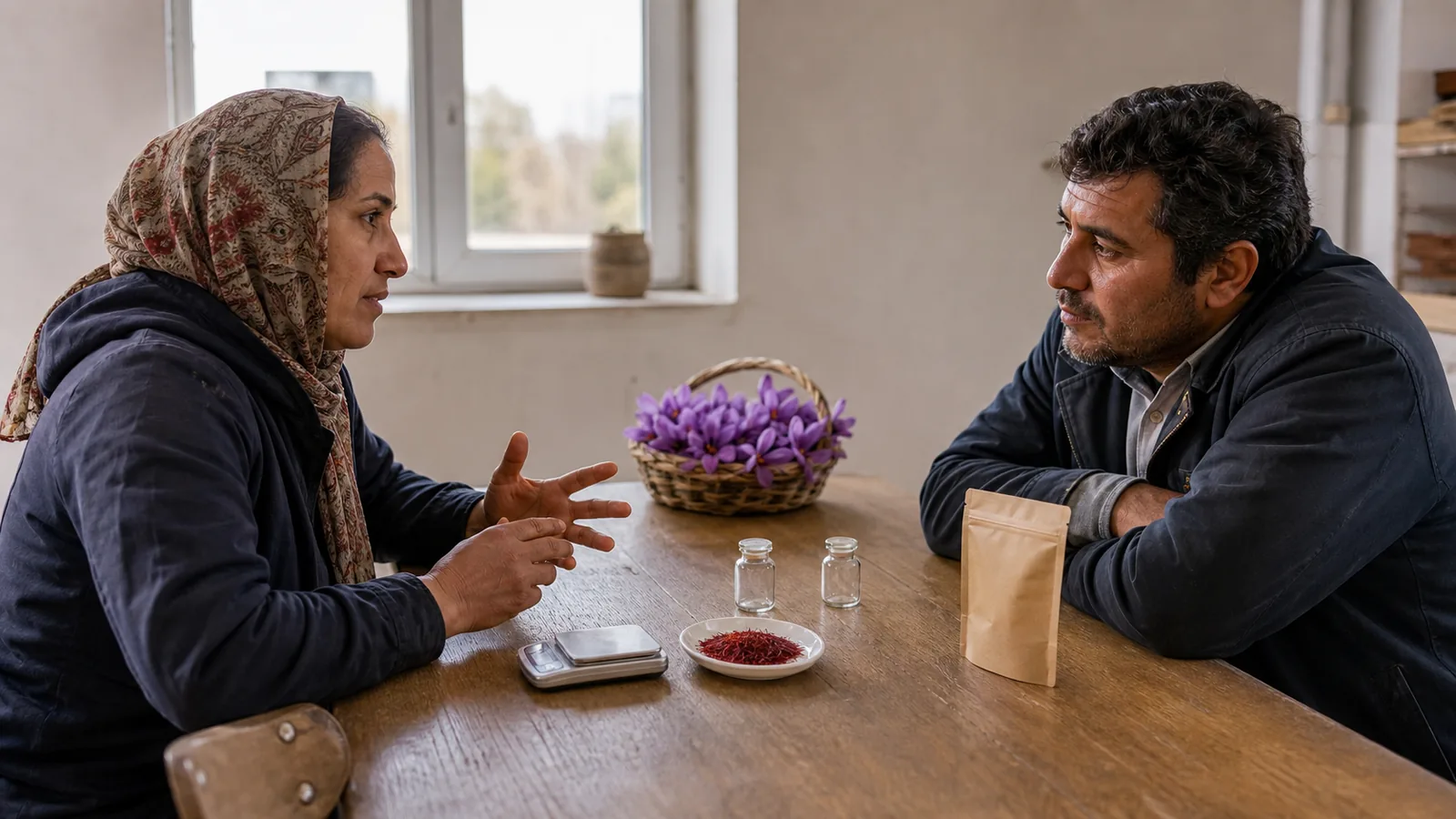
Ali Hosseini, identified in the original report as a member of Iran’s National Saffron Council, was describing a paradox: saffron commanded a high price per gram, but producing a small annual quantity did not necessarily give a farming household a secure income.
A high saffron price is not the same as high farm profit
At the time of the interview, Hosseini said saffron was worth more than 5,000 tomans per gram. That figure is a historical quotation, not a current retail or farm-gate price. Currency values, grades, crop size and the point in the supply chain all change what a quoted price means.
He initially argued that farmers received the largest share of profit and that brokers did not play a major role. Later in the same account, however, he said intermediaries could seriously harm growers in some seasons. Both statements are part of the original report, and the tension between them is important.
A high unit price can obscure the economics of a small farm. A household may produce only one or a few kilograms of dried saffron in a year. From its sales revenue come the costs and labour of corm management, weeding, irrigation, picking flowers in a narrow window, separating stigmas and drying the crop. Revenue per gram is therefore not the same as net income per grower.
Who buys saffron from farmers?
The buyer depends on the region and the way a grower sells. A crop may move to a local collector, wholesaler, processor, exporter or cooperative. In a standardised warehouse-and-exchange system, the grower or owner may instead sell a commodity certificate connected to an accepted lot.
Each buyer can provide a service—aggregation, grading, storage, packaging, finance or access to a larger market. Problems arise when a farmer has little price information, few competing offers or an urgent need for cash. In that situation, the grower may have to sell quickly even if holding a properly dried crop could produce a different price later.
A detailed UNIDO study of Iran’s saffron value chain documented a network involving growers, local dealers, wholesalers, processors and exporters. It also found that considerable value was added after bulk saffron left Iran through processing, packaging, branding and distribution in destination markets.
How harvest-season buying can affect the market
Hosseini said some brokers bought during harvest, stored the product and released it gradually. He believed that this behaviour could disturb the balance of the saffron market and hurt farmers.
Storage is not automatically manipulation. Properly dried saffron is normally held beyond its short harvest season so it can be supplied throughout the year. The market concern is about unequal bargaining power: a cash-constrained farmer may sell when seasonal supply is concentrated, while a better-financed buyer can choose when to resell.
The original article also linked speculative interest to Iran’s coin and currency markets. Hosseini suggested that if those markets became more balanced, mobile capital might move into expensive agricultural goods such as saffron. That was his market view at the time, not a reliable rule for predicting saffron prices.
Why growers can remain deprived
Hosseini described red-gold producers as some of the most deprived farmers, despite saffron’s high and, in his words, continually rising price. The more careful conclusion is not that the price always rises. It is that the crop’s reputation for value can coexist with unstable household income.
Several pressures can create that gap: small production volume, concentrated harvest labour, limited working capital, dependence on a narrow group of buyers, inconsistent grading, bulk sales and weak access to packaging or export markets.
Current development work still recognises the importance of the grower’s position. In 2025, the FAO and Iran announced a saffron value-chain initiative focused on quality, integrity, innovation and support for smallholder farmers. That does not validate every old price claim, but it confirms that production alone is not the whole economic problem.
Does the saffron market have a “king”?
The title’s language is figurative. Saffron is not scientifically the king of plants, and no single buyer controls every domestic and export transaction. Prices emerge from crop supply, grade, storage, buyer demand, exchange and currency conditions, and the negotiating position of participants.
The original interview tried to say both that brokers lacked decisive power and that their seasonal buying could damage growers. A better reading is that intermediaries do not control the crop in every circumstance, but can have strong influence where farmers have few options.
For someone asking who buys saffron, the practical answer is therefore broader than “brokers.” The chain can include collectors, traders, processors, exporters, cooperatives, exchange participants, retailers and direct customers. The important question for growers is not whether an intermediary exists, but whether quality is measured fairly, prices are visible, terms are clear and enough of the final value returns to the farm.

![Exporting Saffron to Turkey + Price Guide [Complete 0 to 100]](https://img.rowhanisaffron.com/20260827003933/saffron-export-turkey-quality-inspection.webp)



