


“Profit of Iranian saffron to the taste of the Spaniards” describes a familiar tension in Kashmar: farmers produce a valuable spice, yet much of the value can be created later through testing, packaging, branding and overseas distribution.
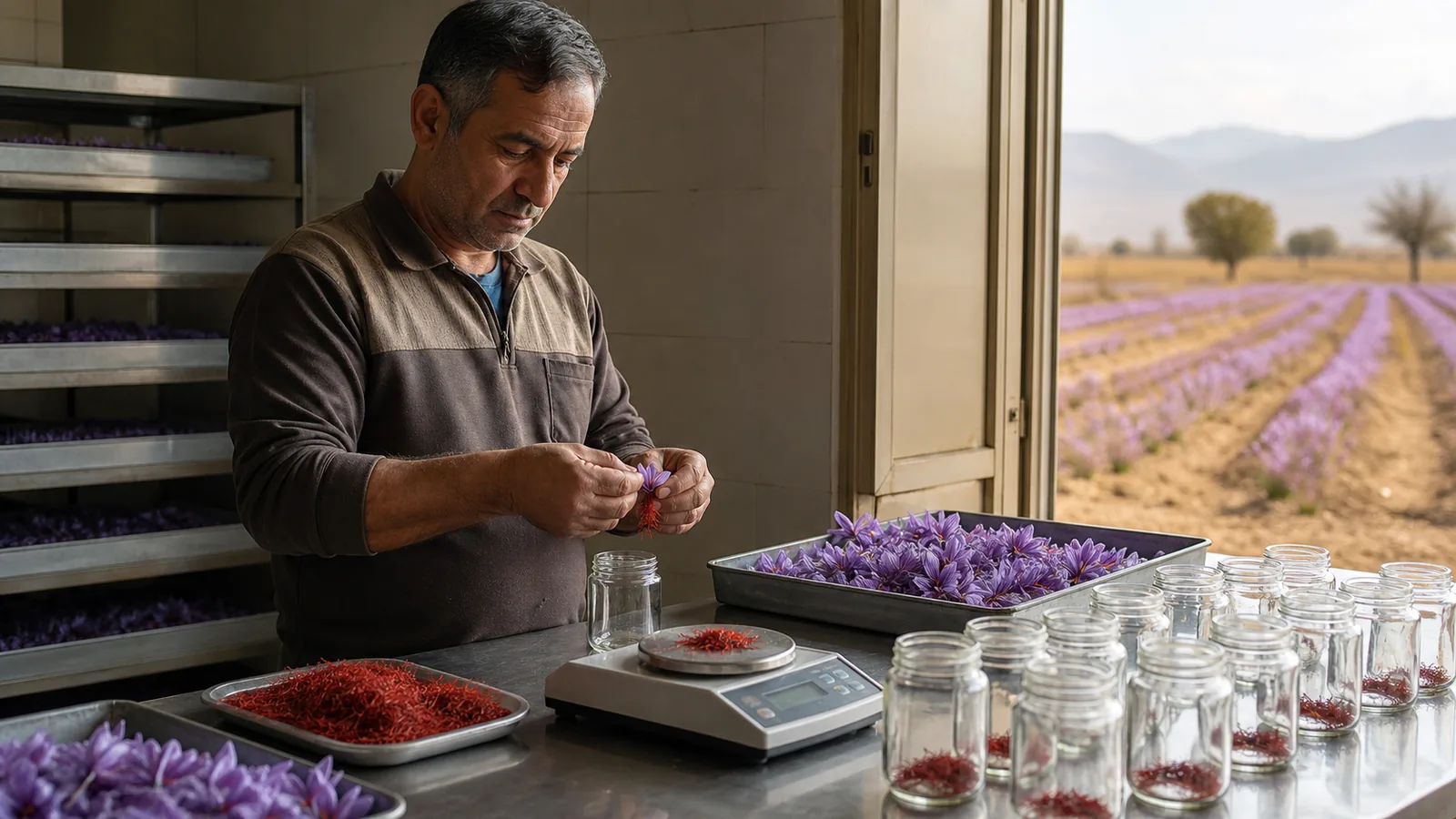
This article began as a January 2021 report built around comments from local agriculture officials and exporters in Khorasan Razavi. Its named figures are preserved below as historical claims, not presented as fresh statistics. Recent trade and quality data are identified separately so the older report remains useful without being mistaken for a current market bulletin.
Why Kashmar matters to Iranian saffron
Kashmar is one of the saffron-growing centers of Khorasan Razavi and part of the wider Tarshiz region. Saffron is an important medicinal-plant crop and rural source of income there, but production alone does not determine how much money stays with growers.
The original report put Kashmar’s saffron area at more than 7,000 hectares and cited an average yield of about 3 kg per productive hectare. On those assumptions, the calculation points to roughly 21 metric tonnes of dried saffron. The old English version called this “20 tons of saffron flowers,” which does not fit the stated yield unit; the more coherent reading is finished saffron rather than the much heavier fresh flowers.
That distinction matters. A hectare figure, a flower weight and a dried-stigma yield describe different things. Combining them can make a farming region appear more or less productive than it really is.
Where the value in saffron is created
A grower’s work ends only after the flowers have been picked, the stigmas separated and the spice dried correctly. The commercial chain continues through grading, laboratory checks, documentation, packaging, branding, wholesale distribution and retail. Each stage can add value, and each requires equipment, knowledge, market access or working capital.
The Kashmar report argued that weak local packaging and reliance on intermediaries left farmers with a smaller share of the final selling price. It said saffron often passed through several buyers before reaching an exporter, then reached foreign companies that processed, packed and distributed it under their own commercial identity.
This does not mean every shipment to Spain loses its Iranian origin or that every Spanish seller relabels Iranian saffron. Country of production, customs origin, the exporter’s location and the consumer-facing brand are separate facts. The useful point is narrower: when processing and branding happen after a crop leaves the farm, some of the margin is earned away from the producing community.
What the historical Kashmar report said about exports
Exporter Saeed Moazen was quoted as saying that 75% of Iranian saffron left in bulk or in packs weighing less than 10 grams. For the Tarshiz region, he described Spain as the destination for more than 90% of exports, with roughly 10% going mainly to Arab markets. These percentages belong to the period and speaker recorded in the original article; they should not be treated as a current national breakdown.
There is, however, clear recent evidence that the Iran–Spain saffron trade remains substantial. The World Bank’s WITS record for Spain’s 2024 saffron imports, based on UN Comtrade data, lists 39,649 kg imported from Iran with a reported trade value of about US$50.74 million. That is a customs record for HS 091020, not a measure of what individual farmers received.
The two sets of information answer different questions. The local report describes how people in Kashmar saw the chain and where they believed margin was being lost. The customs data confirms a large trade flow from Iran to Spain, but it does not reveal the contracts, grades, packaging arrangements or later resale price behind each shipment.
Traditional processing, packaging and farmer returns
Kashmar agriculture director Sayyed Abolghasem Mousavi was quoted as saying that more than 95% of saffron in Khorasan was then harvested and separated through traditional farm or household methods, while less than 5% was handled by registered companies under formal hygiene procedures. Again, those are historical local-report figures, not a current audit of the province.
Traditional handling is not automatically poor handling. Experienced families can separate and dry saffron carefully. The commercial difficulty is consistency: an export buyer needs repeatable moisture, purity, color, aroma, traceability and documentation across a shipment. Small lots may be combined, retested and repacked later because the buyer can provide those controls at scale.
This is why better packaging is only part of the answer. A beautiful box cannot compensate for uneven drying or incomplete records. Local producers retain more value when packaging is backed by reliable grading, authenticity testing, batch traceability, stable supply and direct access to suitable buyers.
Counterfeit saffron and the cost of weak quality control
Ahmad Reza Mahmoudi Moghaddam, identified in the report as a Kashmar agricultural education and extension official, warned that saffron’s price and limited supply make it a target for fraud. The examples in the original text included coloring pale floral material, adding moisture to increase weight, applying artificial scent, and mixing in unrelated plant material or other substances.
Those practices do more than mislead one buyer. Adulteration makes honest lots harder to trust, increases testing costs and can weaken the reputation on which growers depend. Our practical guide to identifying pure saffron explains what consumers can check while recognizing that visual tests cannot replace a qualified laboratory.
The problem is still relevant. In September 2025, the Food and Agriculture Organization of the United Nations said Iran produces more than 90% of the world’s saffron and identified adulteration and inconsistent post-harvest handling as continuing risks to the value chain. FAO and Mashhad University of Medical Sciences began work on stronger authenticity-testing methods and field guidance.
The 2021 report also named Afghanistan, Pakistan, Spain and China when discussing saffron production outside Iran. That list recorded the speaker’s market view at the time; it was not accompanied by comparable production data for those countries.
Drought, irrigation and the movement of saffron cultivation
The historical report also connected lower yields with sharply reduced autumn and winter rainfall during the crop’s growth period. It described supplementary irrigation as one response during field maintenance.
Local officials said repeated droughts had encouraged saffron cultivation to move from South Khorasan and southern parts of Khorasan Razavi toward colder areas, other Iranian provinces and, in some cases, other countries. That observation should be read as a period account of changing cultivation, not proof that every new region offers suitable soil, water or climate.
Moazen placed the average yield at roughly 3–5 kg per hectare and argued that improved methods could raise it. Yield is only one part of farmer income, though. A larger crop can still sell poorly if drying is uneven, quality is uncertain or producers must accept the first available bulk price.
What would keep more saffron value in producing regions?
The report’s practical message is stronger when it is expressed as a value-chain problem rather than a contest between countries. Several improvements can help Kashmar and other Iranian saffron communities keep more of the final value:
- consistent harvesting, stigma separation and drying procedures;
- batch records that connect a finished lot with its producer and processing history;
- credible testing for purity, moisture and quality;
- grading that buyers can understand and compare;
- packaging suited to the destination market, with accurate origin information;
- cooperative processing or sales where individual farms lack scale;
- better access to export information and buyers; and
- contracts that reward measurable quality instead of weight alone.
These steps do not remove the role of exporters, packers or distributors. They give growers and local processors stronger evidence of what they are selling and a better basis for negotiation.
Reading “Profit of Iranian saffron to the taste of the Spaniards” today
The original phrase is deliberately pointed, but the underlying story is not that Spain benefits simply by buying Iranian saffron. It is that origin and final market recognition can separate when a product travels in bulk and later gains testing, packaging and a retail identity elsewhere.
Iran remains the dominant producer, and Spain remains an important buyer and international saffron trader. For Kashmar, the durable opportunity is to pair its cultivation knowledge with verifiable quality and stronger post-harvest systems. That is how more of the spice’s value can remain close to the farms and communities that produce it.

![Exporting Saffron to Turkey + Price Guide [Complete 0 to 100]](https://img.rowhanisaffron.com/20260827003933/saffron-export-turkey-quality-inspection.webp)



