


Productivity challenges of red gold (saffron) in Khorasan reach from the corm and field to harvest hygiene, processing, finance, packaging and the final sale.
Khorasan’s problem is not a lack of importance. The region remains the center of Iranian saffron. The harder question is how much clean, high-quality product each hectare and hour of work creates, and how much of the final value returns to growers and local processors.
What the original Khorasan figures described
This page began as a report on one crop year and the officials working in Khorasan Razavi at that time. Its numbers should remain attached to that historical setting rather than being read as a current forecast.
Mohammad Reza Orani, then head of the Khorasan Razavi Agricultural Jihad Organization, was quoted as reporting 90,000 hectares of saffron in the province and expected production of about 280 to 290 tonnes. The same account put Iran’s total area at 114,000 hectares: 90,000 in Khorasan Razavi, 15,000 in South Khorasan and 9,000 in other provinces.
It also said the provincial area had increased from 87,000 to 90,000 hectares in one crop year and that 131,000 people were directly employed in saffron production. These are valuable markers of the sector’s scale at the time, not figures to reuse without a year.
Orani discussed an agreed-purchase program and the commodity exchange as ways to reduce disruption by brokers. He also cited 78 tonnes of exports in the first half of that year and estimated 14 to 15 tonnes remained in the market. Those short-term market claims are preserved here as attributed statements, not as today’s stock balance.
He said support policies had been adopted and asked growers not to react to alarming claims circulated online by people affected by the exchange policy. He also said sufficient processing or “conversion” industries had been established in producing cities. Other speakers in the same report still identified processing capacity, finance and packaging as constraints; the disagreement shows why capacity should be measured rather than assumed.
What current evidence adds
Recent official language still places Iran at the center of the crop, while using more careful ranges. FAO reported in November 2025 that Iran produced 85–90% of world saffron and that cultivation remained deeply rooted in Khorasan Razavi and South Khorasan.
The companion overview of Iran’s share of world saffron production explains why an older 94% or 95% estimate should not be treated as a permanent annual constant.
FAO’s current work in the region emphasizes production practice, post-harvest handling, safety, traceability, marketing and branding. Its 2025 visit to Mashhad farms and processing facilities documented traditional harvesting alongside modern processing and packaging. That combination describes the real productivity task: protect useful local knowledge while improving the stages where avoidable loss occurs.
Challenge 1: yield starts with the corm and field
Adding hectares does not automatically improve productivity. Growers need healthy corms, an appropriate planting density, sound soil preparation, well-timed irrigation and a plan for field age. Weak planting material or an aging, overcrowded field can lower the amount harvested from the same land.
A UNIDO diagnostic study of Iran’s saffron value chain identified corm selection, limited access to improved planting material, fragmented small farms and weak transfer of research into commercial practice among the obstacles to higher efficiency. Its figures are historical, but the system problems remain useful categories for inspection.
Climate belongs in that field assessment. A 2024 study indexed by FAO AGRIS examined temperature, humidity and rainfall effects on South Khorasan saffron yield across 1390–1402 in the Iranian calendar. Productivity planning therefore has to use local weather and soil evidence, not one planting formula for every county.
Challenge 2: water scarcity needs precise management
Ali Rasoulian, then deputy governor for economic affairs coordination, described saffron’s economic importance in water-scarce districts. That advantage is real, but it is sometimes simplified too far. Saffron is suited to an arid production calendar; it is not a crop that succeeds without water management.
The timing and uniformity of irrigation affect emergence and flowering. Water quality, soil salinity and drainage can also alter field performance. The useful comparison is value and yield per unit of scarce water, not the claim that the crop needs no water.
Challenge 3: harvesting is a race against quality loss
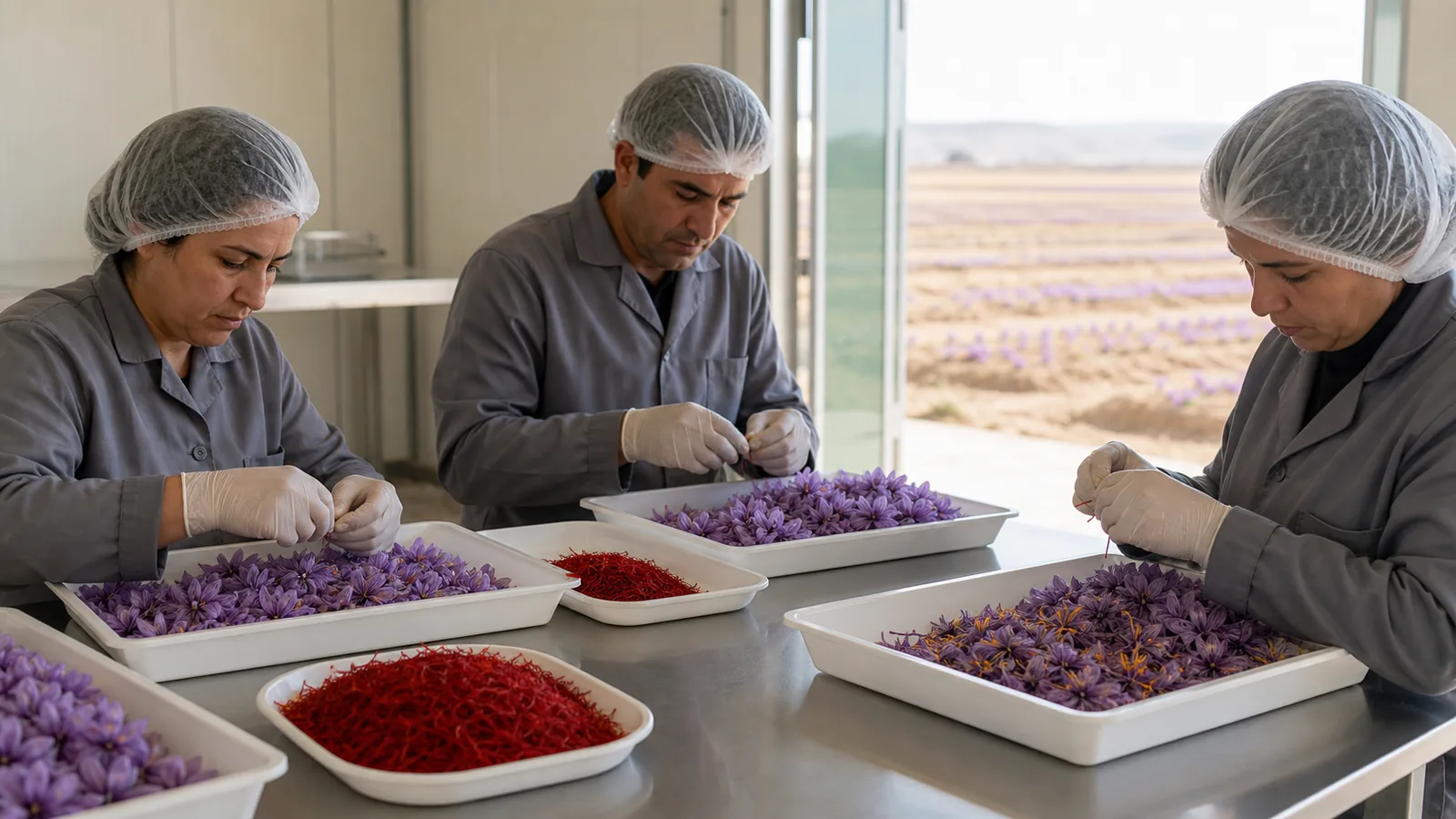
Saffron flowers arrive in a short seasonal wave. Picking, transport, stigma separation and drying all compete for labor during the same narrow window. Delays can damage the material before it reaches a package.
Productivity at harvest is therefore more than the number of flowers collected. It includes how quickly clean flowers reach the separation area, how much usable stigma is recovered, how consistently it is dried and how much product is downgraded or discarded.
Modernization does not have to mean replacing careful hand work with a machine at every step. Simple improvements—clean rigid containers, shade during transport, planned shifts, washable work surfaces and controlled drying—can remove bottlenecks while keeping delicate handling intact.
Challenge 4: contamination can erase field value
Exporter Mohammad Shakeri was quoted in the original report describing hair and fibers from carpets, rugs or blankets among the contaminants found with saffron flowers. The wording was blunt, but the underlying problem is serious: a valuable crop can lose buyer confidence through preventable handling contamination.
Flowers and stigmas should not be spread over household textiles. Separation areas need cleanable food-contact surfaces, controlled access, suitable clothing and hair restraints, clean tools, protected drying and lots that remain identifiable.
FAO’s saffron authenticity program with Mashhad University highlights adulteration, inconsistent post-harvest handling and the need to preserve color, flavor and aroma. Laboratory testing is essential, but hygiene and traceability have to begin before a sample reaches the laboratory.
Challenge 5: low efficiency is not only a farm problem
Rasoulian’s list of constraints included traditional cultivation, low production efficiency, bulk exports, weak producer organizations, limited working capital for processing units and traditional packaging. Those problems sit in different parts of the chain and need different responses.
He attributed about 90% of Iranian saffron to Khorasan Razavi in that report and called for scientific planting and crop-maintenance methods to reach villages through private-sector and extension work. He also advocated products that could earn more in international markets, including certified organic saffron. These were policy aims tied to that period, not proof that every farm needed the same intervention.
A grower cannot solve processor finance alone. A packaging company cannot correct poor drying after the damage has happened. A laboratory result cannot tell a buyer which farm or batch produced a sample unless traceability is already working.
Useful coordination means defining ownership at each handoff: farm, collection point, separator, dryer, laboratory, packer and exporter. Cooperatives and commercial contracts can help, but only when grading, weight, payment time and rejection criteria are transparent to the farmer.
Challenge 6: bulk exports leave value on the table
The original article argued that inadequate processing and packaging allowed more of the final profit to accrue abroad, especially in Spain. That should not be simplified into saying that Spanish saffron is secretly Iranian. Spain grows saffron and also participates in international processing and trade.
Shakeri paired that market concern with an older estimate that Iran produced about 95% of world saffron. As with the headline’s percentage, the enduring fact is Iran’s dominance; the exact share varies by year and source.
The defensible point is about value capture. When Iranian saffron leaves in bulk without a recognized producer brand, consumer packaging, traceability or a direct buyer relationship, another business can earn the margin from sorting, certification, presentation and retail access.
Packaging alone is not a cure. A smaller box cannot compensate for uncertain origin or inconsistent quality. Market growth depends on reliable specifications, honest labeling, repeatable sensory and laboratory performance, and delivery formats that match how customers actually use saffron.
Challenge 7: quality must be measurable
Words such as “pure,” “high quality” and “organic” need evidence. Organic production requires compliance with a defined certification system; it cannot be created by describing a traditional farm as natural.
Quality control should combine physical inspection, contamination checks, moisture management, chemical testing and traceability. FAO’s current work notes the role of crocin, picrocrocin and safranal in chemical profiling while also warning that routine grading alone may not catch subtle quality differences or sophisticated adulteration.
The goal is not a laboratory number for marketing copy. It is a repeatable process that connects the field and drying method to a trustworthy batch sold to a buyer.
How Khorasan should measure saffron productivity
A complete productivity record should track more than total tonnes. At minimum, producers and processors need to know:
- Dry saffron yield per hectare and per field age
- Labor hours required for flower picking and stigma separation
- Time from picking to separation and controlled drying
- Loss, rejection and contamination rates
- Water use and field-level input costs
- Quality results for each traceable batch
- The share sold in bulk versus processed and packaged form
- Farm-gate price, payment delay and the farmer’s share of final value
These measures turn a broad discussion about “red gold” into practical decisions. They show whether a new method improves the grower’s result, merely shifts cost to another stage, or produces a prettier package without stronger quality underneath.
A more productive saffron chain in Khorasan
Khorasan already has the crop knowledge, production concentration and global recognition. Its next gains are likely to come from many connected improvements: better planting material, field-specific advice, careful water use, faster clean handling, controlled drying, testable origin, appropriate finance and stronger access to buyers.
That is a broader definition of productivity than hectares or tonnes alone. It protects the saffron itself, raises the amount of usable value created from each harvest and gives farmers a better chance of sharing in the value their work produces.

![Exporting Saffron to Turkey + Price Guide [Complete 0 to 100]](https://img.rowhanisaffron.com/20260827003933/saffron-export-turkey-quality-inspection.webp)



