


Production of 94% of the world’s saffron in Iran is a widely repeated estimate, but it should be read as a historical percentage rather than a fixed annual total.
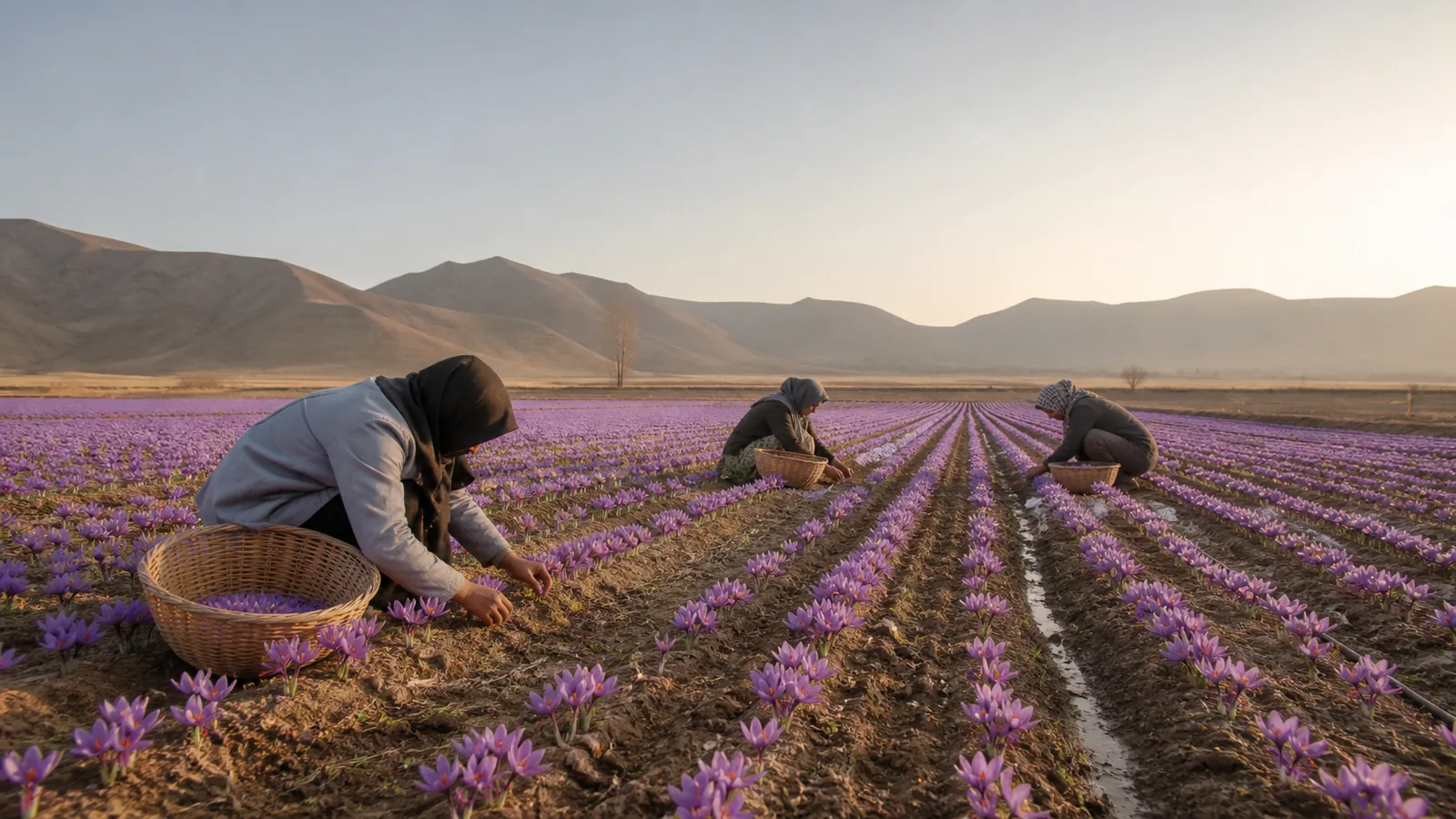
Iran remains the clear leader in world saffron production. The important correction is precision: output changes from one harvest to another, and recent official sources describe Iran’s share as a range instead of confirming that it is exactly 94% every year.
Does Iran still produce 94% of the world’s saffron?
The short answer is that Iran still produces most of it, but 94% is not a timeless measurement. A September 2025 Food and Agriculture Organization report said that Iran produced more than 90% of the world’s saffron. A later FAO account of a November 2025 value-chain workshop gave a range of 85% to 90% of global production.
Those figures support the central point behind the original headline: Iran is the world’s largest saffron producer by a very large margin. They do not support presenting 94% as an exact current figure without a harvest year and a defined dataset.
Why the Iran saffron production percentage changes
An annual percentage has two moving parts: Iran’s crop and the combined output of every other producing country. Weather, water availability, corm condition, cultivated area, labor at harvest and changes in other countries can all alter the balance.
“Production” also needs to be kept separate from exports. A country may grow saffron, import it for processing or packaging, and then export it again. Trade data therefore cannot automatically be used as a saffron production-by-country table.
This is why a responsible answer to “Iran saffron production percentage world” should name the source and year. For a broad current description, “about nine-tenths” is better supported than attaching permanent certainty to 94%.
Where saffron production in Iran is concentrated
The heart of saffron production in Iran is the Khorasan region, particularly Razavi Khorasan and South Khorasan. The crop is also cultivated elsewhere in the country, but these northeastern provinces have the strongest concentration of fields, growers and accumulated production knowledge.
FAO’s profile of the qanat-based saffron system in Gonabad describes an arid and semi-arid landscape where saffron is tied to water management, rural livelihoods and agricultural heritage. Qanats carry groundwater to farms without the continuous pumping required by a surface system.
The relationship is visible at village level as well. This account of saffron farming in Seno village shows how cultivation, flower processing, local skills and family income meet in one Gonabad community.
What older Iranian acreage figures tell us
The archived version of this article quoted Mohammad Hassan Asareh, then secretary of a medicinal-plants and traditional-medicine development body. It reported that Iran’s saffron area rose from 77,300 hectares in the Iranian year 1391 to 96,000 hectares in 1394, roughly 2012–13 to 2015–16.
Those numbers are useful historical context, not present-day acreage. They describe a period of rapid expansion and should retain their original dates whenever they are repeated. They should not be combined with a recent production percentage as though every figure came from the same season.
The old text also discussed registered herbal products, licorice exports and restrictions on harvesting wild medicinal plants. Those subjects belonged to the broader briefing from which the saffron quotation came, but they do not measure saffron production and can distract from the question this page answers.
Saffron production by country
Iran is not the only saffron-growing country. India, Afghanistan, Greece and Morocco are among the other producers identified in international agricultural and standards work. Spain has a major historical and commercial relationship with saffron, including processing and trade, but trade prominence is not the same as growing most of the crop.
The previous version of this page referred to 800,000 hectares of Spanish saffron and suggested cultivation stopped because the plant lacked active ingredients. That statement was not credible and is not retained as fact. Spain continues to cultivate saffron, and no reliable source reviewed for this update supports the 800,000-hectare claim.
Saffron is also called kesar in South Asia. Consequently, a reference to “kesar production in world” data concerns the same Crocus sativus crop, even though country reports may use different names.
Why Iran remains the largest producer
Iran’s position rests on more than cultivated area. Saffron production demands coordinated work across the entire season: healthy corms must be planted and maintained; flowers must be collected during a short autumn window; the red stigmas must be separated promptly; and drying must protect color, aroma and flavor.
Khorasan combines suitable dry conditions with farming knowledge carried through generations. The work is still labor-intensive, especially at flowering, because the valuable portion of each flower is small and delicate. A large established network of growers, seasonal workers, processors and traders gives Iran a scale that newer producing regions do not yet match.
Water use is part of the picture, but calling saffron simply “waterless” would be misleading. The plant is suited to dry climates and does not need the same irrigation pattern as many summer crops; it still requires appropriate moisture at key stages and responsible local water management.
Production volume is not the whole value chain
A dominant share of world saffron production does not guarantee that all of the value remains with the grower or producing country. Cleaning, grading, laboratory testing, traceability, packaging, branding and direct access to buyers influence what the crop ultimately earns.
FAO’s recent work with Iranian institutions has focused on authenticity testing and post-harvest practice because adulteration and inconsistent handling can weaken trust. For customers, origin should be supported by traceability and quality evidence rather than by a percentage printed on a package.
The original article ended with an unsupported statement that an active ingredient for an Alzheimer’s drug is extracted from saffron. That is not a production statistic and should not be presented as an established medicine claim without a named, approved drug and regulatory evidence. It has therefore been removed rather than amplified.
How to quote Iran’s share accurately
For a current summary, say that Iran is the largest saffron producer and accounts for roughly 85% to more than 90% of world output in recent FAO descriptions. If the figure 94% is used, label it as an older estimate and avoid implying that every harvest produces the same result.
That wording preserves the real significance of saffron in Iran while remaining honest about the limits of global crop statistics. It also makes comparisons clearer: production year, source, unit and the distinction between cultivated crop and traded product all matter.

![Exporting Saffron to Turkey + Price Guide [Complete 0 to 100]](https://img.rowhanisaffron.com/20260827003933/saffron-export-turkey-quality-inspection.webp)



