


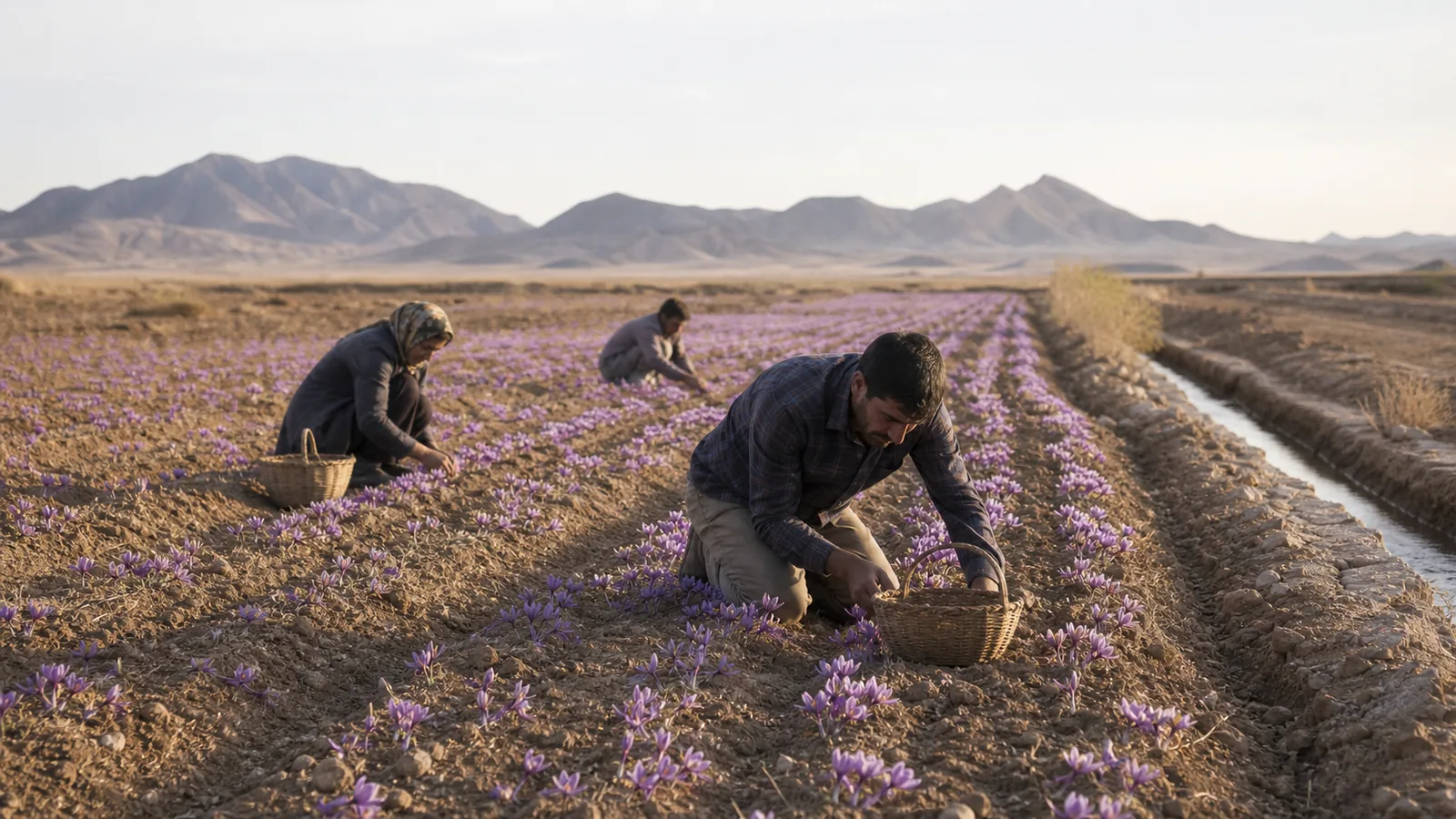
Saffron production in Sabzevar reached a reported 5,400 kilograms in the reference harvest. The crop came from about 1,500 hectares, making the city an important production centre in Iran’s Razavi Khorasan province. The figures also show why yield, irrigation and careful field management matter as much as the number of hectares planted.
This is a historical production report rather than a forecast for the current season. Mansour Boroumandi, then a deputy director in Sabzevar’s agricultural administration, said output had risen by about 20% from the previous year. The same report placed average yield at roughly 3.5 kilograms per hectare. Multiplying that rounded yield by the reported area gives 5,250 kilograms, so the 5,400-kilogram headline should be read as an approximate total rather than a perfectly reconciled measurement.
What supported Sabzevar’s 5,400 kg harvest?
The local account attributed the increase mainly to better management and a more even crop across farms. That distinction is useful. Expanding the planted area can raise total output, but the result still depends on corm health, soil condition, water timing, labour at flowering and the speed with which stigmas are separated and dried.
At the stated scale, Sabzevar’s result works out to approximately 3.6 kilograms per hectare when calculated from the headline total. That is close to the reported 3.5-kilogram average and helps explain the difference as ordinary rounding in a news account.
Water availability remains a practical limit
Saffron is often described as suitable for dry regions, but “low-water” does not mean “no-water.” The Sabzevar report warned growers not to choose the crop without a dependable supply. It described a seasonal programme with several irrigations and said tanker irrigation was unlikely to be economical at farm scale.
That warning is especially relevant where farms rely on qanats. Mohammad Aziminejad, who was responsible for horticulture in the local agricultural administration, linked the flow of many qanats in the area to precipitation. A weak recharge season can therefore affect the water available to saffron fields even when the crop itself is relatively drought tolerant.
The original report also offered fixed nitrogen and micronutrient schedules. Those figures should not be treated as a universal prescription. Fertiliser needs vary with soil tests, corm condition, irrigation water and field history. A grower should use a current local agronomy recommendation rather than copy a dated rate from a general news article.
Post-harvest field care shapes the next crop
The field does not stop working when the flowers are picked. Saffron leaves continue supporting the corms that will produce a later harvest. Appropriate irrigation and nutrition after flowering can help that cycle, while excessive nitrogen or poorly timed watering can waste inputs and create other problems. The practical lesson from the Sabzevar account is to manage the crop as a full-season system, not as a few weeks of flower picking.
Khorramabad shows how saffron can expand in another dry region
A separate historical report from Khorramabad, the capital of Lorestan province, illustrates the same development pattern on a smaller base. Morad Beyranvand, then the city’s agriculture director, said saffron area had grown from about four hectares to 30 hectares in three years, with another 15 hectares planned.
Khorramabad’s output had been about 30 kilograms in preceding years and was forecast to approach 100 kilograms in the reference year. Across Lorestan, the same official said production had risen from about 100 to 700 kilograms over three years. These are period-specific administrative figures, not current production estimates. Later provincial reports record further growth; our overview of saffron production in Lorestan explains that longer trend.
Employment and crop diversification
Beyranvand highlighted saffron’s role in employment for rural women. That value is tied to the crop’s labour-intensive harvest and stigma separation, but the benefit depends on fair pay, safe working conditions and access to markets rather than cultivation alone.
He also placed saffron within Khorramabad’s broader medicinal-plant activity, reporting about 33 hectares under such crops and more than 600 tonnes of annual production. The source did not break that total down by species, so it should not be read as saffron output. Unrelated poultry statistics from the same announcement do not help explain saffron and have not been carried into this article.
What the two regional reports tell growers
Sabzevar demonstrates production at scale: a large established area, an approximate 5.4-tonne harvest and a yield close to 3.5 kilograms per hectare. Khorramabad shows the earlier stage of expansion, where a small planted area grew quickly and saffron became part of rural employment and crop diversification.
Neither case supports planting on headline numbers alone. Before committing land, a grower needs a realistic water budget, tested planting material, field-specific soil advice, enough labour for the short flowering window and a plan for drying, storage and sale. Those decisions are what turn an attractive regional statistic into a crop that can be sustained.

![Exporting Saffron to Turkey + Price Guide [Complete 0 to 100]](https://img.rowhanisaffron.com/20260827003933/saffron-export-turkey-quality-inspection.webp)



