


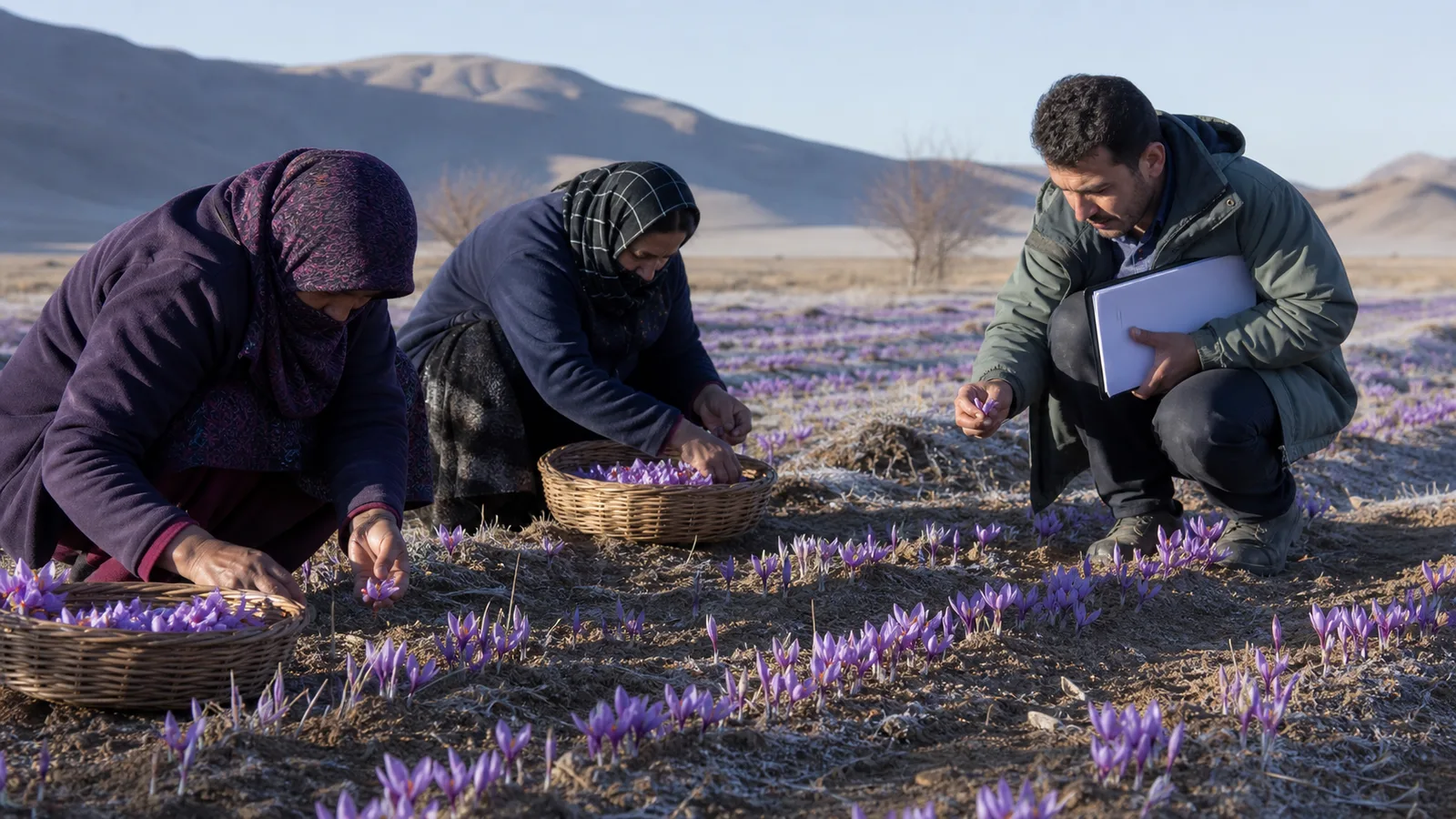
A historical forecast put saffron production in North Khorasan at 21 tonnes from 4,300 hectares, up from a reported 19 tonnes in the preceding year. Earlier provincial records describe a much smaller cultivated area, development finance, processing plans and a damaging frost. Together they show growth over time, but the figures belong to different reporting years and cannot be treated as one current dataset.
This article also places North Khorasan beside several smaller Iranian producing regions and a dated national production and export briefing. None of the quantities is a 2026 forecast.
The 21-tonne North Khorasan forecast
Mohammad Ali Sharikian, identified as the provincial horticulture director, announced the start of the flower harvest and expected 21 tonnes of saffron from 4,300 hectares. He said 19 tonnes had been harvested in the previous year and ranked North Khorasan third nationally by cultivated area and production.
The report also stated an average yield of seven kilograms per hectare. Multiplying that average by 4,300 hectares would exceed the 21-tonne forecast, so the two numbers appear to use different bases—perhaps mature fields versus total area. The source does not define them, and the discrepancy should remain visible rather than be “fixed” with an invented figure.
The official described the province’s saffron as high quality. Regional reputation is useful context, but a province-wide statement does not establish the grade of an individual lot. Drying, moisture, thread composition, storage, traceability and test results still matter.
How North Khorasan expanded from an earlier baseline
An earlier development report recorded 1,238 hectares under saffron: 780 hectares described as bearing and 458 as not yet bearing. It gave a yield of 1.4 kilograms per hectare and annual production of 3.2 tonnes, with a later estimate of more than 3.7 tonnes. These numbers predate the 4,300-hectare, 21-tonne forecast.
Abdullah Yousefi, then head of the provincial agricultural organisation, described a five-year plan to add 330 hectares and 1.05 tonnes of output. The report said 53.896 billion rials of banking credit had been approved to develop 197 hectares for 168 farmers.
Officials were also seeking licences for three processing and packaging stations. Farooj was identified as the province’s main saffron-growing city. Yousefi warned that planting material was not consistently identified or standardised, leading to poor corm selection as cultivation expanded.
The same source said an earlier 607-hectare increase had moved North Khorasan into third place by area after Khorasan Razavi and South Khorasan. This is a dated ranking, not proof that the province holds the same position today.
Frost risk before harvest was complete
Three assigned source posts report the same frost episode, so the event is consolidated once. Abdolhossein Namvar of the provincial agricultural risk headquarters said temperatures reached about −13°C in some areas in early December. Roughly 200 of the then-reported 1,238 saffron hectares were affected before every grower had finished collecting the crop.
Esfarayen, Jajarm and Shirvan were described as the hardest-hit areas. The damage estimate was preliminary and sent back for revision, so 200 hectares should be read as an early affected-area estimate rather than a final loss of saleable saffron.
The cold also affected wheat, barley, sugar beet and rapeseed. That wider event matters because it confirms a regional freeze, but those cereal losses are not part of the saffron production total.
The dated national production picture
Three other sources reproduce the same national briefing from Mohammad Kiyaee, then an official responsible for greenhouses and medicinal plants. They are also merged once.
Kiyaee reported about 351 tonnes of saffron from 94,000 hectares in the preceding year and forecast roughly 360 tonnes for the next crop. The stated national average was about 3.8 kilograms per hectare. A sample farm reportedly reached 34 kilograms per hectare; an exceptional plot is not a national expectation.
The briefing assigned about 75,000 hectares and 280 tonnes to Khorasan Razavi and 15,000 hectares and 94 tonnes to South Khorasan, while saying the two provinces represented 95 percent of national area and production. Those regional tonnages sum to more than the stated 351-tonne national total. It also referred to 14 percent being produced in North Khorasan, Yazd, Isfahan and Kerman, which conflicts with the 95 percent share. The report therefore contains incompatible figures or translations and should not be used to reconstruct a precise national balance.
Historical export figures
The same briefing reported 66.1 tonnes of saffron exports worth US$96.7 million during the first seven months of its reporting year. It described growth of 15 percent by weight and 14 percent by value from 57.4 tonnes in the comparable period.
For the full prior year, it gave 114 tonnes and US$165 million. Listed markets included China, Australia, Spain, Japan, the United States and South Africa. These figures are historical customs or ministry commentary, not a current export result.
Current comparisons should identify the reporter, partner, product classification and period. UN Comtrade can be filtered on those fields and notes that records are updated as official national data become available.
Corm standards, mechanisation and the supply chain
Kiyaee said a standard for saffron corm production was being developed so growers could obtain suitably sized, healthy planting material. The briefing referred to about five tonnes of corms per hectare in production units, but field requirements depend on corm size, spacing and the actual standard.
A national plan to improve production, processing, distribution and exports had been drafted in Iranian year 1391 but was still awaiting finance. A working group was intended to connect producers, exporters, cooperatives and the public sector across the supply chain.
The official also discussed bulb planters and harvest machinery. Mechanisation should be judged by whether it reduces labour pressure without damaging flowers, stigmas or corms; an announcement is not evidence that a machine was widely adopted.
A specialised saffron fund was described with a planned 49 percent government share and at least 25 billion tomans in public capital. One machine-translated version incorrectly labelled this as dollars. The stated purpose was to provide roughly four-percent member loans so growers would not have to sell immediately to meet cash needs. The archived reports document the proposal, not its later implementation.
Smaller producing regions in the same archive
Izeh in Khuzestan
Cyrus Nowruzi reported 12 hectares of saffron in Izeh—then 12 of Khuzestan Province’s total 20 hectares. Cultivation had begun about seven years earlier. At a stated average of two kilograms per hectare, the city expected 24 kilograms.
The crop was described as traditionally grown and rainfed. Thirty tonnes of corms had been distributed free to farmers, while extension training had run for more than ten years. Qala-e-Sard village in the Dehdez district was identified as the strongest area. These are local programme figures, not a recommendation to grow saffron without checking water, soil and frost conditions.
Mazandaran and its packaging gap
Hadi Izadi reported 40 hectares of saffron in Mazandaran: 38 under traditional cultivation and two in greenhouses. The article placed planting from July to September and harvesting from late October to the end of November.
Despite increased production, the province reportedly exported no saffron. Officials cited the absence of branding and weak packaging. Packaging can protect and identify a lot, but export readiness also requires repeatable quality, traceability, testing, buyer access and compliance.
Kermanshah’s rapid expansion
Noorbakhsh Hatami said Kermanshah’s area rose by 96 hectares to 185, with a 700-kilogram forecast. The earlier 2017 baseline was 89 hectares and 360 kilograms. Provincial credits of 3.6 billion tomans funded distribution of more than 300 tonnes of corms.
The report described average yields rising with field age: 0.5, 2, 4, 7 and 11 kilograms per hectare from years one through five, with a 17-kilogram sample-farm record. These are attributed local figures, not guaranteed yield curves. A three-year plan targeted 1,200 hectares and seven tonnes.
Hatami also said the crop needed only two irrigations in September and cited excellent quality tests. The source did not identify climate, field method, test report or laboratory. Neither claim should be used as a universal growing instruction or lot certificate.
Ijroud in Zanjan
Ijroud’s starting scale was much smaller: six farmers cultivated three hectares and harvested six kilograms. Mohammad Baqer Aghajanloo expected about 20 additional hectares over the following years.
The reported establishment cost was around 300 million rials per hectare, leading officials to request low-interest credit. The crop was already sold within Zanjan Province and in Tehran. These values capture the programme at that time; they do not establish today’s cost or market.
How to compare the regional figures
The North Khorasan, Izeh, Mazandaran, Kermanshah and Ijroud articles cover different years and stages of development. A valid comparison needs the same definitions:
- total planted area versus mature bearing area;
- forecast versus final dried output;
- province-wide average versus a sample-farm record;
- fresh flowers versus dried stigmas;
- programme allocations versus equipment actually used;
- regional reputation versus lot-specific quality evidence.
ISO 3632-1:2025 covers dried saffron in filament, cut-filament and powder forms. It provides a current specification framework but does not validate the old provincial quality statements. A buyer should request the actual lot’s origin, harvest or packing date, traceability and agreed test results.
For another region-by-region historical comparison, see this overview of saffron production in Iran.
References: ISO 3632-1:2025 saffron specification; UN Comtrade trade-data explorer. Provincial, national, finance and export figures are retained as dated, attributed evidence from the twelve archived posts consolidated here.

![Exporting Saffron to Turkey + Price Guide [Complete 0 to 100]](https://img.rowhanisaffron.com/20260827003933/saffron-export-turkey-quality-inspection.webp)



