


“85% of saffron products are exported from Iran” was a historical estimate attributed to a speaker identified in the source only as Rostami. It describes how much of Iran’s saffron crop entered export channels, not Iran’s share of world production or the value earned at retail.
What the 85 percent estimate means
Rostami said about 85 percent of the saffron produced in Iran was exported and roughly 15 percent was consumed within the country. The archived report does not provide his first name, position, interview date or the dataset behind that split. The percentage should therefore be read as an attributed estimate from that reporting period, not as a live statistic for every crop year.
That distinction matters. Export share can be measured by weight or value, and the result changes with production, stocks carried from an earlier harvest, informal trade and the dates used for customs reporting. “Saffron products” is also broader wording than the tonnage figures that follow, which appear to refer mainly to saffron itself.
The central point remains useful: when most of a crop depends on foreign buyers, a disruption at the border can quickly be felt by growers, processors and traders at home.
The export figures belong to different time periods
According to Rostami, approximately 286 tonnes of saffron were exported in the previous year. He then placed exports in the first six months of the current year at about 86 to 90 tonnes.
Those figures are not a like-for-like annual comparison. One covers a full year; the other covers six months. Rostami also said most saffron exports took place in the second half of the year, so he believed it was necessary to wait until year-end before judging the final result.
The original report does not name the calendar system or attach explicit years to the two figures. It would be misleading to assign dates now or use 86–90 tonnes as proof of a full-year collapse. The numbers are most reliable when kept in their original form: a 286-tonne annual reference point followed by a partial-year estimate during the coronavirus period.
COVID-19 affected movement more than overseas use
A poor translation in the old post referred to an “outbreak of coronary heart disease.” In context, Rostami was discussing the coronavirus pandemic, or COVID-19, not heart disease.
He did not believe the pandemic had greatly reduced saffron consumption abroad at that stage. His concern was the practical route to market. Transport was disrupted, flights were not operating normally and those constraints made exporting harder even when demand still existed.
Sanctions were the other risk he named. The two pressures were different, but both could interrupt the chain between a domestic seller and an overseas buyer. A market can therefore weaken without the end consumer suddenly losing interest: freight capacity, payment channels, customs procedures and delivery reliability all sit between demand and a completed sale.
The harvest creates its own short, labour-intensive bottleneck
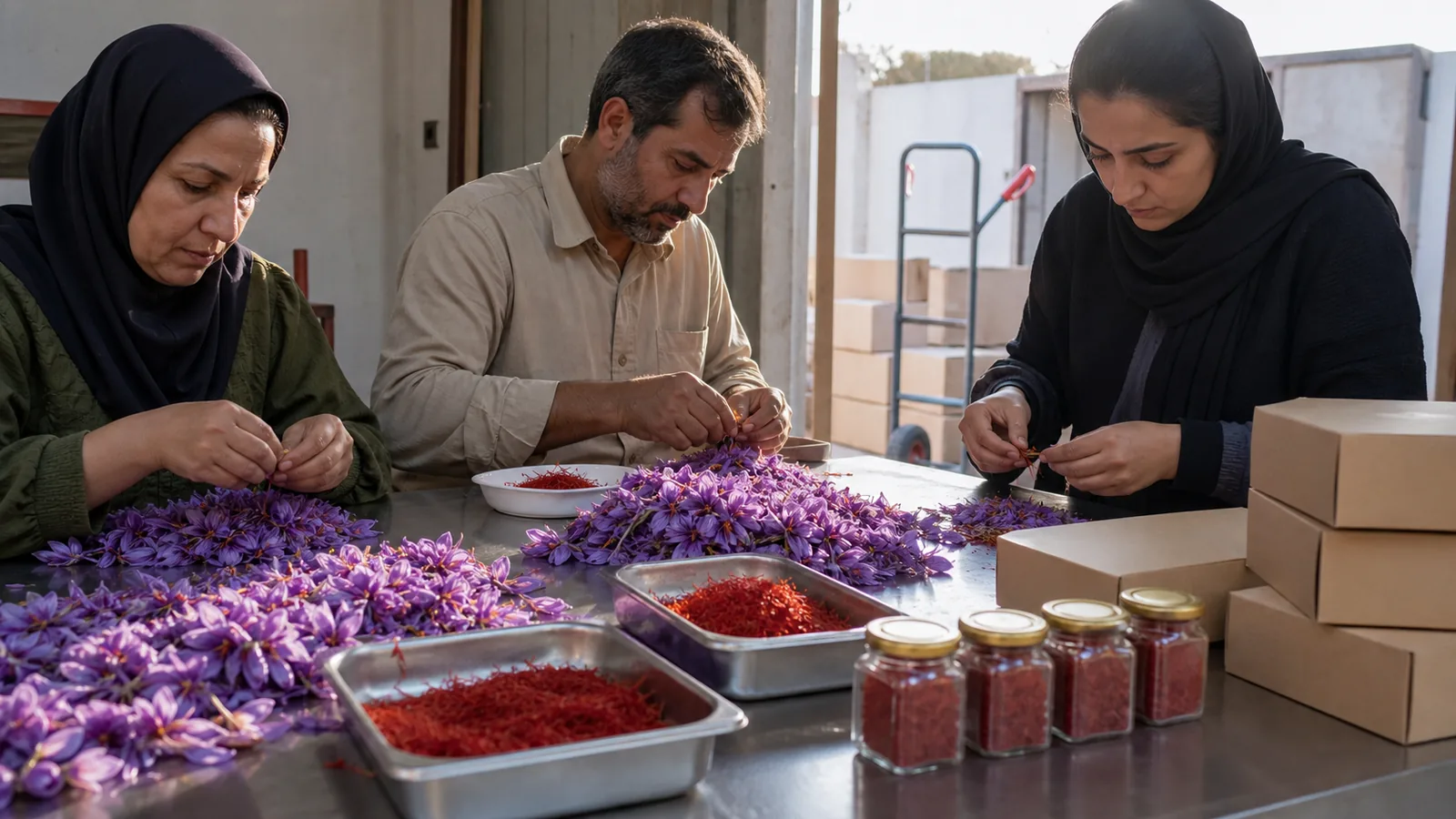
Rostami connected export conditions with a second pressure much closer to the farm. Saffron flowers have to be picked, opened and separated, and the stigmas must be dried within a brief harvest window. A large amount of careful labour is needed at the same time.
If enough workers are not available, a farmer may have to sell whole flowers instead of processing them into dried saffron. A sudden volume of perishable flowers can then reach the market at once, putting downward pressure on the flower price.
The English source contains the phrase “zinc saffron flowers,” which has no clear meaning in this context. With the original Persian sentence unavailable, it is safer to record the understandable point—the rushed sale of raw flowers—without inventing a commodity or handling method that Rostami may never have named.
Why flower prices and processing costs can unsettle the market
A processor buying whole flowers takes on the cost of separating the stigmas, drying them and managing the resulting saffron. Rostami’s argument was that a buyer who acquires flowers cheaply but pays high separation wages may still be willing to sell the finished saffron quickly, even into a weak market. By contrast, someone who paid a high flower price has more reason to hold out for a price that covers that purchase.
This does not mean every buyer behaves the same way. It explains the mechanism behind the “disorder” described in the report: a compressed harvest, labour scarcity and uneven purchasing costs can produce very different selling pressures across the chain.
Longer-term value depends on more than the raw price. A UNIDO diagnostic of Iran’s saffron value chain documented fragmented farm supply, weak coordination and the importance of processing, packaging and access to end markets. Those structural issues help explain why a short disruption can travel quickly from the flower market to exporters.
Support purchases can steady prices, but cannot solve the whole chain
Asked how the market might be stabilised, Rostami pointed to supportive purchasing from farmers. A public or cooperative buyer can create an outlet when private demand is temporarily weak and may reduce the pressure to accept any available price.
He was equally clear that this was not a final solution. Production in the region was too large for a limited support programme to absorb indefinitely. Purchasing also does not remove the need for seasonal labour, sound drying, quality control, storage, financing, dependable transport or lasting relationships with buyers.
What makes the export chain more resilient
The durable answer is to reduce avoidable losses at each hand-off. Growers need a realistic labour plan before flowering begins. People separating stigmas need clean working conditions and enough capacity for the short peak. Drying must preserve colour, aroma and safety, while records should keep each lot traceable through testing, storage and packing.
Exporters, in turn, need more than an order: they need a practical route for payment and delivery. Buyers need consistent specifications and evidence that the saffron they receive matches the sample. These details are less dramatic than a headline percentage, but they determine how much value reaches the people who produced the crop.
That remains a current priority. In 2025, the Food and Agriculture Organization and Iranian partners focused on quality integrity across the saffron value chain, including post-harvest management, safety, traceability, marketing and stronger competitiveness from farm to export.
How to read the historical claim today
The 85 percent export estimate, 15 percent domestic-use estimate, 286-tonne annual baseline and 86–90-tonne first-half figure should stay together as one historical account. None should be presented as a current customs total without a year and a matching official dataset.
What survives beyond the reporting period is Rostami’s practical warning. When a country exports most of a crop, transport shocks can affect the domestic market. When harvesting and processing are concentrated into a few demanding weeks, labour shortages can affect the price before the saffron is even dried. Support buying may offer temporary relief, but a dependable market requires a stronger chain from flower picking to the final buyer.

![Exporting Saffron to Turkey + Price Guide [Complete 0 to 100]](https://img.rowhanisaffron.com/20260827003933/saffron-export-turkey-quality-inspection.webp)



