


The end of the saffron harvest in Torbat-e Heydariyeh did not end the season’s worries. In a historical coronavirus-era report, Governor Ali Rostami described a crop 30 percent smaller than the previous year, weak prices and sharply higher input costs.
Why Torbat-e Heydariyeh matters to saffron
Rostami described a wider southern Khorasan Razavi production belt that included Torbat-e Heydariyeh, Zaveh, Mahvelat and Rashtkhar. The old English text called this combined area the world’s largest saffron-producing region.
That wording should not be read as a current audited league table for one city. It reflects the concentration of farms, workers and trading activity across several adjoining counties. Torbat-e Heydariyeh is the centre named in the report, but its regional importance is inseparable from the surrounding saffron districts.
The geographic identity deserves to stay clear. “Torbat-e Heydariyeh” is the spelling used in this article’s title and URL; English sources also render the name as Torbat-e Heydarieh or Torbat Heydariyeh. Mahvelat appears as “Mahvlat” in the original translation.
The historical harvest figures
Rostami placed the area under saffron in Torbat-e Heydariyeh at about 8,000 to 9,000 hectares. He said the county normally produced roughly 35 to 40 tonnes of dried saffron a year, but production in the season being discussed was 30 percent lower than in the previous year.
These numbers belong to that reporting period. The source does not give a precise crop year, a survey method or a final measured harvest total. The 35–40-tonne range is presented as usual annual production, while the 30 percent figure is a year-on-year decline. It would be inaccurate to subtract one mechanically from the other and call the result an official current total.
The report was published during the COVID-19 period and refers to the harvest approaching its end. Those clues establish the context, but they are not enough to supply a date that the original English copy omitted.
What was behind the 30 percent fall
Rostami did not attribute the weaker crop to one cause. He named changes in cultivation methods, expansion of the planted area, water shortage and warm weather. He also connected low saffron prices and high input costs with farmers becoming less willing or able to care for their fields as intensively.
The combination is important. A larger cultivated area does not guarantee a larger harvest if yield per hectare falls. Field age, corm density and health, irrigation timing, soil conditions, heat during sensitive stages and farm management can all produce different yields across the same district.
A regional study indexed by FAO’s AGRIS database found substantial yield differences among the Rokh Plain, Zaveh and central Torbat-e Heydariyeh study areas. The Torbat-e Heydariyeh water-footprint research does not verify Rostami’s 30 percent estimate, but it supports his broader point that local water conditions and management matter when interpreting production.
Why low prices can affect the next crop
According to Rostami, chemical fertiliser prices had risen to about 12 times their level in the previous year. The source does not identify the fertiliser, package size, currency or survey behind that comparison, so it should remain an attributed period estimate rather than a universal cost claim.
Its practical meaning is straightforward. When the sale price weakens while fertiliser, labour, irrigation and other inputs become more expensive, a grower has less money and less incentive to maintain the field. Skipped or delayed care may then affect flower numbers and stigma yield, extending a market problem into the following season.
This does not mean discouragement alone caused the decline. Rostami presented farmer confidence as one factor alongside water and weather. The report’s value lies in showing how agronomy and economics were acting on the same harvest.
Harvesting during the coronavirus period
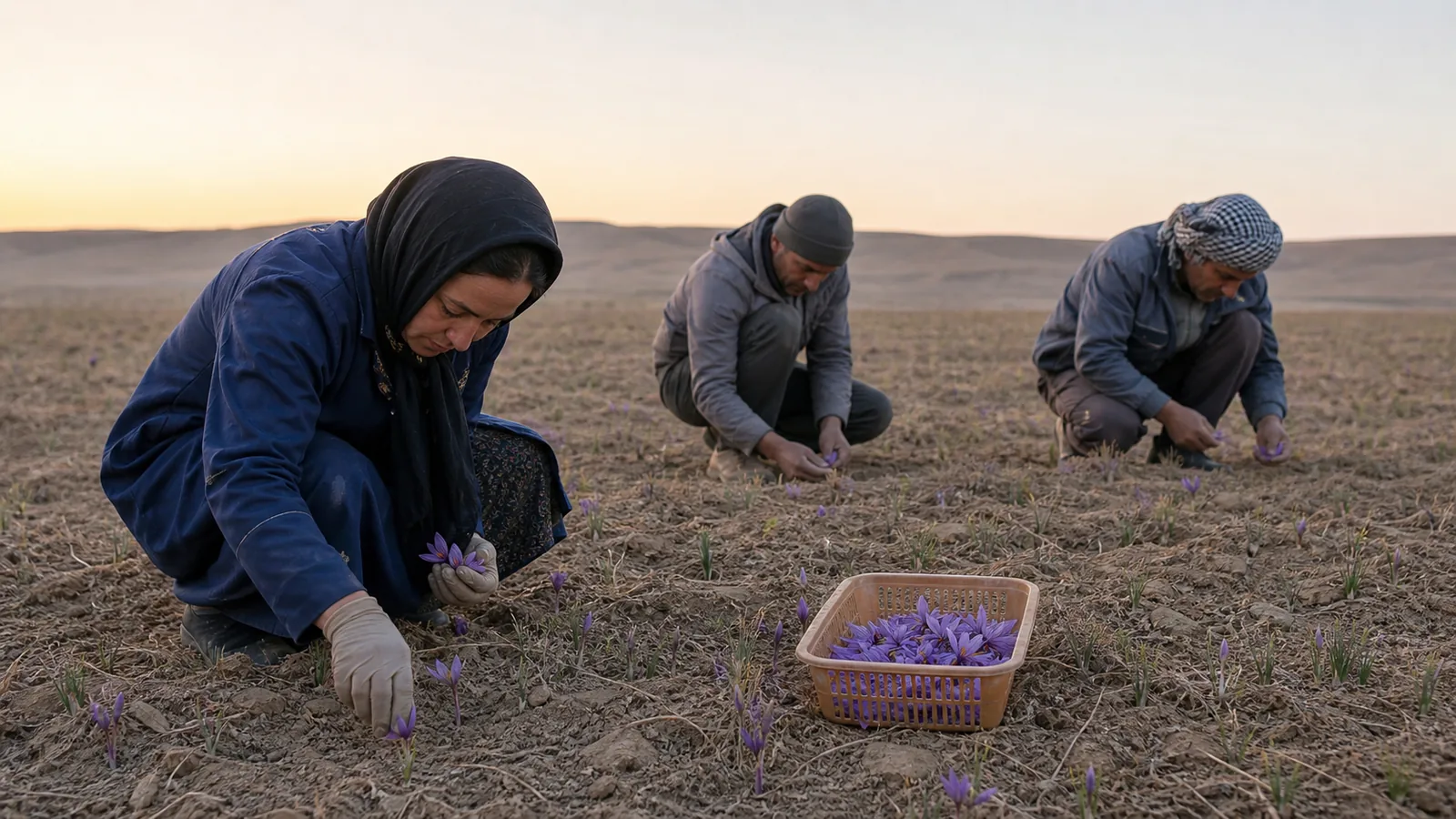
The old account described southern Khorasan Razavi’s autumn as its most violet time, with fields and collection points full of saffron flowers. That colour came with an unusual concern: the harvest coincided with the coronavirus epidemic.
Saffron requires many people over a short period. Flowers are picked, moved quickly, opened and separated; the red stigmas then have to be dried carefully. Seasonal workers earn income at several steps between harvest and sale, but crowded transport or working areas created an added concern during the pandemic.
The source does not provide local infection data or claim that COVID-19 directly reduced the plants’ yield. It records the social and operational pressure surrounding a labour-intensive harvest. Those are different claims and should not be blended.
Market frustration continued after the flowers were picked
Farmers’ concerns did not finish with the last flowers. The report says saffron prices had been falling for months and sales were unstable. Many growers were dissatisfied and some protested the market conditions.
A dried product gives a farmer more time than a fresh flower, but storage is not cost-free or risk-free. Saffron still needs protection from light, moisture, contamination and substitution, and a household may need cash before a stronger buyer appears. The ability to wait therefore differs from one grower to another.
Modern value-chain work places the same emphasis on what happens after harvest. FAO describes saffron quality as a farm-to-market responsibility involving post-harvest handling, safety, traceability and transparent marketing. Its account of the Iran saffron value chain and quality integrity also explains why production tonnage alone does not determine the return captured by farmers.
Where supportive saffron purchasing was offered
The director of the Khorasan Razavi Rural Cooperative Organization had announced supportive saffron purchasing at six centres: Torbat-e Jam, Torbat-e Heydariyeh, Mashhad, Sabzevar, Kashmar and Gonabad.
A support centre can give growers an additional outlet when private prices are weak. Whether it helps an individual farm depends on the accepted grade, testing, volume, price, payment timing and delivery rules. None of those operating details appears in the archived post, so the announcement should not be turned into a promise about what every grower received.
The people behind the finished spice
Rostami noted that saffron provides work from harvest through sale. The most visible jobs are picking flowers and separating stigmas, but the chain also needs careful drying, sorting, testing, clean storage, packing, transport and trade.
Much of that work is seasonal. A strong year can bring concentrated income to families and local workers; a smaller crop or weak price can reduce the benefit just as quickly. Describing saffron as valuable is therefore not enough. The relevant question is how much of that value survives the costs and reaches the people doing the work.
How to read the end-of-harvest report now
The figures—8,000 to 9,000 hectares, 35 to 40 tonnes of usual annual production, a 30 percent decline and a roughly twelvefold fertiliser-price increase—are historical statements by Ali Rostami. They should not be presented as current Torbat-e Heydariyeh statistics without a new, dated source.
The report nevertheless captures a durable part of saffron farming. Harvest is the brief visible climax of a much longer season. Water, temperature, field care, labour, input prices and the market meet at that point. When the purple flowers disappear, the work of protecting quality and securing a fair route to market is only beginning.

![Exporting Saffron to Turkey + Price Guide [Complete 0 to 100]](https://img.rowhanisaffron.com/20260827003933/saffron-export-turkey-quality-inspection.webp)



