


Planting saffron using hydroponic method is possible, but the phrase covers several very different systems. Saffron corms can flower in a controlled, soilless environment, and research has also grown roots and daughter corms hydroponically. A tray of flowering corms is not automatically proof of a profitable, repeatable farm.
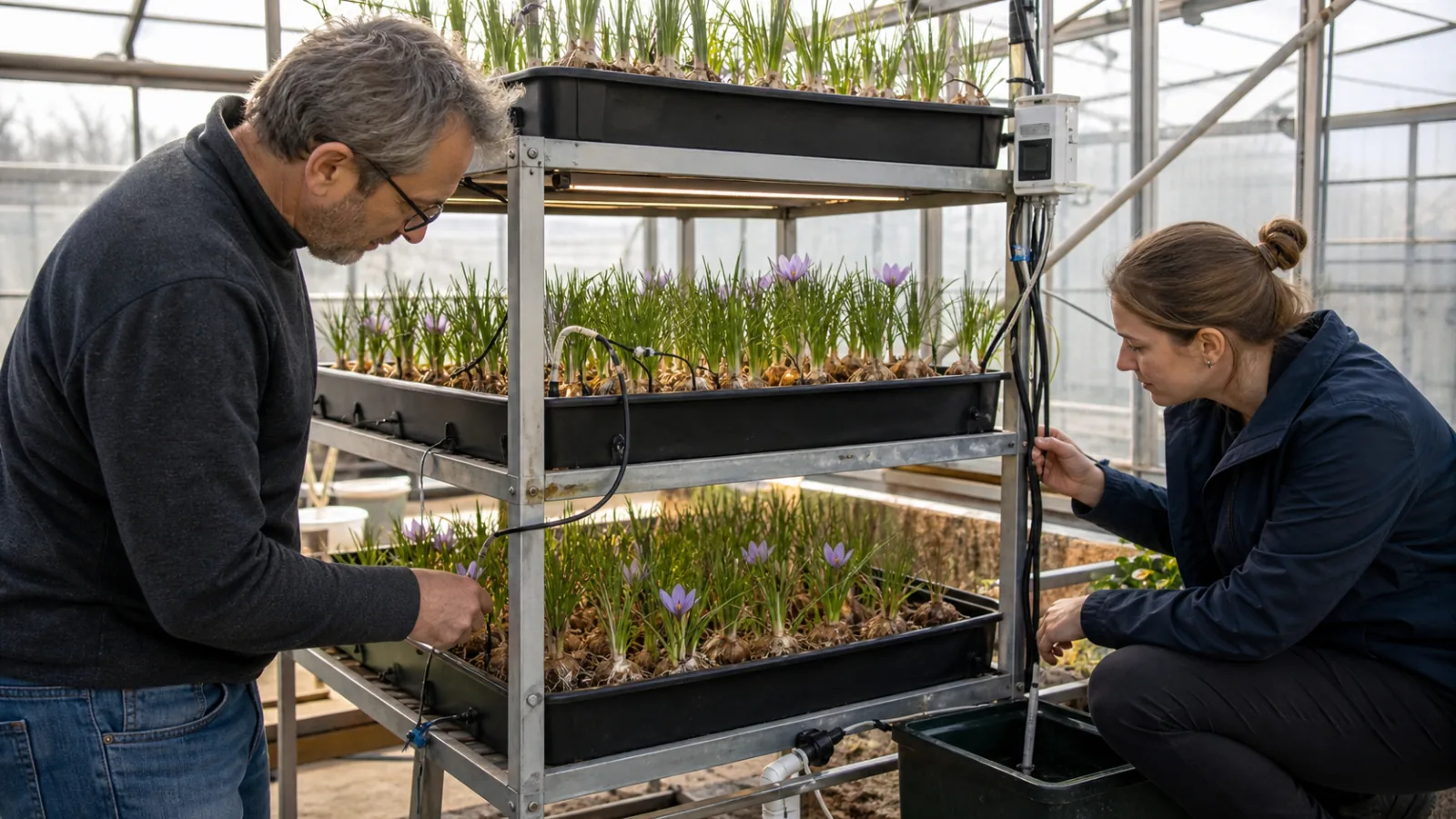
Kashmar’s first reported pilot used a 100-square-metre greenhouse arranged in eight levels. That makes it a useful case study in vertical production. The original announcement did not publish its system design, yield, water meter, energy use or financial result, so its promised advantages must still be tested.
The Kashmar hydroponic saffron pilot
Seyyed Abolqasem Mousavi, Director of Agricultural Jihad in Kashmar, announced that an operator in the county’s central district had begun the project in September. The report was published in April 2019 but does not give a clear year for that September start.
Mousavi called it the first hydroponic saffron experience in Kashmar and said it was already operating. The greenhouse occupied 100 square metres and used eight stacked growing levels. In theory, eight full tiers could provide as much as 800 square metres of tray surface, but aisles, equipment and incomplete racks normally reduce the usable area.
Can saffron be grown hydroponically?
Yes. Saffron (Crocus sativus) grows from a corm that already contains reserves and a developing flower. With the right preconditioning, temperature and humidity, a corm can flower in a soilless tray. The harder question is whether the system can produce healthy replacement corms and repeat the crop economically over several seasons.
Peer-reviewed work has tested hydroponic saffron in substrates such as perlite, volcanic rock and expanded clay, using nutrient delivery methods including ebb-and-flow. Controlled-environment research has also produced dried stigmas while measuring crocin and picrocrocin. Results depend on corm size, preconditioning, light, temperature, nutrient concentration, irrigation method and whether the goal is flowers, daughter corms or a specialised composition.
A strong result from one cultivar and controlled recipe should not be applied directly to Kashmar. Local corms, electricity costs, water chemistry and summer conditions may change the outcome.
Hydroponic and aeroponic saffron are not identical
In hydroponics, roots receive water and nutrients through a solution, often while supported by an inert substrate. In aeroponics, roots hang in air and receive a fine mist. Both are soilless systems, and both may be arranged vertically.
The old article puts “air conditioning” in brackets after hydroponics. That may be a mistranslation of “aeroponic,” or it may refer only to environmental control. Without photographs of the roots, irrigation equipment or a technical description, this Kashmar installation should be called a reported soilless, multi-tier pilot rather than assigned a precise system it never documented.
Our review of a later greenhouse saffron workshop in Mahabad explains the same boundary: vertical density is promising, but promoter projections need measured flower, stigma and corm data.
What a full saffron cycle requires
A controlled system must manage more than flowering. The production cycle includes:
- selecting healthy corms of a recorded size and source;
- providing a controlled dormant and flower-induction period;
- moving corms into trays without damaging buds or roots;
- controlling temperature, humidity, airflow, light and nutrient delivery;
- harvesting flowers quickly and drying stigmas under a repeatable process;
- allowing leaves and roots to support daughter-corm development;
- sanitising the system and tracking disease, losses and corm replacement.
Some indoor projects focus only on forcing flowers from large field-grown corms and then replace the corms. That can produce a harvest, but the farm’s real input includes the outdoor land, water and labour used to raise those corms. A fair comparison must include that upstream stage.
Does vertical cultivation save water?
Recirculating nutrient systems can deliver water precisely and recover drainage. A greenhouse also protects the root zone from uncontrolled rainfall and some evaporation. Those features make water saving plausible, not automatic.
The comparison should measure litres added to the system per gram of dried saffron and per kilogram of viable daughter corms. It should include cleaning, rejected solution, leaks and water used by cooling or humidification. Reporting only the tray irrigation can make the saving look larger than it is.
Frost protection and the energy trade-off
Mousavi listed protection from frost among the advantages. A well-managed greenhouse can buffer outdoor temperature and shelter flowers from direct frost. In return, fans, pumps, cooling, heating, dehumidification and lights may consume energy. A power outage can threaten several stacked levels at once.
Before expansion, an operator needs hourly environmental records, energy use per crop cycle and a plan for pump, ventilation and power failure. Insulation and passive design may matter as much as the growing tray.
Hydroponic does not automatically mean organic
The Kashmar statement also promised “organic saffron.” A cultivation method cannot make that claim by itself. Organic status depends on the rules of the destination market, permitted inputs, records, inspections and certification.
The rules are not the same everywhere. USDA labelling requires production and handling under its organic regulations and oversight by an authorised certifier. European Union rules do not allow hydroponically grown plants to be marketed as organic, except plants that naturally grow in water. An exporter must check the intended market before using the word on a pack.
How to test whether the Kashmar system is economical
Mousavi said the pilot’s main goal was to establish economic justification for local operators. That requires results from more than one flowering:
- dried stigma yield and grade per original square metre and per tray square metre;
- percentage of corms that flower, flowers per corm and loss to disease;
- number, size and health of daughter corms at the end of the full cycle;
- labour for loading, monitoring, harvest, cleaning and stigma separation;
- corm, structure, rack, lighting, climate, nutrient, water and energy costs;
- depreciation, finance, downtime and the sale price actually received.
The historical report says Kashmar had 12,300 saffron-growing households, 7,200 hectares under saffron and ranked third in the province. Its closing price sentence gives figures of 8.5–12.5 million and total revenue of 253 billion but incorrectly labels them as US dollars. The original currency and weight unit are missing, so those figures cannot support a business case.
Hydroponic saffron is technically credible. The decision to invest should rest on a complete, repeated cycle that counts corm renewal, energy and certified product quality—not on vertical floor area or one successful bloom.
Sources
- The Kashmar pilot statements attributed to Seyyed Abolqasem Mousavi and preserved in this post.
- Plants: controlled-environment hydroponic process for saffron production.
- HortTechnology: effects of substrate, nutrient supply and corm size in hydroponic saffron.
- European Commission: organic production rules for hydroponic crops.
- USDA Agricultural Marketing Service: organic labelling and certification requirements.

![Exporting Saffron to Turkey + Price Guide [Complete 0 to 100]](https://img.rowhanisaffron.com/20260827003933/saffron-export-turkey-quality-inspection.webp)



