


Unknown, the biggest problem is Iranian saffron was the blunt conclusion of a Khorasan trade official: Iran produces most of the world’s saffron, yet many shoppers and commercial buyers do not connect the finished product with its Iranian origin. In this context, “unknown” means weak recognition, traceability and brand ownership—not that saffron itself is unfamiliar.
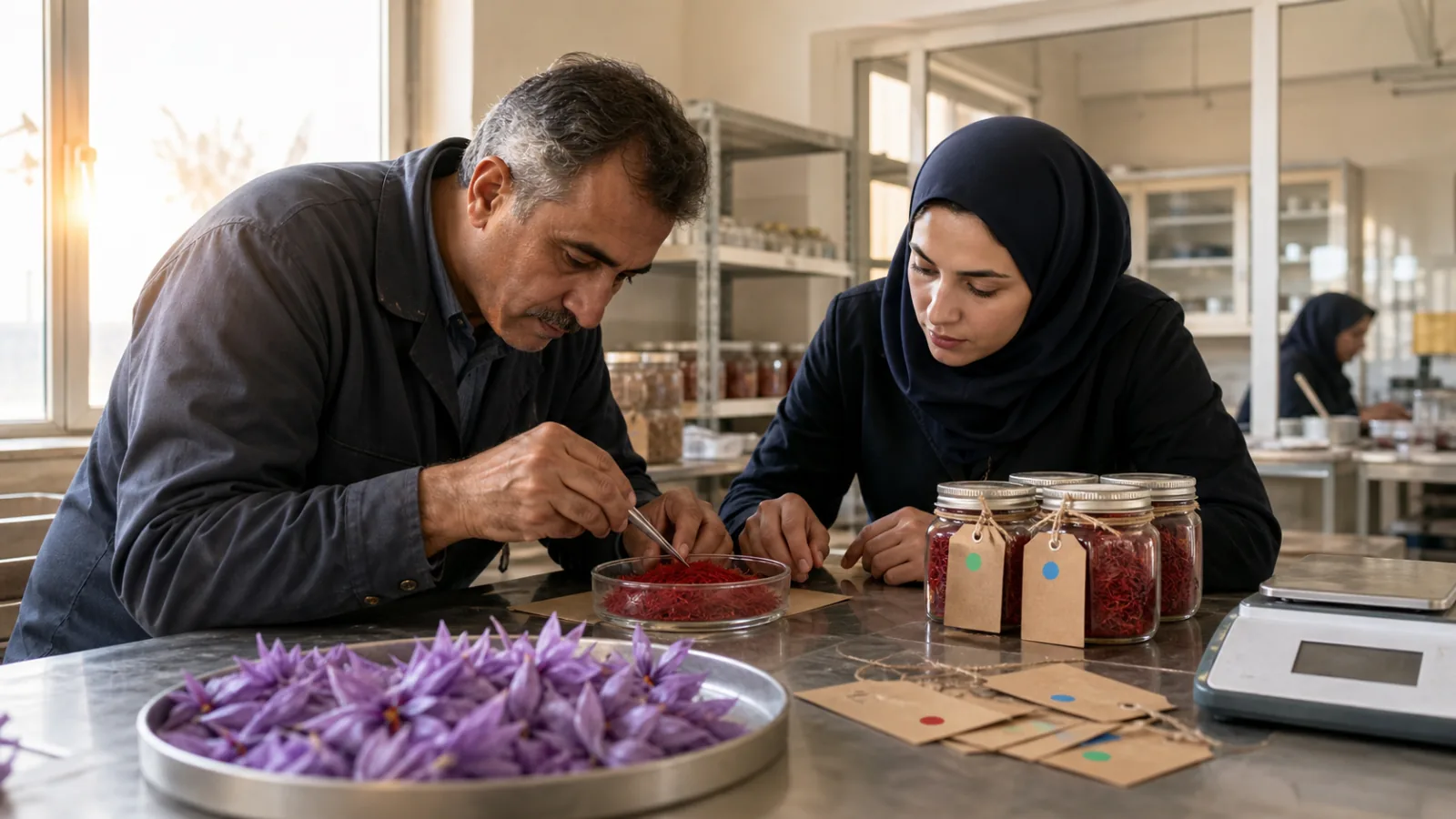
Production leadership does not automatically create a recognised name at the retail shelf. A reliable origin story has to survive every step from the field to the final pack, supported by consistent quality, clear records and information a buyer can verify.
What Ali Shariati Moghaddam said
The original report quoted Ali Shariati Moghaddam, then chairman of the Agriculture and Water Commission of the Khorasan Razavi Chamber of Commerce. He described discussions about agricultural cooperation between Iran and the European Union and an invitation to the Spanish ambassador. The proposed areas included greenhouse technology, investment and more efficient water use.
His central argument was about the gap between production and market identity. He put Iran’s share of world saffron production at about 96 percent, while pointing to Spain’s longer commercial history and stronger experience in presenting and selling saffron. That percentage belongs to the period of the statement; it should not be treated as a permanent annual figure. The FAO now describes Iran as the world leader and estimates its share at roughly 85–90 percent.
The report also said substantial private investment in Iran’s saffron trade had begun about 30 years earlier. It referred to Spanish companies as having a century of commercial experience. These are Shariati Moghaddam’s historical comparisons, not audited ages for every business in either country.
Why a large crop can still have a recognition problem
A country may grow the raw material while other businesses carry out sorting, blending, packing, distribution and consumer marketing. Once those stages are separated, the producer’s origin can become less visible. Iran’s output is therefore only the beginning of the value chain.
The issue is sometimes reduced to putting a national name on a box. A durable Iranian saffron identity needs more substance:
- a documented link between the pack and the farm, cooperative or processor;
- consistent drying, storage and grading practices;
- batch records and credible authenticity testing;
- accurate labels for product style, net weight and commercial grade;
- packaging that protects aroma, colour and the delicate stigmas;
- reliable delivery and specifications that buyers can compare from one order to the next.
These are practical trust signals. They help a buyer distinguish a traceable product from an anonymous commodity and give a producer a better chance of retaining the value created after harvest.
Quality must make the name believable
Recognition cannot be built by promotion alone. FAO’s work with Iran’s Ministry of Agriculture-Jahad has focused on authenticity, post-harvest handling, safety, traceability and quality assurance throughout the saffron supply chain. Its recent value-chain programme also includes modern marketing and digital branding, but places those activities beside product integrity rather than ahead of it.
The international Codex standard for dried saffron provides a useful common language. It identifies filament, cut-filament and powdered styles and sets expectations for characteristic colour, flavour and odour, freedom from foreign odour and limits for defects and extraneous matter. It also covers hygiene, contaminants, weights and labelling. A brand promise that cannot be checked against an agreed specification is fragile.
Origin claims need the same care. Saffron packed or traded in another country does not automatically become saffron grown there. The pack should make the roles of country of harvest, processor, packer and seller clear wherever the applicable market rules require them. For a closer look at this part of the trade, see how Iranian saffron can enter international supply chains through Spanish branding.
Demand matters as much as supply
Shariati Moghaddam wanted cooperation to increase saffron consumption, not simply to plant more fields. The report imagined a future crop above 1,000 tonnes, but that was an aspiration rather than a measured production forecast. Expanding supply without dependable demand can put growers under pressure.
His suggestion was to develop foods in Iran that use saffron and can be introduced to markets where saffron already belongs in the cuisine. The sound part of that idea is product development around a real use: a clearly formulated food, a stable dose, lawful labelling and a price that works for the intended customer. Merely colouring a generic product or adding “with saffron” to its name does not create lasting demand.
Different buyers need different formats. A household may want a small sealed pack with preparation guidance. A restaurant needs repeatable strength and portion cost. A food manufacturer needs specifications, test results and dependable volumes. Recognition grows when the offer answers those needs without hiding the origin or overstating quality.
Water, rural livelihoods and responsible growth
The historical statement also connected saffron with rural development and its relatively modest irrigation needs. Saffron is well suited to some arid production areas, and FAO recognises the qanat-based saffron system in Gonabad for its relationship with water management, livelihoods and agricultural heritage.
That does not make every expansion automatically sustainable. Water use depends on local climate, irrigation practice, corm production and yield. New planting should be judged against the water balance of its own basin and the income that actually reaches farming households.
What solving the “unknown” problem looks like
The useful goal is not fame in the abstract. It is for a buyer to recognise Iranian saffron and understand why a particular batch deserves trust. That requires coordinated work from growers, processors, laboratories, exporters and retailers.
- Protect identity at collection. Keep lots separate and record where and when the flowers were harvested.
- Control the process. Define drying, storage and handling procedures that can be repeated.
- Verify the product. Use suitable laboratory and sensory checks, with results tied to the batch.
- Describe it honestly. State style, grade, net weight, origin and responsible business details without vague superlatives.
- Design for the customer. Choose the pack size, preparation information and sales channel around a real use.
- Measure recognition. Track repeat orders, direct destination markets, complaints and the price returned through the chain—not production volume alone.
Iranian saffron is not unknown because it lacks history or production scale. The problem appears when that history and origin disappear between the field and the person who opens the pack. Traceability, consistent quality and useful products make the name visible—and give customers a reason to remember it.
Sources
- The statements attributed to Ali Shariati Moghaddam in the original post.
- FAO: innovation and quality integrity in Iran’s saffron value chain.
- FAO: Iran saffron authenticity and transparent supply-chain project.
- FAO GIAHS: Qanat-based saffron farming system in Gonabad.
- Codex CXS 351-2022: Standard for dried floral parts—saffron.
- European External Action Service: EU–Iran cooperation statement covering agriculture and agri-food standards.

![Exporting Saffron to Turkey + Price Guide [Complete 0 to 100]](https://img.rowhanisaffron.com/20260827003933/saffron-export-turkey-quality-inspection.webp)



