


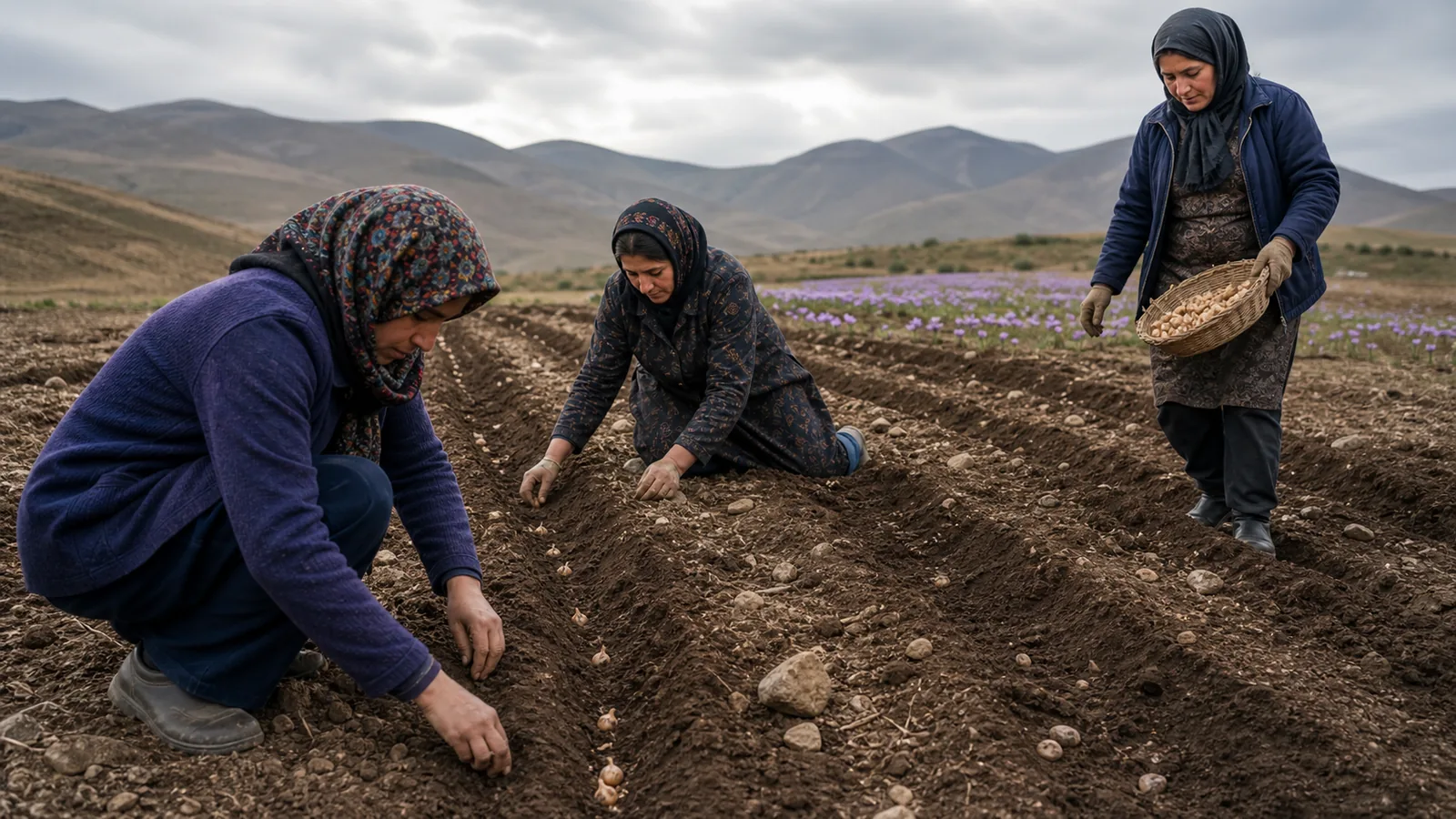
Saffron in Ardabil—spelled “Ardebil” in this page’s original title—began as a crop-diversification response to limited water, supported by subsidized corms and a 1.5-billion-rial grant. An archived follow-up adds the people behind the programme: about 40 farmers were active, most of them women, and women managed most of the province’s saffron sites.
Why Ardabil introduced saffron
Asghar Partovi, then a planning and economic official in the provincial Agriculture Jihad organization, said the first provincial saffron programme aimed to change cropping patterns where water resources were constrained. Subsidized saffron corms were distributed to growers, and the report listed plantings in Garmi, Khalkhal, Kosar, Nir, Namin, and Meshgin Shahr.
The same account said 1.5 billion rials in non-repayable assistance had been provided to support saffron growers. That is a historical programme amount, not a current grant. It also referred to satisfactory harvests in earlier trial years, which helps explain how officials could describe a “first” provincial rollout after experimental cultivation had already taken place.
Water-conscious does not mean water-free
Saffron can suit some dry or water-limited farming systems because its growth cycle and irrigation timing differ from many summer crops. FAO’s account of Iran’s qanat-based saffron farming system describes the crop as adapted to an arid and semi-arid setting and valuable where water is scarce.
That does not make saffron a zero-water crop or guarantee that it is the best choice for every Ardabil field. Soil drainage, winter cold, rainfall, corm condition, planting depth, irrigation access, labour, and the market all matter. A responsible change in crop pattern compares the full local water budget and farm return, rather than relying on saffron’s reputation alone.
The women running Ardabil’s saffron sites
Ashraf Aghaberati, an Agriculture Jihad adviser on women’s affairs, said the province’s saffron study had begun about 10 years before her report and that operational cultivation started in Iranian year 1387, roughly 2008–09. She described strong participation by women: most cultivation sites were managed by women, and most of the approximately 40 active saffron farmers were women.
The source also said women seeking work were employed in the cultivation workshops. Aghaberati connected this entrepreneurship with changing perceptions of women’s economic role in the province. That is her reported assessment; the archived page does not provide income records, ownership data, hours, pay, or a gender-disaggregated count beyond “most.”
FAO’s 2024 review of rural women in Iranian agriculture similarly emphasizes training and income-generating opportunities. The practical implication is not simply to celebrate participation, but to ensure women farmers can reach extension services, finance, inputs, land decisions, processing equipment, and buyers.
Where the women-led plantings were reported
The women-farmer report used a 15-hectare provincial figure and named Khalkhal, Ardabil, Garmi, and Namin. The earlier programme listed two additional areas, Kosar, Nir, and Meshgin Shahr, but gave no total hectares. These lists are not necessarily contradictory: they may describe different phases, trial sites, or reporting dates.
The safest historical summary is that cultivation spread across several counties while the women-focused report documented 15 hectares in four of them. A current acreage cannot be inferred by adding place names or assuming every subsidized-corm site became productive.
How to read the old price and quality claims
Aghaberati’s report gave a price of 7,000 to 8,000 tomans but the saved English text omits the unit. A per-gram price is plausible for the period, yet the page does not establish it, so the number should not be converted into current farm revenue. Inflation and market changes also make it unsuitable as a present buying guide.
The official said Ardabil saffron could compete with Khorasan in quality, colour, and taste. That statement records local confidence, not a controlled comparison. No sample, crop year, laboratory, or test method was included. The current ISO 3632-1:2025 specification provides a defined framework for dried saffron, while origin-to-batch records and laboratory results are needed to support a comparative quality claim.
Saffron was part of a wider crop-pattern change
The original Ardabil report also discussed two other adjustments. It mentioned almond planting across 70 hectares of Khalkhal orchards and an experimental winter-potato programme at 11 sites. Winter potatoes were planted in Ardabil, Namin, and Nir to test whether winter rainfall could reduce irrigation demand; the report said evaluation would continue through harvest.
These details matter because saffron was not presented as the only answer. The provincial strategy was testing several crops and calendars under water constraints. The outcomes would need to be compared on water use, yield, market return, labour, and risk before one approach could be expanded confidently.
What a durable Ardabil programme would measure
A useful follow-up should distinguish trial, planted, and productive hectares; report dried yield and water by location; record corm source and field age; and connect each batch to drying and quality tests. For the women-led sites, it should also document who controls the land and sale, who receives payment, access to training and equipment, and whether seasonal work becomes stable income.
Our guide to saffron cultivation and growing conditions explains the crop cycle, but the Ardabil record adds an important local lesson. A new crop succeeds when technical adaptation and access to resources develop together—and when the women already doing the work are visible in the decisions as well as the harvest.

![Exporting Saffron to Turkey + Price Guide [Complete 0 to 100]](https://img.rowhanisaffron.com/20260827003933/saffron-export-turkey-quality-inspection.webp)



