


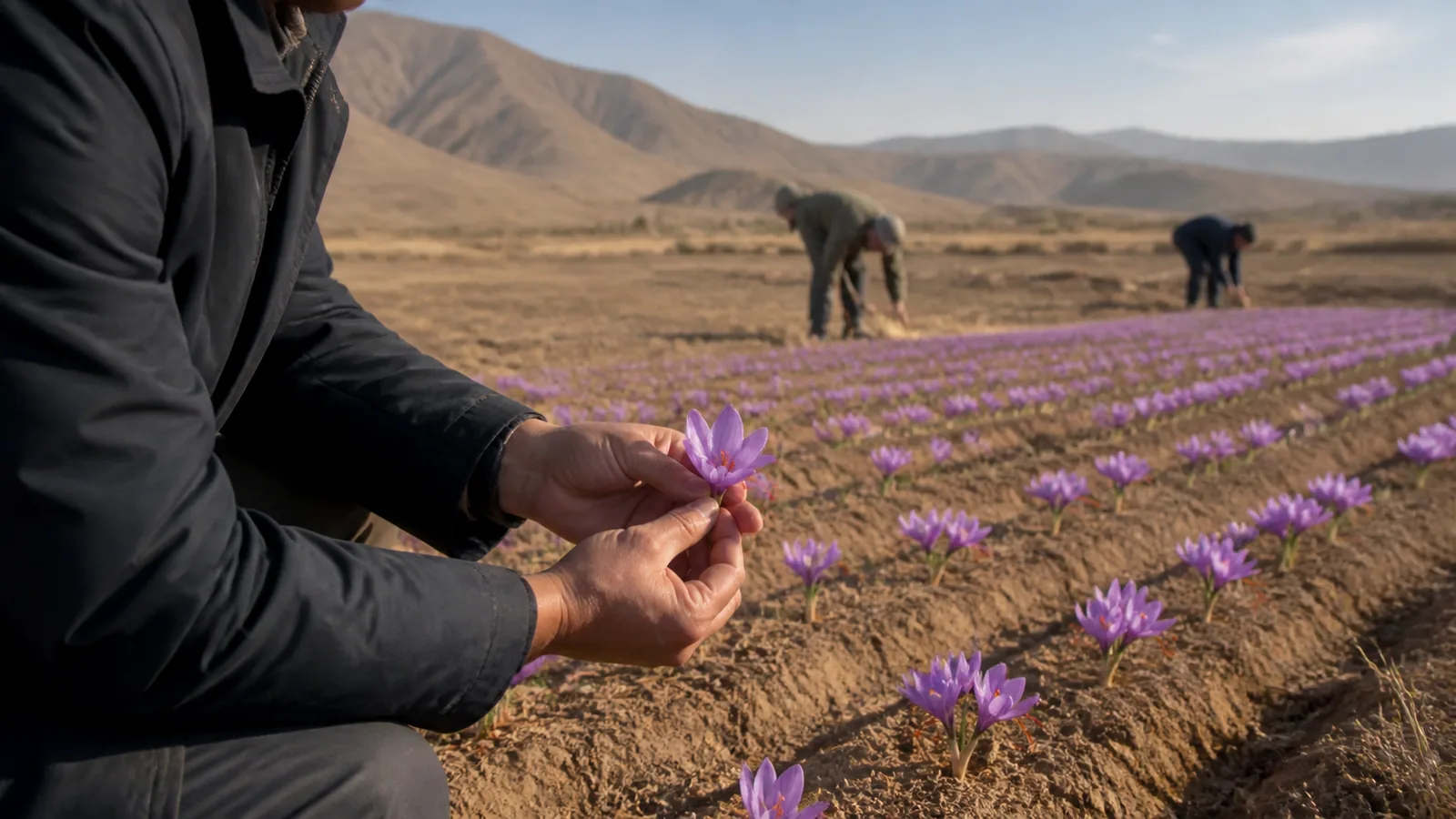
Ali Darabi, then the official responsible for provincial affairs at Iran’s national broadcaster, visited saffron fields in Khosf County during the 2017 flowering season. The visit placed a small rural harvest in front of a senior broadcasting official and connected the sight of the saffron flower with a practical local concern: whether villages in the area could receive reliable radio and television service.
The original report described Darabi walking through the fields and picking a saffron flower before reviewing broadcasting problems in Khosf and the Jolgeh-ye Mazhan district. Local officials presented the issues, and the report said instructions were given for follow-up.
A visit to the saffron fields of Khosf
Khosf lies in South Khorasan, one of the Iranian regions most closely associated with saffron cultivation. During the short autumn flowering period, the fields change quickly: purple blooms appear close to the soil and must be gathered while they are fresh. The red stigmas are then separated and dried to become the spice.
That seasonal setting mattered to the visit. A saffron field is not merely a ceremonial backdrop. It represents early-morning work, family labour, careful processing, and a crop that can create income in dry rural areas. The FAO’s account of Iran’s qanat-based saffron system describes the relationship between saffron farming, water management, local knowledge, and the communities of Khorasan.
The headline’s phrase “the vice president of sound and television” is a literal rendering of an Iranian public title. In context, it refers to Ali Darabi’s role overseeing provincial broadcasting at the Islamic Republic of Iran Broadcasting organisation, commonly known as IRIB—not to a national vice president holding a general government portfolio.
What the 2017 report recorded
According to the Fars News Agency report from Birjand, Darabi visited the saffron-growing area while travelling in Khosf County. He was shown the fields, picked a flower, and met local representatives.
The report named Alireza Fatemi among the local officials involved in presenting concerns. Its machine-translated wording is unclear about every administrative title, so those roles should not be expanded beyond what the source supports. The central sequence is clear:
- A senior provincial-broadcasting official visited Khosf and its saffron fields.
- Local officials raised radio and television coverage problems affecting the county and the Jolgeh-ye Mazhan area.
- The issues were referred for action, with instructions to investigate or resolve them.
This article preserves that event as a dated local news record. It does not claim that the coverage problems still exist or that every instruction described in 2017 was completed; the original report did not provide a later outcome.
Why broadcasting access matters in farming communities
For a rural district, broadcast coverage is more than entertainment. Radio and television can carry weather warnings, agricultural programmes, public notices, educational material, and local reporting. In places where terrain or distance makes other communication uneven, dependable signals can remain part of everyday infrastructure.
Local coverage also decides which stories enter the wider public record. A short report from a saffron village can show the work behind the finished spice: picking flowers at the right moment, separating three delicate stigmas from each bloom, drying them correctly, and bringing the harvest to market.
When regional broadcasters document that work carefully, they can help consumers see saffron as an agricultural product with a place and a season, rather than an anonymous red ingredient in a packet. The same reporting can give growers a forum to discuss water, labour, post-harvest facilities, roads, communications, and access to buyers.
The saffron flower behind the photograph
Crocus sativus flowers grow low to the ground and usually open in autumn. Each bloom contains three valuable red stigmas, as well as yellow stamens and purple tepals. Only the stigmas—and, depending on the commercial grade, a limited part of the attached style—become the saffron used in food.
Picking one flower is simple. Producing a meaningful quantity of dried saffron is not. Large numbers of flowers must be gathered during a narrow window, and the stigmas are normally separated soon afterwards. That contrast helps explain why a field visit during flowering season carries more meaning than a visit to a finished retail display.
Khosf within South Khorasan’s saffron culture
South Khorasan’s dry climate and long farming experience have made saffron an important crop for many communities. Production still depends on local conditions: corm health, field preparation, irrigation timing, temperature, labour, drying, storage, and market access all influence the result.
The harvest is also social. Families and seasonal workers often pick and separate flowers together because the crop cannot wait. A local visit that combines the field with a discussion of public services therefore links two parts of village life—the work that sustains households and the infrastructure that keeps those households connected.
A small event with a clear local message
The 2017 visit did not by itself change saffron production, and the surviving report offers no basis for claiming that it solved Khosf’s broadcasting issues. Its value is more modest and more concrete. It records a senior media official seeing the harvest first-hand while local representatives used the occasion to raise service problems.
The image of a saffron flower being picked made the visit memorable. The lasting substance, however, was the request that rural communities producing one of Iran’s best-known crops should also be heard and connected.

![Exporting Saffron to Turkey + Price Guide [Complete 0 to 100]](https://img.rowhanisaffron.com/20260827003933/saffron-export-turkey-quality-inspection.webp)



