


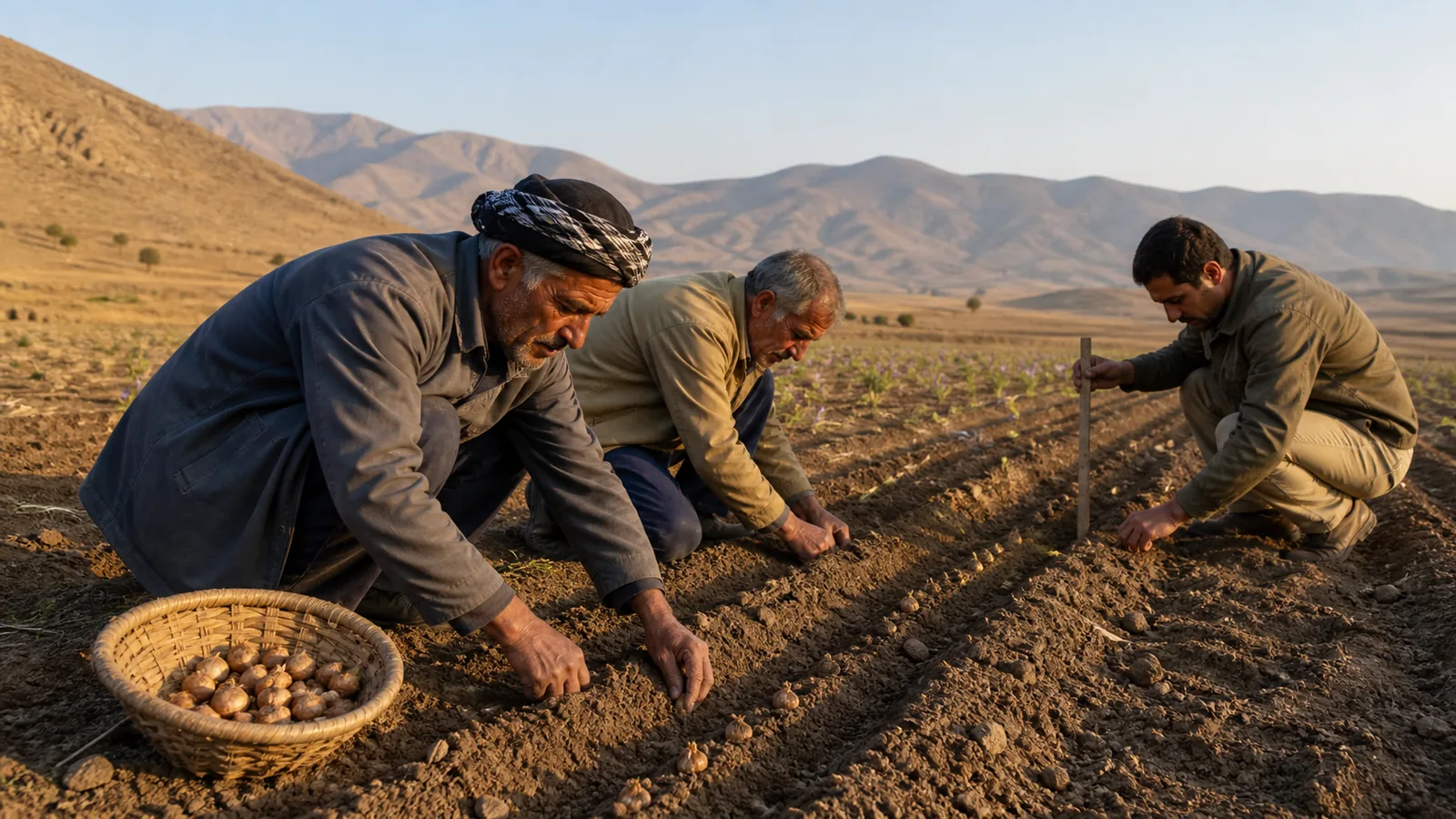
Saffron cultivation in Lorestan was part of a wider provincial effort to expand medicinal and high-value crops, but the archived area and production figures do not all reconcile. One report announced more than 620 hectares of medicinal plants and saffron. It separately listed 570 hectares of medicinal plants and 151 hectares of saffron, while a later report used 82.84 hectares for its saffron production forecast. These numbers preserve useful historical evidence only when their different scopes and arithmetic problems remain visible.
The 620-hectare Lorestan announcement
Behrooz Baharvand, horticulture director of the Lorestan Agriculture Jihad Organization, said 161 hectares had been added during the reporting year and that more than 620 hectares were planted with medicinal crops and saffron. He argued that these crops could generate income and employment and called for more farmer support and cultivation advice.
The same announcement broke the increase into two parts:
- medicinal-plant area reportedly rose by about 100 hectares, from 470 to roughly 570 hectares; and
- saffron area reportedly rose by about 61 hectares to roughly 151 hectares.
Those additions do total 161 hectares, but 570 plus 151 equals 721, not 620. The archive does not say whether saffron was counted within the medicinal-plant category, whether the headline used an earlier cut-off, or whether one figure was transcribed incorrectly. The safest account retains the figures and the uncertainty rather than inventing a corrected provincial total.
A later saffron production forecast
A separate report, republished in 2022, again quoted Baharvand. It described 82.84 hectares used for a saffron forecast, a reported average yield of five kilograms per hectare, and expected production of 216 kilograms. It also called the expected crop “excellent” in quality.
Here too, the arithmetic does not agree. At five kilograms per hectare, 82.84 hectares would imply about 414 kilograms. A 216-kilogram crop across that area implies about 2.6 kilograms per hectare. The stored report supplies no district breakdown or correction, so none of the three figures should be silently changed to force a match.
What the 82.84 and 151 hectares may represent
The smaller 82.84-hectare figure may have referred to productive fields, a surveyed subset, or a different reporting period than the 151-hectare area. That is plausible, but it is not established by the text. The article therefore treats them as separate historical observations, not as evidence that Lorestan’s saffron area rose or fell by a precisely known amount.
Quality cannot be established by the word “excellent”
The official’s quality description was not accompanied by a sample size, laboratory, certificate, or test results. Colour and aroma may appear promising, but “excellent” is not a reproducible grade without defined criteria. The current ISO 3632-1:2025 specification applies to dried saffron in filament, cut-filament, and powder forms and includes storage and transport recommendations.
For a provincial crop, useful reporting would connect each batch to its farm and harvest date, document drying and moisture control, and publish the test method behind any grade. Buyers can use our practical saffron quality guide for first checks, but visual inspection cannot resolve the conflicting production figures or replace laboratory evidence.
When saffron corms can be planted
The later Lorestan report gave a broad planting window from early June, when the crop is dormant, to mid-October. Its next sentence is mistranslated: it calls mid-summer preferable because air and soil are very hot and humidity is extremely low, then warns that corms may be damaged and fail to grow. That wording cannot support a clear “best date” recommendation.
Planting time should be matched to corm condition, local temperature, soil preparation, and irrigation. A primary field experiment indexed by FAO’s AGRIS database compared 10 June, two September dates, and 12 October under Varamin conditions. Large corms planted on 10 June produced the highest first-year flower and dry-stigma yield in that experiment. It is useful evidence that date and corm size interact, not proof that one date is ideal across every Lorestan field.
Planting material and field preparation
The old pages repeatedly call saffron corms “onions,” a common translation error. Saffron is propagated with corms. Before planting, growers need healthy, appropriately sized material and a field that drains well; damaged or diseased corms can undermine establishment regardless of the calendar.
Our guide to saffron cultivation and growing conditions covers the broader crop cycle. For Lorestan, local extension advice and field records matter because the province’s conditions are not identical to Khorasan or Varamin, where much saffron research has been conducted.
What support would make the expansion credible
The 620-hectare announcement was right to connect expansion with farmer support. A larger planted area is not automatically a successful programme. Growers need reliable corm sources, soil and water guidance, training for harvest and drying, access to testing, transparent buyers, and records that distinguish newly planted fields from productive ones.
Future updates should publish separate, dated totals for medicinal plants and saffron, explain whether categories overlap, distinguish planted from bearing area, and show how forecast yield was calculated. That would turn the Lorestan story from a set of conflicting headlines into a measurable account of land, production, quality, and farmer value.

![Exporting Saffron to Turkey + Price Guide [Complete 0 to 100]](https://img.rowhanisaffron.com/20260827003933/saffron-export-turkey-quality-inspection.webp)



