


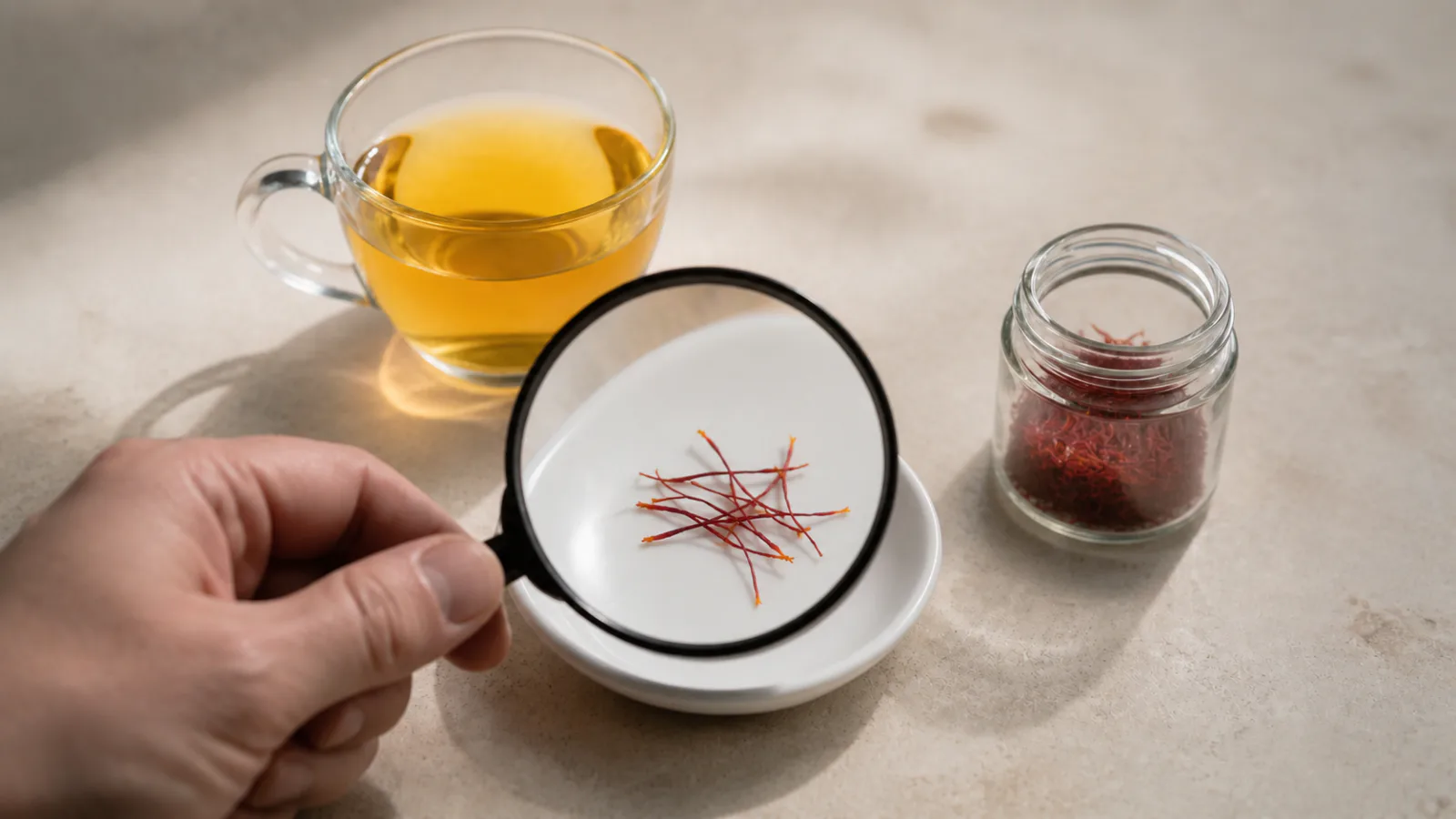
“Miraculous properties of saffron” is a memorable phrase, but it is not a scientific category. Saffron has remarkable colour, aroma and flavour, and standardised preparations have produced promising findings in some human trials. It has not been proved to cure cancer, prevent neurodegenerative disease, repair DNA or treat the long list of conditions often attached to it online.
The useful question is not whether saffron is a miracle. It is which properties are observable, which traditional uses are documented, which effects have human evidence, and which claims should be rejected.
What saffron actually is
Saffron is the dried stigma of Crocus sativus, a perennial plant grown from an underground corm. The flower normally has six purple tepals and three red stigmas. Those stigmas—not the petals, leaves or corm—are harvested as the spice.
The old article described “one to three flowers,” “three flags” and a red-orange triangle. Those were translation errors around genuine botany. Crocin-related pigments produce colour, picrocrocin contributes bitterness and safranal is central to the dried aroma.
Why a small amount costs so much
Each flower contributes little usable weight, while picking, separation and drying require care during a short season. Estimates often place the flowers needed for a kilogram of dried saffron around 150,000, though yield varies.
The previous five-kilograms-of-flowers-to-one-kilogram-of-spice statement should not be treated as a universal conversion. Flower size, stigma mass, moisture, drying and grading all affect yield. Labour intensity and traceable processing explain more than one repeated ratio.
Culinary properties that do not need a miracle claim
A few threads can colour and flavour a shared dish. Blooming them in a small amount of warm liquid distributes the pigments and aroma through rice, sauce, tea, milk or dessert. More is not necessarily better; an excessive amount can taste bitter.
Saffron does not remove fat or cholesterol from food. Nutrient values quoted per 100 grams are also misleading for ordinary diets because normal servings use a fraction of a gram. Its value in a recipe is sensory, not as a major source of vitamins or minerals.
Claims with some human research
A systematic map of saffron clinical evidence found trials across mood, cognition, eye conditions, metabolic markers and other topics. Results, study size, product, dose and quality differ. Most research tests a defined powder or extract rather than a normal portion in food.
Mood
A 2024 systematic review of neurological and psychiatric trials reported favourable findings for depression and anxiety in studied preparations. That does not mean saffron prevents depression or that everyone should drink one cup of tea for relaxation. Tea is not a substitute for mental-health care or prescribed medicine.
Memory, cognition and sleep
Small trials have explored cognition, Alzheimer’s disease and sleep. This evidence does not show that saffron prevents Alzheimer’s or Parkinson’s disease, restores the senses, cures insomnia or treats nerve pain. Those stronger statements on the old page went beyond the research.
Blood pressure and metabolic markers
Reviews have examined blood pressure, blood lipids and blood glucose, sometimes finding modest changes. Saffron is not an antihypertensive or cholesterol medicine, and it should not replace monitoring, diet, activity or prescribed treatment.
Traditional uses without reliable treatment evidence
Saffron appears in traditional practice for digestion, appetite, spasms, flatulence, stomach discomfort, menstrual symptoms, asthma, skin conditions, eye problems, urinary complaints, jaundice, anaemia and gum pain. Traditional use is part of the history, but it cannot verify that saffron treats these conditions.
Several items can signal serious disease. Breathing difficulty, jaundice, urinary symptoms, anaemia, persistent abdominal pain or a sudden visual change need appropriate assessment. Using saffron first can be harmful if it delays diagnosis.
Antioxidants do not prove an anticancer effect
Saffron compounds can act as antioxidants and have shown antitumour activity in cell and animal models. Those experiments do not prove that saffron prevents cancer-causing gene changes, repairs damaged DNA in people or works as an antitumour drug.
The National Cancer Institute states that no herb or special food has been proved to slow or cure cancer or prevent it from returning. Someone receiving cancer care should discuss supplements with the oncology team because interactions and contamination matter.
How to use saffron in tea
The old method boiled two grams in one litre for 30 minutes. That is a very strong, gram-level preparation and prolonged heat can flatten the aroma. For an ordinary cup, lightly crush 5–8 threads, add about 240 ml (8 fl oz) of hot water, cover and steep for 10–15 minutes.
Our complete saffron tea recipe includes ginger, green-tea and Persian serving variations. Enjoy the drink for flavour; do not turn strength into a medical experiment.
How to grind saffron
There is no need to dry saffron in an oven at 25°C before every use. Properly dried threads can be crushed on a clean saucer or in a small mortar shortly before blooming. Grind only what the recipe needs because increased surface area speeds aroma loss.
A very fine sieve is unnecessary for most cooking. Whole threads are also easier to inspect than powder, which can conceal substituted material or added colour.
Disadvantages and side effects
A 2026 systematic review of saffron adverse events found that studied preparations were generally tolerated, with gastrointestinal problems reported most often, while noting potentially significant events with higher doses or prolonged medicinal use.
The older page listed kidney harm, reduced appetite, headache, disturbed senses, vomiting, slow heart rate, nosebleeds, bleeding from the eyelids and lips, dizziness, lethargy, jaundice and death as though every effect followed one known amount. That list is not a reliable home diagnostic guide. Large or concentrated exposure can be dangerous, but symptoms require individual assessment rather than an internet threshold.
Seek urgent help for breathing difficulty, swelling, fainting, severe vomiting, unusual bleeding or altered consciousness. Ask a clinician or pharmacist before combining concentrated saffron with antidepressants, blood-pressure medicines, anticoagulants or antiplatelet medicines.
Pregnancy and abortion claims
The possibility of uterine effects is a reason for caution, not a recipe for inducing abortion or labour. A 2026 review of saffron in pregnancy found limited and inconclusive evidence, possible effects at term and concern around higher or occupational exposure.
Pregnant people should avoid saffron extracts and medicinal amounts unless their obstetric clinician specifically recommends and supervises them. Normal seasoning is a separate question, but high-risk pregnancies need individual advice. Evidence for concentrated use during breastfeeding is insufficient.
No universal three-gram or five-gram rule
There is no recognised rule that three grams per person per month is “very healthy,” that more than five grams per month is always harmful, or that five grams in one meal necessarily causes death. Those figures should not be used to plan intake or decide that a large exposure is safe.
Culinary saffron is used by the pinch and distributed across servings. Deliberate gram-level self-dosing is not ordinary food use. If a large amount has been swallowed, contact local poison-control or emergency services rather than waiting for symptoms.
Storage protects the real properties
Keep dry saffron in a tightly closed food-safe glass or metal container, away from light, heat, moisture and strong odours. Use a dry utensil and close the lid promptly. Light and open storage gradually weaken colour and volatile aroma.
The current ISO 3632-1:2025 specification sets requirements for dried saffron, but a consumer jar does not become verified merely because it looks red. Traceability, intact threads and appropriate testing offer better evidence than a miraculous label.
What is genuinely remarkable?
Three tiny stigmas from one flower can colour and perfume a family dish. A short harvest supports a complex chain of skilled labour. A small plant has produced compounds interesting enough for serious clinical research.
Those facts are remarkable without promising a cure. Saffron is best understood as a concentrated spice with promising product-specific research and important safety boundaries—not a miracle medicine.

![Exporting Saffron to Turkey + Price Guide [Complete 0 to 100]](https://img.rowhanisaffron.com/20260827003933/saffron-export-turkey-quality-inspection.webp)



