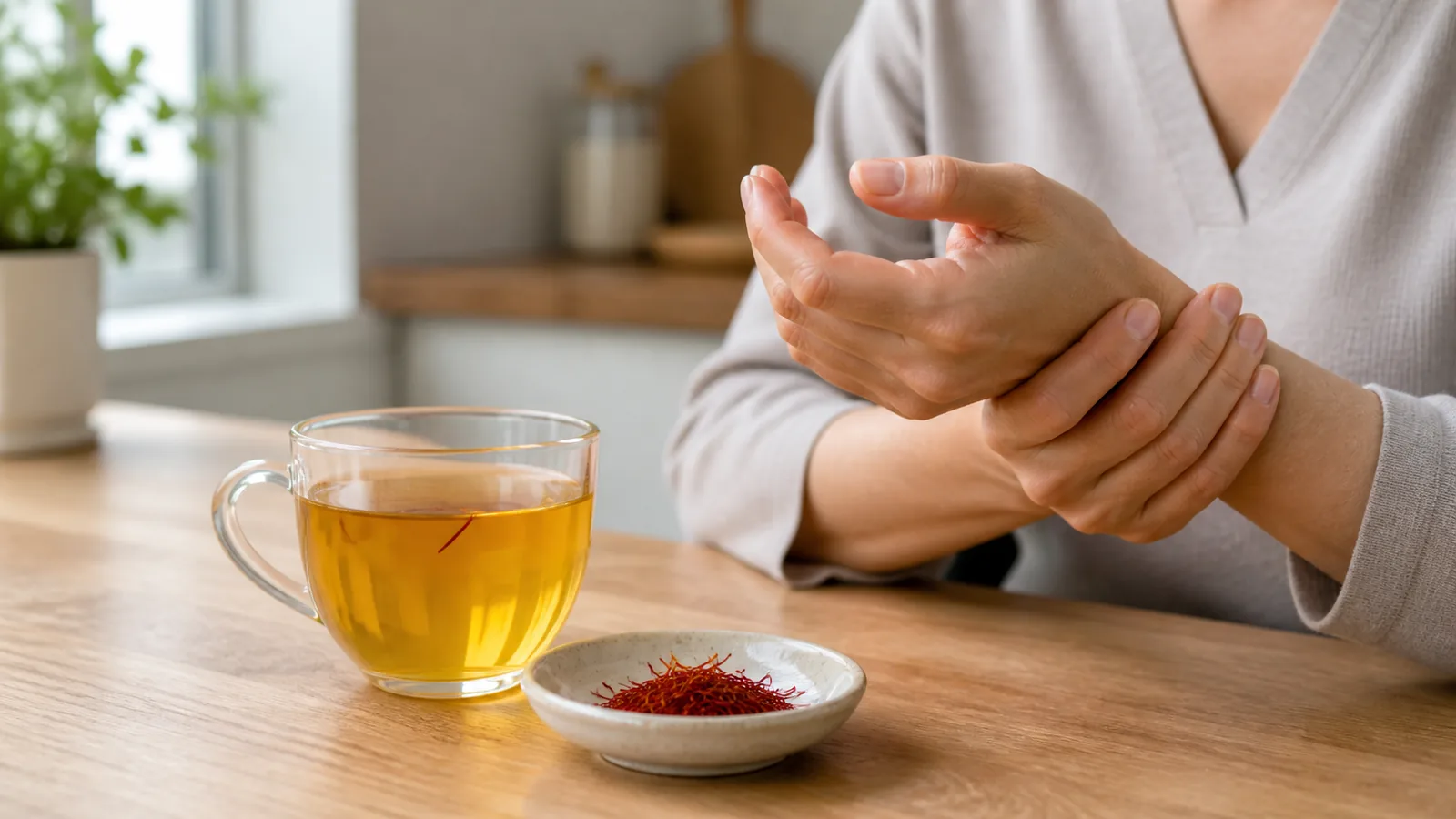
Research suggests that standardized saffron preparations may reduce some symptoms of premenstrual syndrome (PMS) and menstrual cramps, but the evidence is still limited. Saffron for menstrual pain is not a guaranteed remedy, it does not correct every irregular cycle, and a culinary cup of saffron tea is not equivalent to the measured capsules used in clinical trials.
Those distinctions are especially important because “period problems” can mean several different things. Cramping during bleeding, mood or physical symptoms before a period, unusually heavy bleeding, and an irregular cycle have different causes and do not call for the same treatment.
Menstrual pain, PMS, and PMDD are different
Primary dysmenorrhea is cramping that occurs just before or during a period, largely in response to prostaglandins that make the uterus contract. Premenstrual syndrome describes a recurring pattern of physical or emotional symptoms before menstruation, such as bloating, breast tenderness, fatigue, irritability, food cravings, or mood changes. Premenstrual dysphoric disorder (PMDD) is a more severe condition in which mood symptoms substantially disrupt daily life.
An irregular period is not another name for PMS. Cycles can change with pregnancy, hormonal contraception, stress, weight changes, perimenopause, polycystic ovary syndrome, thyroid conditions, and other causes. Saffron has not been shown to diagnose or reliably correct those causes.
What research says about saffron for menstrual pain
A 2026 systematic review and meta-analysis combined randomized trials of saffron for PMS and dysmenorrhea. It found an overall improvement compared with control groups for both symptom clusters. The pooled result is promising, but it does not make every saffron product interchangeable: the trials used particular preparations, doses, schedules, and participant groups.
A broader 2024 systematic review of saffron and female reproductive conditions also found potentially helpful results across PMS, dysmenorrhea, menopause, sexual function, and several experimental outcomes. Its evidence included cell, animal, and human studies, so a finding in the review is not automatically a clinical recommendation.
The 50-participant Tehran trial
The study described in the original destination article was a double-blind, randomized, placebo-controlled trial at Tehran University of Medical Sciences. Fifty women aged 20 to 45 with regular cycles and PMS symptoms were enrolled. After recording symptoms for two cycles, participants received either saffron capsules containing 15 mg twice daily or placebo for two further cycles.
The published BJOG trial record reported greater symptom improvement with saffron than with placebo. It supports further research into a measured saffron preparation for PMS. It does not prove that two unspecified capsules, saffron added to food, or a homemade infusion will produce the same result.
A later PMDD trial
A separate randomized trial enrolled 120 women with PMDD and compared saffron, fluoxetine, and placebo during the luteal phase of two menstrual cycles. The published results found improvement on the primary symptom record with saffron compared with placebo. The study was short, conducted in one setting, and used a defined capsule regimen under research supervision.
It should not be read as advice to replace an antidepressant or hormonal treatment. Severe premenstrual mood symptoms require diagnosis and an individual plan; abruptly stopping prescribed medicine can be harmful.
What might explain the research interest?
Saffron stigmas contain compounds such as crocin, crocetin, picrocrocin, and safranal. Laboratory research has explored antioxidant, inflammatory, pain-related, and neurotransmitter pathways. Earlier articles often reduced the explanation to “saffron raises serotonin,” but human physiology and menstrual symptoms are more complicated than a single chemical switch.
A plausible biological mechanism can support a reason to run trials. It does not establish the correct product, dose, or treatment for an individual, and it does not prove that more saffron will work better.
The archived Iranian capsule report
The source being consolidated into this article preserved an ISNA-era report about a project led by Dr. Jamal al-Din Jamali at Tehran University of Medical Sciences. It described a saffron-extract PMS capsule translated as “Message Stop” or “Stop Message,” said that 75 women were observed between December 2005 and April 2007, and attributed a 50–70% reduction in symptoms during months two and three to the project lead. The report also claimed that an Iranian Ministry of Health production licence had been obtained.
That same archival text named two other translated products, “Safromood” for depression and “Saffrotin” for Alzheimer’s symptoms. We could not corroborate those exact product names, the licence, the claimed response percentage, or a peer-reviewed report of the 75-participant project in the authoritative sources reviewed for this update. They are retained here as historical reporting, not as verified efficacy data or a recommendation to buy or use those products.
The source also claimed the capsule had no side effects and suggested choosing it instead of antidepressants. Those statements are not retained as medical advice. No active preparation should be described as universally free of adverse effects, and treatment should not be substituted without a clinician who knows the patient’s diagnosis and medicines.
Can saffron regulate an irregular period?
No reliable evidence shows that saffron corrects all irregular periods. The trials above focused on symptom severity in selected participants; they were not tests of saffron as a way to start a late period, restore ovulation, or treat every reason for cycle changes.
Take a pregnancy test when pregnancy is possible. Seek medical advice if periods repeatedly become irregular, bleeding is unusually heavy, periods stop without an expected reason, or the pattern changes alongside pelvic pain, dizziness, marked fatigue, or other concerning symptoms. Treating the cause matters more than trying to force a bleed with an herb.
Safety comes before experimenting with a supplement
Culinary saffron dispersed through a meal is a different exposure from a concentrated extract taken repeatedly. A 2026 systematic review of human adverse events found saffron preparations generally well tolerated, but adverse effects did occur, most commonly gastrointestinal symptoms. Higher-dose or prolonged medicinal use deserves more care than ordinary seasoning.
- Do not use saffron to induce a period or self-treat unexplained bleeding.
- Do not start a concentrated product during pregnancy or when trying to manage a possible pregnancy without obstetric advice.
- Ask a clinician or pharmacist first if you take antidepressants, blood-pressure medicine, anticoagulants, or other regular medication.
- Stop and seek advice for a suspected allergic reaction, persistent vomiting, severe dizziness, fainting, or other significant symptoms.
- Choose a product with clear identity, standardized content, manufacturer information, and a legitimate regulatory route; do not rely on a translated product name alone.
Proven ways to manage ordinary menstrual cramps
Saffron research is an adjunct to, not a replacement for, established care. The American College of Obstetricians and Gynecologists explains that nonsteroidal anti-inflammatory drugs such as ibuprofen or naproxen can lessen cramps by reducing prostaglandin effects, when those medicines are safe for the person taking them. Hormonal contraception is another option to discuss with a clinician.
Heat on the lower abdomen or back, regular exercise, adequate sleep, and relaxation techniques may also help. Some people cannot safely take NSAIDs because of bleeding disorders, ulcers, kidney or liver problems, asthma, allergy, pregnancy, or interactions, so personal medical advice still matters.
When period pain needs medical assessment
Common cramps often improve after the first days of bleeding. Pain that is new, steadily worsening, present outside menstruation, or severe enough to stop normal activity can have another cause. Endometriosis, adenomyosis, fibroids, ovarian cysts, pelvic inflammatory disease, and pregnancy-related problems are among the possibilities a clinician may consider.
Get urgent care for severe or sudden pelvic pain, fainting, possible pregnancy with pain or bleeding, fever, very heavy bleeding, or pain that is markedly worse than usual and does not respond to appropriate pain relief. A supplement should never delay that assessment.
What is the responsible conclusion?
Standardized saffron preparations have produced encouraging results for PMS and dysmenorrhea in small clinical trials and recent evidence syntheses. That is a reason for informed discussion and better research, not proof that any saffron tea or capsule will relieve every menstrual symptom.
Keep the question specific: cramping, premenstrual mood symptoms, heavy bleeding, and irregular cycles are not interchangeable. If someone wishes to consider saffron after the cause is understood, the safest path is to review the exact product, dose used in evidence, current medicines, pregnancy possibility, and treatment alternatives with a qualified professional.